

266
5.1. CONSTRUCTING ACCURATE GRAPHS OF ANTIDERIVATIVES
up and concave down. Thus, the combination of knowing f ′ and f ′′ enables us to fully
understand the shape of the graph of f .
We returned to this question in even more detail in Section 4.1; there, we considered
the situation where we knew the instantaneous velocity of a moving object and worked
from that information to determine as much information as possible about the object’s
position function. We found key connections between the net-signed area under the
velocity function and the corresponding change in position of the function; in Section 4.4,
the Total Change Theorem further illuminated these connections between f ′ and f in a
more general setting, such as the one found in Figure 4.34, showing that the total change in
the value of f over an interval [a, b] is determined by the exact net-signed area bounded
by f ′ and the x-axis on the same interval.
In what follows, we explore these issues still further, with a particular emphasis on
the situation where we possess an accurate graph of the derivative function along with a
single value of the function f . From that information, we desire to completely determine
an accurate graph of f that not only represents correctly where f is increasing, decreasing,
concave up, and concave down, but also allows us to find an accurate function value at
any point of interest to us.
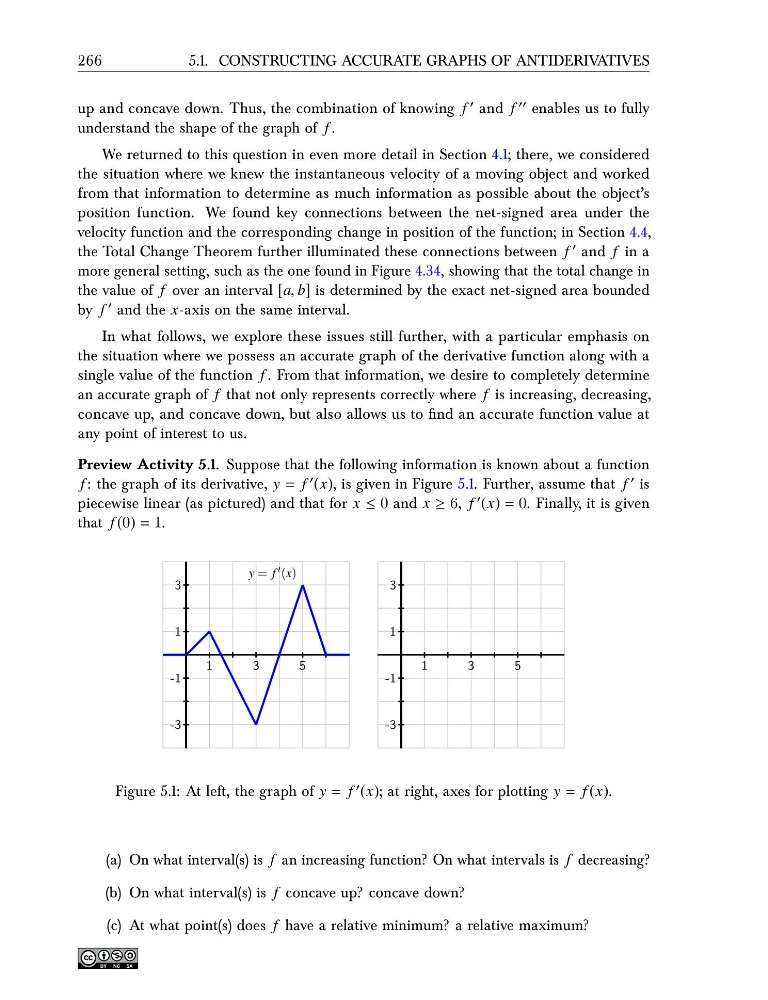
Preview Activity 5.1. Suppose that the following information is known about a function
f : the graph of its derivative, y = f ′ (x), is given in Figure 5.1. Further, assume that f ′ is
piecewise linear (as pictured) and that for x ≤ 0 and x ≥ 6, f ′ (x) = 0. Finally, it is given
that f (0) = 1.
1
3
5
-3
-1
1
3
y = f ′ (x)
1
3
5
-3
-1
1
3
Figure 5.1: At left, the graph of y = f ′ (x); at right, axes for plotting y = f (x).
(a) On what interval(s) is f an increasing function? On what intervals is f decreasing?
(b) On what interval(s) is f concave up? concave down?
(c) At what point(s) does f have a relative minimum? a relative maximum?
5.1. CONSTRUCTING ACCURATE GRAPHS OF ANTIDERIVATIVES
up and concave down. Thus, the combination of knowing f ′ and f ′′ enables us to fully
understand the shape of the graph of f .
We returned to this question in even more detail in Section 4.1; there, we considered
the situation where we knew the instantaneous velocity of a moving object and worked
from that information to determine as much information as possible about the object’s
position function. We found key connections between the net-signed area under the
velocity function and the corresponding change in position of the function; in Section 4.4,
the Total Change Theorem further illuminated these connections between f ′ and f in a
more general setting, such as the one found in Figure 4.34, showing that the total change in
the value of f over an interval [a, b] is determined by the exact net-signed area bounded
by f ′ and the x-axis on the same interval.
In what follows, we explore these issues still further, with a particular emphasis on
the situation where we possess an accurate graph of the derivative function along with a
single value of the function f . From that information, we desire to completely determine
an accurate graph of f that not only represents correctly where f is increasing, decreasing,
concave up, and concave down, but also allows us to find an accurate function value at
any point of interest to us.
Preview Activity 5.1. Suppose that the following information is known about a function
f : the graph of its derivative, y = f ′ (x), is given in Figure 5.1. Further, assume that f ′ is
piecewise linear (as pictured) and that for x ≤ 0 and x ≥ 6, f ′ (x) = 0. Finally, it is given
that f (0) = 1.
1
3
5
-3
-1
1
3
y = f ′ (x)
1
3
5
-3
-1
1
3
Figure 5.1: At left, the graph of y = f ′ (x); at right, axes for plotting y = f (x).
(a) On what interval(s) is f an increasing function? On what intervals is f decreasing?
(b) On what interval(s) is f concave up? concave down?
(c) At what point(s) does f have a relative minimum? a relative maximum?