

12
1.2. THE NOTION OF LIMIT
in the instantaneous velocity of the ball when t = 1, we’ d like to know what happens to
g(x) as x gets closer and closer to 1. At the same time, g(1) is not defined, because it
leads to the quotient 0/0.
This is where the idea of limits comes in. By using a limit, we’ll be able to allow x to
get arbitrarily close, but not equal, to 1 and fully understand the behavior of g(x) near this
value. We’ll develop key language, notation, and conceptual understanding in what follows,
but for now we consider a preliminary activity that uses the graphical interpretation of a
function to explore points on a graph where interesting behavior occurs.
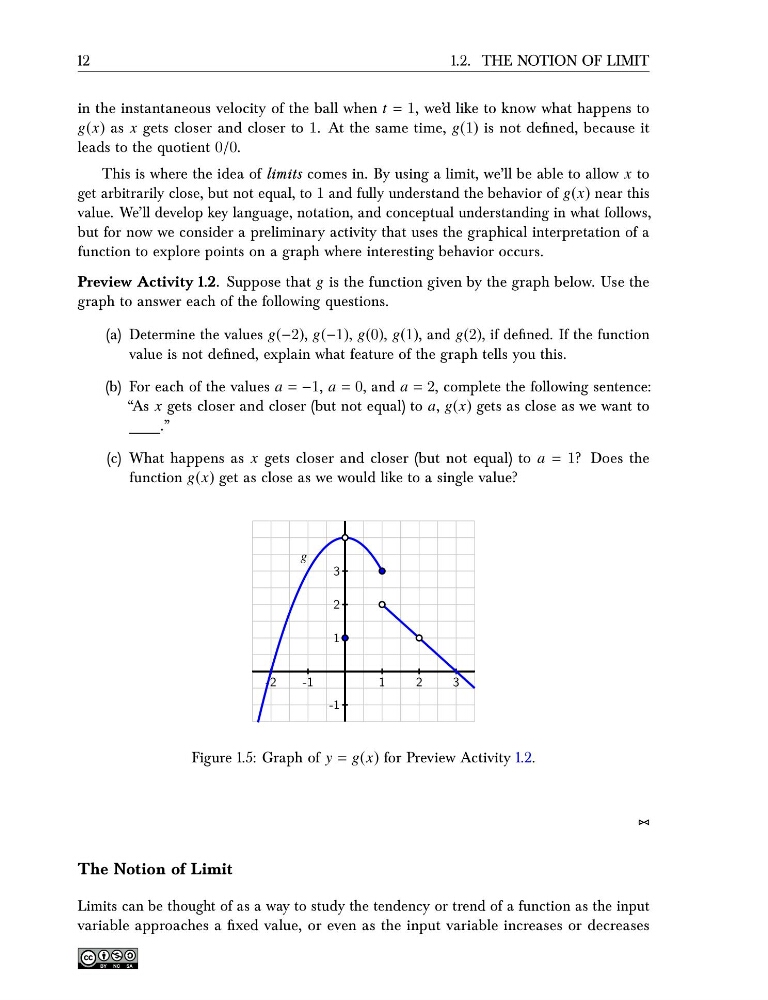
Preview Activity 1.2. Suppose that g is the function given by the graph below. Use the
graph to answer each of the following questions.
(a) Determine the values g(−2), g(−1), g(0), g(1), and g(2), if defined. If the function
value is not defined, explain what feature of the graph tells you this.
(b) For each of the values a = −1, a = 0, and a = 2, complete the following sentence:
“As x gets closer and closer (but not equal) to a, g(x) gets as close as we want to
.”
(c) What happens as x gets closer and closer (but not equal) to a = 1? Does the
function g(x) get as close as we would like to a single value?
-2
-1
1
2
3
-1
1
2
3
g
Figure 1.5: Graph of y = g(x) for Preview Activity 1.2.
⊲⊳
The Notion of Limit
Limits can be thought of as a way to study the tendency or trend of a function as the input
variable approaches a fixed value, or even as the input variable increases or decreases
1.2. THE NOTION OF LIMIT
in the instantaneous velocity of the ball when t = 1, we’ d like to know what happens to
g(x) as x gets closer and closer to 1. At the same time, g(1) is not defined, because it
leads to the quotient 0/0.
This is where the idea of limits comes in. By using a limit, we’ll be able to allow x to
get arbitrarily close, but not equal, to 1 and fully understand the behavior of g(x) near this
value. We’ll develop key language, notation, and conceptual understanding in what follows,
but for now we consider a preliminary activity that uses the graphical interpretation of a
function to explore points on a graph where interesting behavior occurs.
Preview Activity 1.2. Suppose that g is the function given by the graph below. Use the
graph to answer each of the following questions.
(a) Determine the values g(−2), g(−1), g(0), g(1), and g(2), if defined. If the function
value is not defined, explain what feature of the graph tells you this.
(b) For each of the values a = −1, a = 0, and a = 2, complete the following sentence:
“As x gets closer and closer (but not equal) to a, g(x) gets as close as we want to
.”
(c) What happens as x gets closer and closer (but not equal) to a = 1? Does the
function g(x) get as close as we would like to a single value?
-2
-1
1
2
3
-1
1
2
3
g
Figure 1.5: Graph of y = g(x) for Preview Activity 1.2.
⊲⊳
The Notion of Limit
Limits can be thought of as a way to study the tendency or trend of a function as the input
variable approaches a fixed value, or even as the input variable increases or decreases