

4.4. THE FUNDAMENTAL THEOREM OF CALCULUS
263
4 8 12 16 20 24
3
6
9
12
15
m/min
min
y = v(t)
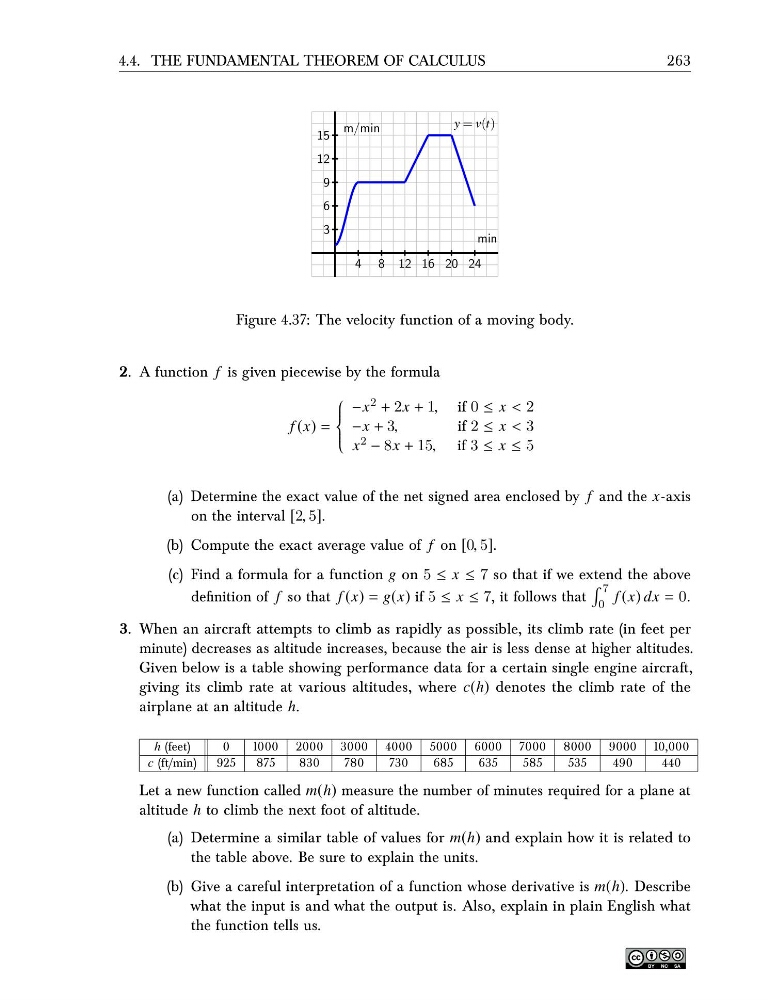
Figure 4.37: The velocity function of a moving body.
2. A function f is given piecewise by the formula
f (x) =
−x 2 + 2x + 1, if 0 ≤ x < 2
−x + 3,
if 2 ≤ x < 3
x 2 − 8x + 15, if 3 ≤ x ≤ 5
(a) Determine the exact value of the net signed area enclosed by f and the x-axis
on the interval [2, 5].
(b) Compute the exact average value of f on [0, 5].
(c) Find a formula for a function g on 5 ≤ x ≤ 7 so that if we extend the above
definition of f so that f (x) = g(x) if 5 ≤ x ≤ 7, it follows that
7
0
f (x) dx = 0.
3. When an aircraft attempts to climb as rapidly as possible, its climb rate (in feet per
minute) decreases as altitude increases, because the air is less dense at higher altitudes.
Given below is a table showing performance data for a certain single engine aircraft,
giving its climb rate at various altitudes, where c(h) denotes the climb rate of the
airplane at an altitude h.
h (feet)
0
1000 2000 3000 4000 5000 6000 7000 8000 9000 10,000
c (ft/min)
925
875
830
780
730
685
635
585
535
490
440
Let a new function called m(h) measure the number of minutes required for a plane at
altitude h to climb the next foot of altitude.
(a) Determine a similar table of values for m(h) and explain how it is related to
the table above. Be sure to explain the units.
(b) Give a careful interpretation of a function whose derivative is m(h). Describe
what the input is and what the output is. Also, explain in plain English what
the function tells us.
263
4 8 12 16 20 24
3
6
9
12
15
m/min
min
y = v(t)
Figure 4.37: The velocity function of a moving body.
2. A function f is given piecewise by the formula
f (x) =
−x 2 + 2x + 1, if 0 ≤ x < 2
−x + 3,
if 2 ≤ x < 3
x 2 − 8x + 15, if 3 ≤ x ≤ 5
(a) Determine the exact value of the net signed area enclosed by f and the x-axis
on the interval [2, 5].
(b) Compute the exact average value of f on [0, 5].
(c) Find a formula for a function g on 5 ≤ x ≤ 7 so that if we extend the above
definition of f so that f (x) = g(x) if 5 ≤ x ≤ 7, it follows that
7
0
f (x) dx = 0.
3. When an aircraft attempts to climb as rapidly as possible, its climb rate (in feet per
minute) decreases as altitude increases, because the air is less dense at higher altitudes.
Given below is a table showing performance data for a certain single engine aircraft,
giving its climb rate at various altitudes, where c(h) denotes the climb rate of the
airplane at an altitude h.
h (feet)
0
1000 2000 3000 4000 5000 6000 7000 8000 9000 10,000
c (ft/min)
925
875
830
780
730
685
635
585
535
490
440
Let a new function called m(h) measure the number of minutes required for a plane at
altitude h to climb the next foot of altitude.
(a) Determine a similar table of values for m(h) and explain how it is related to
the table above. Be sure to explain the units.
(b) Give a careful interpretation of a function whose derivative is m(h). Describe
what the input is and what the output is. Also, explain in plain English what
the function tells us.