

4.4. THE FUNDAMENTAL THEOREM OF CALCULUS
257
given function, f (x)
antiderivative, F(x)
k, (k is constant)
x n , n −1
1
x , x > 0
sin(x)
cos(x)
sec(x) tan(x)
csc(x) cot(x)
sec 2 (x)
csc 2 (x)
e x
a x (a > 1)
1
1+x 2
1
√
1−x 2
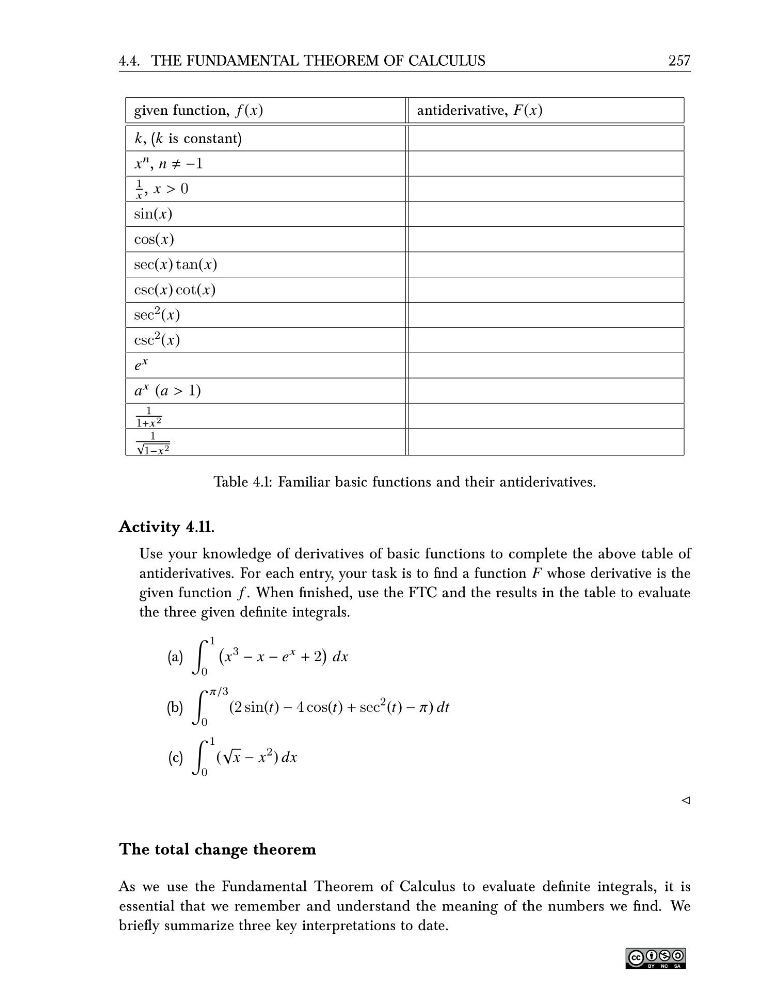
Table 4.1: Familiar basic functions and their antiderivatives.
Activity 4.11.
Use your knowledge of derivatives of basic functions to complete the above table of
antiderivatives. For each entry, your task is to find a function F whose derivative is the
given function f . When finished, use the FTC and the results in the table to evaluate
the three given definite integrals.
(a)
1
0
x
3 − x − e
x + 2
dx
(b)
π/3
0
(2 sin(t) − 4 cos(t) + sec
2 (t) − π) dt
(c)
1
0
(
√
x − x
2 ) dx
⊳
The total change theorem
As we use the Fundamental Theorem of Calculus to evaluate definite integrals, it is
essential that we remember and understand the meaning of the numbers we find. We
briefly summarize three key interpretations to date.
257
given function, f (x)
antiderivative, F(x)
k, (k is constant)
x n , n −1
1
x , x > 0
sin(x)
cos(x)
sec(x) tan(x)
csc(x) cot(x)
sec 2 (x)
csc 2 (x)
e x
a x (a > 1)
1
1+x 2
1
√
1−x 2
Table 4.1: Familiar basic functions and their antiderivatives.
Activity 4.11.
Use your knowledge of derivatives of basic functions to complete the above table of
antiderivatives. For each entry, your task is to find a function F whose derivative is the
given function f . When finished, use the FTC and the results in the table to evaluate
the three given definite integrals.
(a)
1
0
x
3 − x − e
x + 2
dx
(b)
π/3
0
(2 sin(t) − 4 cos(t) + sec
2 (t) − π) dt
(c)
1
0
(
√
x − x
2 ) dx
⊳
The total change theorem
As we use the Fundamental Theorem of Calculus to evaluate definite integrals, it is
essential that we remember and understand the meaning of the numbers we find. We
briefly summarize three key interpretations to date.