

4.3. THE DEFINITE INTEGRAL
245
a
b
b
a f (x) dx
y = f (x)
a
f AVG[a,b]
(b − a) · f AVG[a,b]
b
y = f (x)
a
b
A 1
A 2
y = f (x)
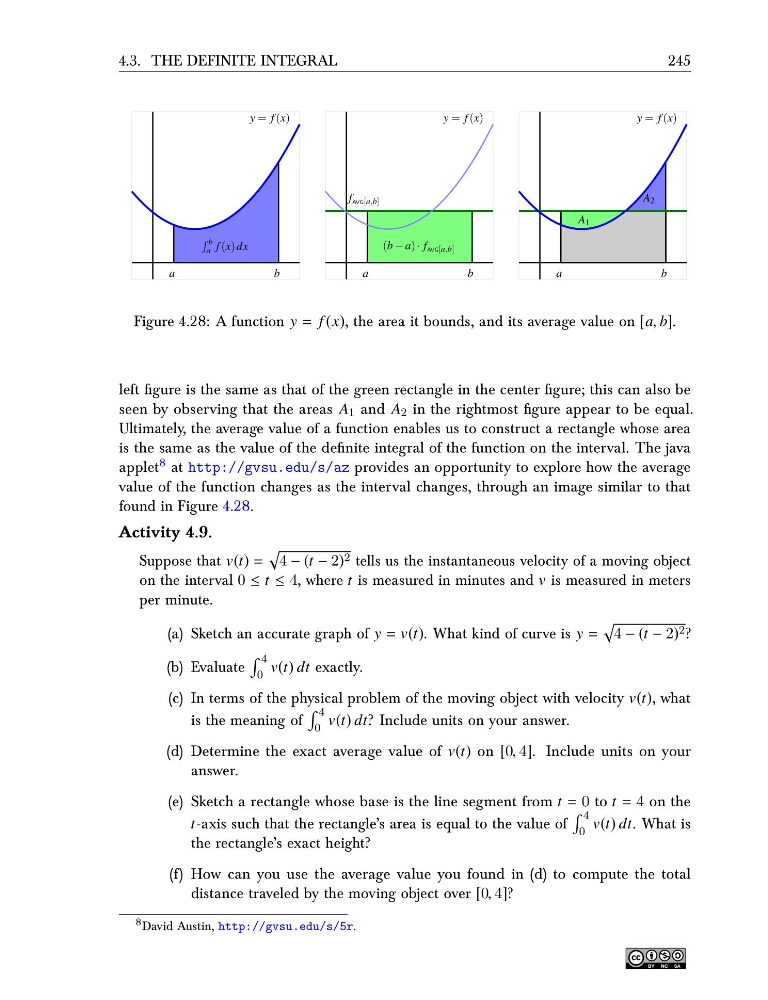
Figure 4.28: A function y = f (x), the area it bounds, and its average value on [a, b].
left figure is the same as that of the green rectangle in the center figure; this can also be
seen by observing that the areas A 1 and A 2 in the rightmost figure appear to be equal.
Ultimately, the average value of a function enables us to construct a rectangle whose area
is the same as the value of the definite integral of the function on the interval. The java
applet 8 at http://gvsu.edu/s/az provides an opportunity to explore how the average
value of the function changes as the interval changes, through an image similar to that
found in Figure 4.28.
Activity 4.9.
Suppose that v(t) =
4 − (t − 2) 2 tells us the instantaneous velocity of a moving object
on the interval 0 ≤ t ≤ 4, where t is measured in minutes and v is measured in meters
per minute.
(a) Sketch an accurate graph of y = v(t). What kind of curve is y =
4 − (t − 2) 2 ?
(b) Evaluate
4
0
v(t) dt exactly.
(c) In terms of the physical problem of the moving object with velocity v(t), what
is the meaning of
4
0
v(t) dt? Include units on your answer.
(d) Determine the exact average value of v(t) on [0, 4]. Include units on your
answer.
(e) Sketch a rectangle whose base is the line segment from t = 0 to t = 4 on the
t-axis such that the rectangle’s area is equal to the value of
4
0
v(t) dt. What is
the rectangle’s exact height?
(f) How can you use the average value you found in (d) to compute the total
distance traveled by the moving object over [0, 4]?
8 David Austin, http://gvsu.edu/s/5r.
245
a
b
b
a f (x) dx
y = f (x)
a
f AVG[a,b]
(b − a) · f AVG[a,b]
b
y = f (x)
a
b
A 1
A 2
y = f (x)
Figure 4.28: A function y = f (x), the area it bounds, and its average value on [a, b].
left figure is the same as that of the green rectangle in the center figure; this can also be
seen by observing that the areas A 1 and A 2 in the rightmost figure appear to be equal.
Ultimately, the average value of a function enables us to construct a rectangle whose area
is the same as the value of the definite integral of the function on the interval. The java
applet 8 at http://gvsu.edu/s/az provides an opportunity to explore how the average
value of the function changes as the interval changes, through an image similar to that
found in Figure 4.28.
Activity 4.9.
Suppose that v(t) =
4 − (t − 2) 2 tells us the instantaneous velocity of a moving object
on the interval 0 ≤ t ≤ 4, where t is measured in minutes and v is measured in meters
per minute.
(a) Sketch an accurate graph of y = v(t). What kind of curve is y =
4 − (t − 2) 2 ?
(b) Evaluate
4
0
v(t) dt exactly.
(c) In terms of the physical problem of the moving object with velocity v(t), what
is the meaning of
4
0
v(t) dt? Include units on your answer.
(d) Determine the exact average value of v(t) on [0, 4]. Include units on your
answer.
(e) Sketch a rectangle whose base is the line segment from t = 0 to t = 4 on the
t-axis such that the rectangle’s area is equal to the value of
4
0
v(t) dt. What is
the rectangle’s exact height?
(f) How can you use the average value you found in (d) to compute the total
distance traveled by the moving object over [0, 4]?
8 David Austin, http://gvsu.edu/s/5r.