

3.5. RELATED RATES
205
Summary
In this section, we encountered the following important ideas:
• When two or more related quantities are changing as implicit functions of time, their
rates of change can be related by implicitly differentiating the equation that relates the
quantities themselves. For instance, if the sides of a right triangle are all changing as
functions of time, say having lengths x, y, and z, then these quantities are related by
the Pythagorean Theorem: x 2 + y 2 = z 2 . It follows by implicitly differentiating with
respect to t that their rates are related by the equation
2x
dx
dt
+ 2y
dy
dt
= 2z
dz
dt
,
so that if we know the values of x, y, and z at a particular time, as well as two of the
three rates, we can deduce the value of the third.
Exercises
1. A sailboat is sitting at rest near its dock. A rope attached to the bow of the boat is
drawn in over a pulley that stands on a post on the end of the dock that is 5 feet higher
than the bow. If the rope is being pulled in at a rate of 2 feet per second, how fast is
the boat approaching the dock when the length of rope from bow to pulley is 13 feet?
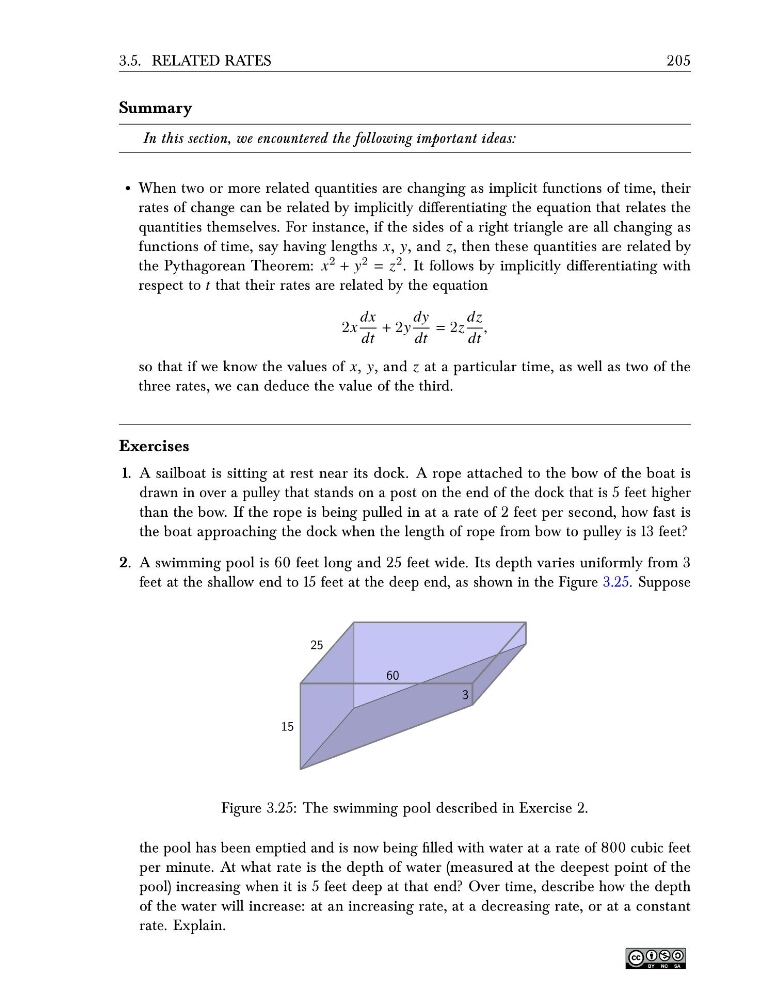
2. A swimming pool is 60 feet long and 25 feet wide. Its depth varies uniformly from 3
feet at the shallow end to 15 feet at the deep end, as shown in the Figure 3.25. Suppose
15
25
60
3
Figure 3.25: The swimming pool described in Exercise 2.
the pool has been emptied and is now being filled with water at a rate of 800 cubic feet
per minute. At what rate is the depth of water (measured at the deepest point of the
pool) increasing when it is 5 feet deep at that end? Over time, describe how the depth
of the water will increase: at an increasing rate, at a decreasing rate, or at a constant
rate. Explain.
205
Summary
In this section, we encountered the following important ideas:
• When two or more related quantities are changing as implicit functions of time, their
rates of change can be related by implicitly differentiating the equation that relates the
quantities themselves. For instance, if the sides of a right triangle are all changing as
functions of time, say having lengths x, y, and z, then these quantities are related by
the Pythagorean Theorem: x 2 + y 2 = z 2 . It follows by implicitly differentiating with
respect to t that their rates are related by the equation
2x
dx
dt
+ 2y
dy
dt
= 2z
dz
dt
,
so that if we know the values of x, y, and z at a particular time, as well as two of the
three rates, we can deduce the value of the third.
Exercises
1. A sailboat is sitting at rest near its dock. A rope attached to the bow of the boat is
drawn in over a pulley that stands on a post on the end of the dock that is 5 feet higher
than the bow. If the rope is being pulled in at a rate of 2 feet per second, how fast is
the boat approaching the dock when the length of rope from bow to pulley is 13 feet?
2. A swimming pool is 60 feet long and 25 feet wide. Its depth varies uniformly from 3
feet at the shallow end to 15 feet at the deep end, as shown in the Figure 3.25. Suppose
15
25
60
3
Figure 3.25: The swimming pool described in Exercise 2.
the pool has been emptied and is now being filled with water at a rate of 800 cubic feet
per minute. At what rate is the depth of water (measured at the deepest point of the
pool) increasing when it is 5 feet deep at that end? Over time, describe how the depth
of the water will increase: at an increasing rate, at a decreasing rate, or at a constant
rate. Explain.