

3.5. RELATED RATES
199
r
h
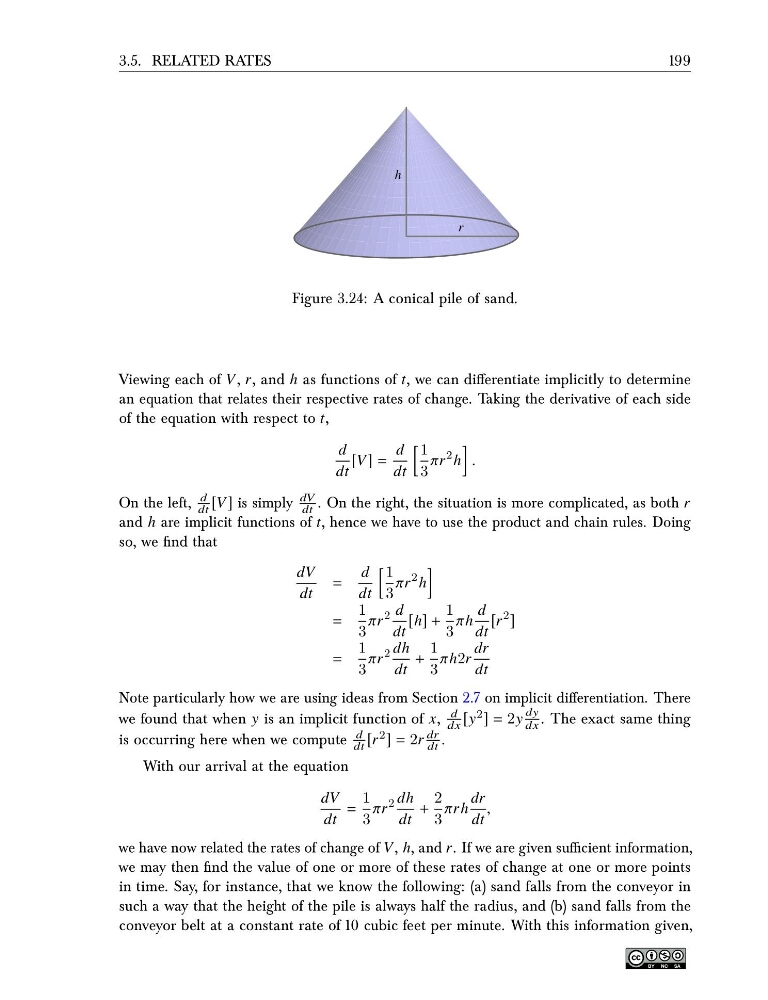
Figure 3.24: A conical pile of sand.
Viewing each of V , r, and h as functions of t, we can differentiate implicitly to determine
an equation that relates their respective rates of change. Taking the derivative of each side
of the equation with respect to t,
d
dt
[V ] =
d
dt
1
3
πr
2 h
.
On the left,
d
dt [V ] is simply
dV
dt . On the right, the situation is more complicated, as both r
and h are implicit functions of t, hence we have to use the product and chain rules. Doing
so, we find that
dV
dt
=
d
dt
1
3
πr
2 h
=
1
3
πr
2 d
dt
[h] +
1
3
πh
d
dt
[r
2 ]
=
1
3
πr
2 dh
dt
+
1
3
πh2r
dr
dt
Note particularly how we are using ideas from Section 2.7 on implicit differentiation. There
we found that when y is an implicit function of x,
d
dx [y 2 ] = 2y
dy
dx . The exact same thing
is occurring here when we compute
d
dt [r 2 ] = 2r
dr
dt .
With our arrival at the equation
dV
dt
=
1
3
πr
2 dh
dt
+
2
3
πr h
dr
dt
,
we have now related the rates of change of V , h, and r. If we are given sufficient information,
we may then find the value of one or more of these rates of change at one or more points
in time. Say, for instance, that we know the following: (a) sand falls from the conveyor in
such a way that the height of the pile is always half the radius, and (b) sand falls from the
conveyor belt at a constant rate of 10 cubic feet per minute. With this information given,
199
r
h
Figure 3.24: A conical pile of sand.
Viewing each of V , r, and h as functions of t, we can differentiate implicitly to determine
an equation that relates their respective rates of change. Taking the derivative of each side
of the equation with respect to t,
d
dt
[V ] =
d
dt
1
3
πr
2 h
.
On the left,
d
dt [V ] is simply
dV
dt . On the right, the situation is more complicated, as both r
and h are implicit functions of t, hence we have to use the product and chain rules. Doing
so, we find that
dV
dt
=
d
dt
1
3
πr
2 h
=
1
3
πr
2 d
dt
[h] +
1
3
πh
d
dt
[r
2 ]
=
1
3
πr
2 dh
dt
+
1
3
πh2r
dr
dt
Note particularly how we are using ideas from Section 2.7 on implicit differentiation. There
we found that when y is an implicit function of x,
d
dx [y 2 ] = 2y
dy
dx . The exact same thing
is occurring here when we compute
d
dt [r 2 ] = 2r
dr
dt .
With our arrival at the equation
dV
dt
=
1
3
πr
2 dh
dt
+
2
3
πr h
dr
dt
,
we have now related the rates of change of V , h, and r. If we are given sufficient information,
we may then find the value of one or more of these rates of change at one or more points
in time. Say, for instance, that we know the following: (a) sand falls from the conveyor in
such a way that the height of the pile is always half the radius, and (b) sand falls from the
conveyor belt at a constant rate of 10 cubic feet per minute. With this information given,