

188
3.3. GLOBAL OPTIMIZATION
5 10 15 20
5
10
15
20
25
y = A(x)
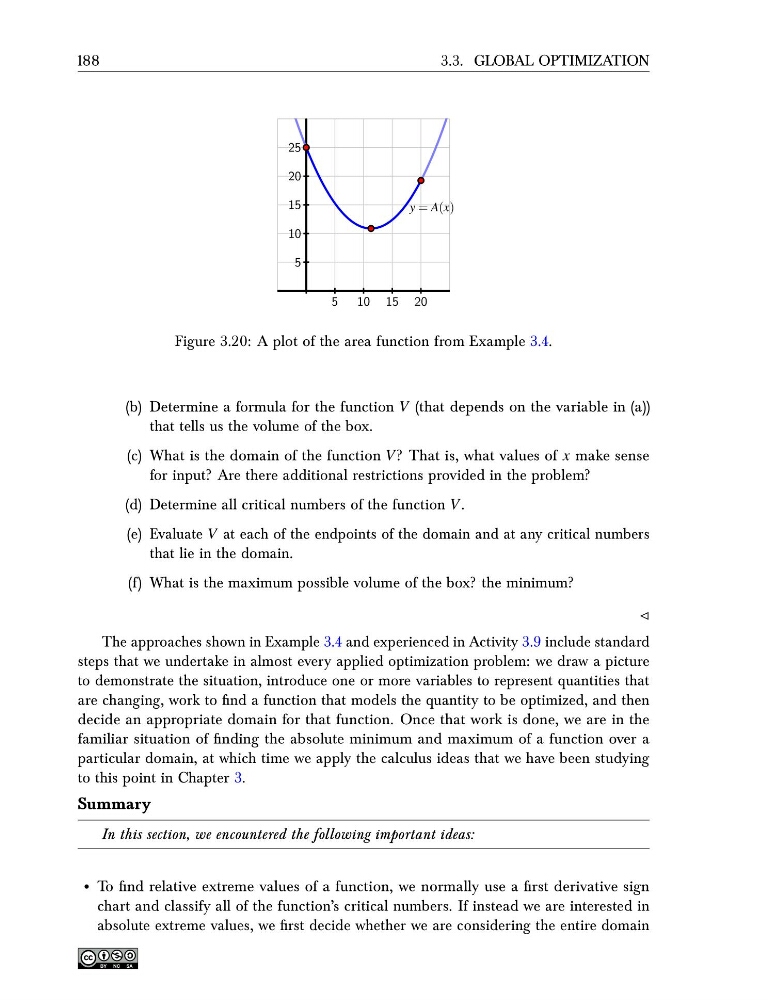
Figure 3.20: A plot of the area function from Example 3.4.
(b) Determine a formula for the function V (that depends on the variable in (a))
that tells us the volume of the box.
(c) What is the domain of the function V ? That is, what values of x make sense
for input? Are there additional restrictions provided in the problem?
(d) Determine all critical numbers of the function V .
(e) Evaluate V at each of the endpoints of the domain and at any critical numbers
that lie in the domain.
(f) What is the maximum possible volume of the box? the minimum?
⊳
The approaches shown in Example 3.4 and experienced in Activity 3.9 include standard
steps that we undertake in almost every applied optimization problem: we draw a picture
to demonstrate the situation, introduce one or more variables to represent quantities that
are changing, work to find a function that models the quantity to be optimized, and then
decide an appropriate domain for that function. Once that work is done, we are in the
familiar situation of finding the absolute minimum and maximum of a function over a
particular domain, at which time we apply the calculus ideas that we have been studying
to this point in Chapter 3.
Summary
In this section, we encountered the following important ideas:
• To find relative extreme values of a function, we normally use a first derivative sign
chart and classify all of the function’s critical numbers. If instead we are interested in
absolute extreme values, we first decide whether we are considering the entire domain
3.3. GLOBAL OPTIMIZATION
5 10 15 20
5
10
15
20
25
y = A(x)
Figure 3.20: A plot of the area function from Example 3.4.
(b) Determine a formula for the function V (that depends on the variable in (a))
that tells us the volume of the box.
(c) What is the domain of the function V ? That is, what values of x make sense
for input? Are there additional restrictions provided in the problem?
(d) Determine all critical numbers of the function V .
(e) Evaluate V at each of the endpoints of the domain and at any critical numbers
that lie in the domain.
(f) What is the maximum possible volume of the box? the minimum?
⊳
The approaches shown in Example 3.4 and experienced in Activity 3.9 include standard
steps that we undertake in almost every applied optimization problem: we draw a picture
to demonstrate the situation, introduce one or more variables to represent quantities that
are changing, work to find a function that models the quantity to be optimized, and then
decide an appropriate domain for that function. Once that work is done, we are in the
familiar situation of finding the absolute minimum and maximum of a function over a
particular domain, at which time we apply the calculus ideas that we have been studying
to this point in Chapter 3.
Summary
In this section, we encountered the following important ideas:
• To find relative extreme values of a function, we normally use a first derivative sign
chart and classify all of the function’s critical numbers. If instead we are interested in
absolute extreme values, we first decide whether we are considering the entire domain