

162
3.1. USING DERIVATIVES TO IDENTIFY EXTREME VALUES
1
2
10
20
30
40
y = s(t)
V
y = g(x)
(a, g(a))
(b, g(b))
(c, g(c))
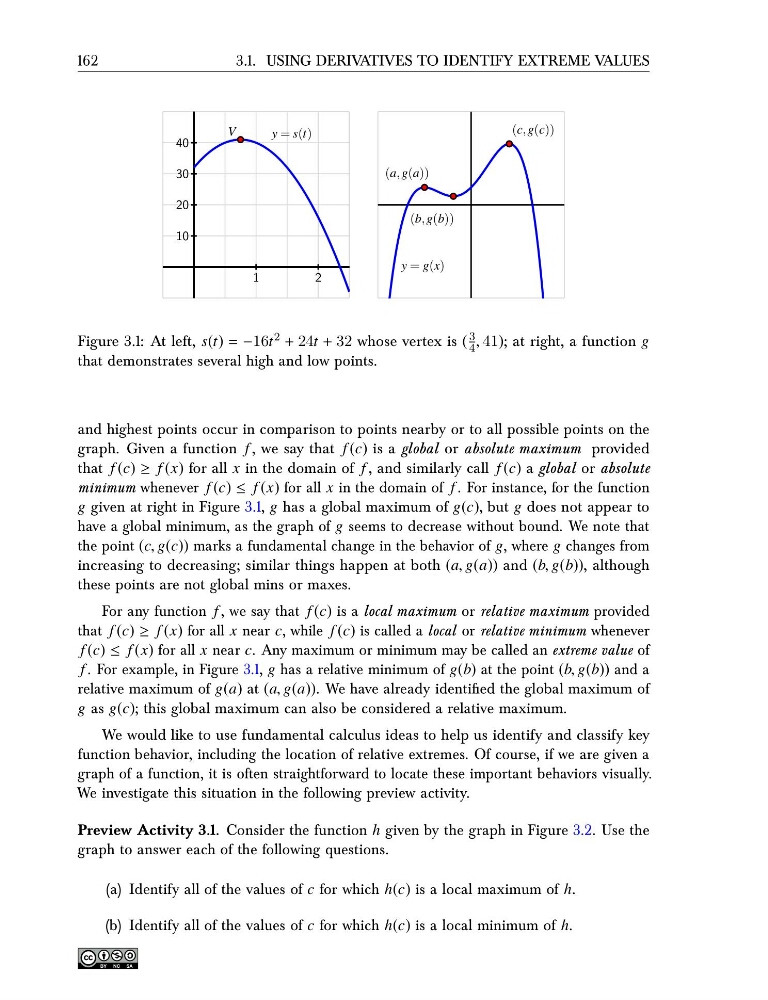
Figure 3.1: At left, s(t) = −16t 2 + 24t + 32 whose vertex is (
3
4 , 41); at right, a function g
that demonstrates several high and low points.
and highest points occur in comparison to points nearby or to all possible points on the
graph. Given a function f , we say that f (c) is a global or absolute maximum provided
that f (c) ≥ f (x) for all x in the domain of f , and similarly call f (c) a global or absolute
minimum whenever f (c) ≤ f (x) for all x in the domain of f . For instance, for the function
g given at right in Figure 3.1, g has a global maximum of g(c), but g does not appear to
have a global minimum, as the graph of g seems to decrease without bound. We note that
the point (c, g(c)) marks a fundamental change in the behavior of g, where g changes from
increasing to decreasing; similar things happen at both (a, g(a)) and (b, g(b)), although
these points are not global mins or maxes.
For any function f , we say that f (c) is a local maximum or relative maximum provided
that f (c) ≥ f (x) for all x near c, while f (c) is called a local or relative minimum whenever
f (c) ≤ f (x) for all x near c. Any maximum or minimum may be called an extreme value of
f . For example, in Figure 3.1, g has a relative minimum of g(b) at the point (b, g(b)) and a
relative maximum of g(a) at (a, g(a)). We have already identified the global maximum of
g as g(c); this global maximum can also be considered a relative maximum.
We would like to use fundamental calculus ideas to help us identify and classify key
function behavior, including the location of relative extremes. Of course, if we are given a
graph of a function, it is often straightforward to locate these important behaviors visually.
We investigate this situation in the following preview activity.
Preview Activity 3.1. Consider the function h given by the graph in Figure 3.2. Use the
graph to answer each of the following questions.
(a) Identify all of the values of c for which h(c) is a local maximum of h.
(b) Identify all of the values of c for which h(c) is a local minimum of h.
3.1. USING DERIVATIVES TO IDENTIFY EXTREME VALUES
1
2
10
20
30
40
y = s(t)
V
y = g(x)
(a, g(a))
(b, g(b))
(c, g(c))
Figure 3.1: At left, s(t) = −16t 2 + 24t + 32 whose vertex is (
3
4 , 41); at right, a function g
that demonstrates several high and low points.
and highest points occur in comparison to points nearby or to all possible points on the
graph. Given a function f , we say that f (c) is a global or absolute maximum provided
that f (c) ≥ f (x) for all x in the domain of f , and similarly call f (c) a global or absolute
minimum whenever f (c) ≤ f (x) for all x in the domain of f . For instance, for the function
g given at right in Figure 3.1, g has a global maximum of g(c), but g does not appear to
have a global minimum, as the graph of g seems to decrease without bound. We note that
the point (c, g(c)) marks a fundamental change in the behavior of g, where g changes from
increasing to decreasing; similar things happen at both (a, g(a)) and (b, g(b)), although
these points are not global mins or maxes.
For any function f , we say that f (c) is a local maximum or relative maximum provided
that f (c) ≥ f (x) for all x near c, while f (c) is called a local or relative minimum whenever
f (c) ≤ f (x) for all x near c. Any maximum or minimum may be called an extreme value of
f . For example, in Figure 3.1, g has a relative minimum of g(b) at the point (b, g(b)) and a
relative maximum of g(a) at (a, g(a)). We have already identified the global maximum of
g as g(c); this global maximum can also be considered a relative maximum.
We would like to use fundamental calculus ideas to help us identify and classify key
function behavior, including the location of relative extremes. Of course, if we are given a
graph of a function, it is often straightforward to locate these important behaviors visually.
We investigate this situation in the following preview activity.
Preview Activity 3.1. Consider the function h given by the graph in Figure 3.2. Use the
graph to answer each of the following questions.
(a) Identify all of the values of c for which h(c) is a local maximum of h.
(b) Identify all of the values of c for which h(c) is a local minimum of h.