

2.8. USING DERIVATIVES TO EVALUATE LIMITS
159
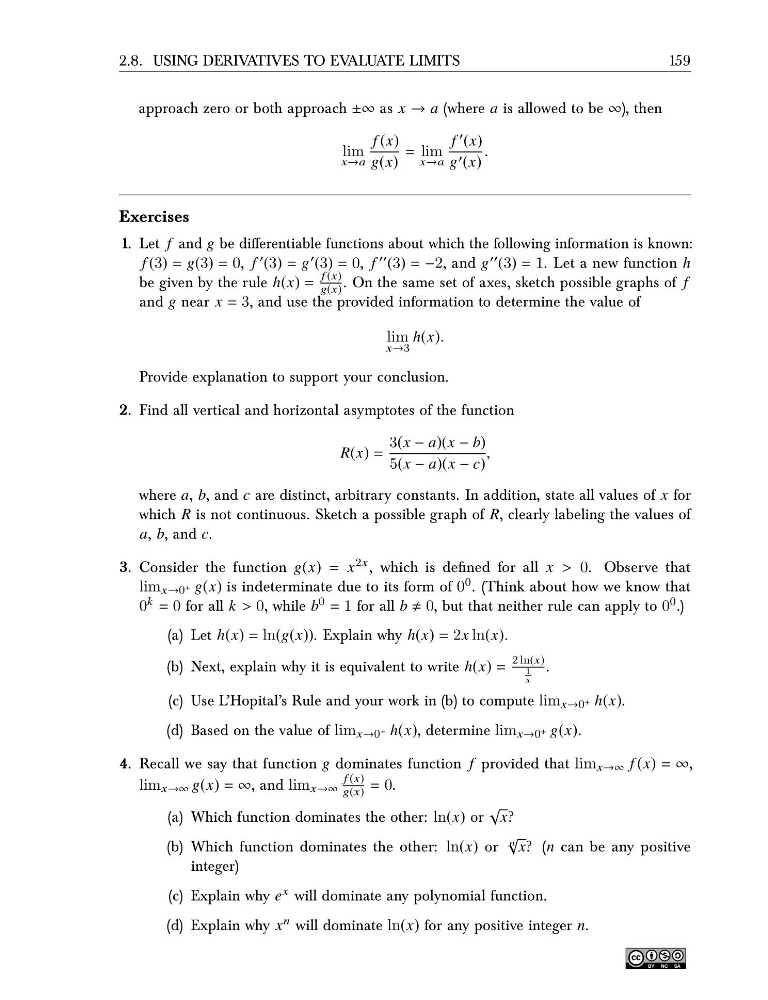
approach zero or both approach ±∞ as x → a (where a is allowed to be ∞), then
lim
x→a
f (x)
g(x)
= lim
x→a
f ′ (x)
g ′ (x)
.
Exercises
1. Let f and g be differentiable functions about which the following information is known:
f (3) = g(3) = 0, f ′ (3) = g ′ (3) = 0, f ′′ (3) = −2, and g ′′ (3) = 1. Let a new function h
be given by the rule h(x) =
f (x)
g(x) . On the same set of axes, sketch possible graphs of f
and g near x = 3, and use the provided information to determine the value of
lim
x→3
h(x).
Provide explanation to support your conclusion.
2. Find all vertical and horizontal asymptotes of the function
R(x) =
3(x − a)(x − b)
5(x − a)(x − c)
,
where a, b, and c are distinct, arbitrary constants. In addition, state all values of x for
which R is not continuous. Sketch a possible graph of R, clearly labeling the values of
a, b, and c.
3. Consider the function g(x) = x 2x , which is defined for all x > 0. Observe that
lim x→0 + g(x) is indeterminate due to its form of 0 0 . (Think about how we know that
0 k = 0 for all k > 0, while b 0 = 1 for all b 0, but that neither rule can apply to 0 0 .)
(a) Let h(x) = ln(g(x)). Explain why h(x) = 2x ln(x).
(b) Next, explain why it is equivalent to write h(x) =
2 ln(x)
1
x
.
(c) Use L’Hopital’s Rule and your work in (b) to compute lim x→0 + h(x).
(d) Based on the value of lim x→0 + h(x), determine lim x→0 + g(x).
4. Recall we say that function g dominates function f provided that lim x→∞ f (x) = ∞,
lim x→∞ g(x) = ∞, and lim x→∞
f (x)
g(x) = 0.
(a) Which function dominates the other: ln(x) or
√
x?
(b) Which function dominates the other: ln(x) or
n
√
x? (n can be any positive
integer)
(c) Explain why e x will dominate any polynomial function.
(d) Explain why x n will dominate ln(x) for any positive integer n.
159
approach zero or both approach ±∞ as x → a (where a is allowed to be ∞), then
lim
x→a
f (x)
g(x)
= lim
x→a
f ′ (x)
g ′ (x)
.
Exercises
1. Let f and g be differentiable functions about which the following information is known:
f (3) = g(3) = 0, f ′ (3) = g ′ (3) = 0, f ′′ (3) = −2, and g ′′ (3) = 1. Let a new function h
be given by the rule h(x) =
f (x)
g(x) . On the same set of axes, sketch possible graphs of f
and g near x = 3, and use the provided information to determine the value of
lim
x→3
h(x).
Provide explanation to support your conclusion.
2. Find all vertical and horizontal asymptotes of the function
R(x) =
3(x − a)(x − b)
5(x − a)(x − c)
,
where a, b, and c are distinct, arbitrary constants. In addition, state all values of x for
which R is not continuous. Sketch a possible graph of R, clearly labeling the values of
a, b, and c.
3. Consider the function g(x) = x 2x , which is defined for all x > 0. Observe that
lim x→0 + g(x) is indeterminate due to its form of 0 0 . (Think about how we know that
0 k = 0 for all k > 0, while b 0 = 1 for all b 0, but that neither rule can apply to 0 0 .)
(a) Let h(x) = ln(g(x)). Explain why h(x) = 2x ln(x).
(b) Next, explain why it is equivalent to write h(x) =
2 ln(x)
1
x
.
(c) Use L’Hopital’s Rule and your work in (b) to compute lim x→0 + h(x).
(d) Based on the value of lim x→0 + h(x), determine lim x→0 + g(x).
4. Recall we say that function g dominates function f provided that lim x→∞ f (x) = ∞,
lim x→∞ g(x) = ∞, and lim x→∞
f (x)
g(x) = 0.
(a) Which function dominates the other: ln(x) or
√
x?
(b) Which function dominates the other: ln(x) or
n
√
x? (n can be any positive
integer)
(c) Explain why e x will dominate any polynomial function.
(d) Explain why x n will dominate ln(x) for any positive integer n.