

144
2.7. DERIVATIVES OF FUNCTIONS GIVEN IMPLICITLY
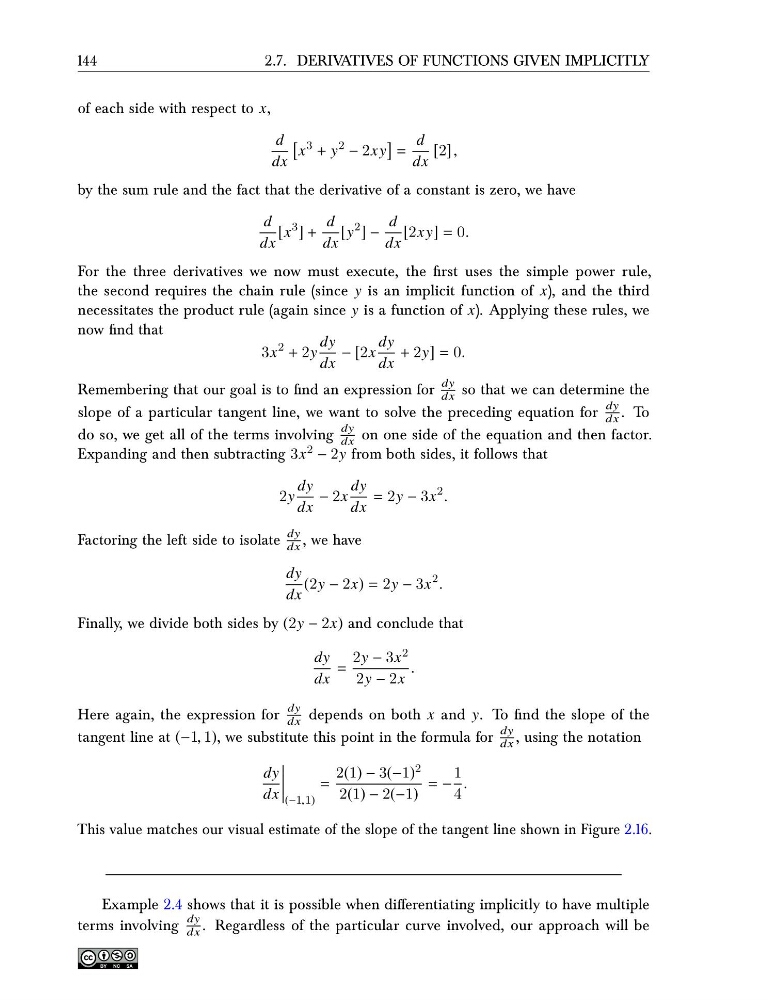
of each side with respect to x,
d
dx
x
3 + y
2 − 2x y
=
d
dx
[2] ,
by the sum rule and the fact that the derivative of a constant is zero, we have
d
dx
[x
3 ] +
d
dx
[y
2 ] −
d
dx
[2x y] = 0.
For the three derivatives we now must execute, the first uses the simple power rule,
the second requires the chain rule (since y is an implicit function of x), and the third
necessitates the product rule (again since y is a function of x). Applying these rules, we
now find that
3x
2 + 2y
dy
dx
− [2x
dy
dx
+ 2y] = 0.
Remembering that our goal is to find an expression for
dy
dx so that we can determine the
slope of a particular tangent line, we want to solve the preceding equation for
dy
dx . To
do so, we get all of the terms involving
dy
dx on one side of the equation and then factor.
Expanding and then subtracting 3x 2 − 2y from both sides, it follows that
2y
dy
dx
− 2x
dy
dx
= 2y − 3x
2 .
Factoring the left side to isolate
dy
dx , we have
dy
dx
(2y − 2x) = 2y − 3x
2 .
Finally, we divide both sides by (2y − 2x) and conclude that
dy
dx
=
2y − 3x 2
2y − 2x
.
Here again, the expression for
dy
dx depends on both x and y. To find the slope of the
tangent line at (−1, 1), we substitute this point in the formula for
dy
dx , using the notation
dy
dx
(−1,1)
=
2(1) − 3(−1) 2
2(1) − 2(−1)
= −
1
4
.
This value matches our visual estimate of the slope of the tangent line shown in Figure 2.16.
Example 2.4 shows that it is possible when differentiating implicitly to have multiple
terms involving
dy
dx . Regardless of the particular curve involved, our approach will be
2.7. DERIVATIVES OF FUNCTIONS GIVEN IMPLICITLY
of each side with respect to x,
d
dx
x
3 + y
2 − 2x y
=
d
dx
[2] ,
by the sum rule and the fact that the derivative of a constant is zero, we have
d
dx
[x
3 ] +
d
dx
[y
2 ] −
d
dx
[2x y] = 0.
For the three derivatives we now must execute, the first uses the simple power rule,
the second requires the chain rule (since y is an implicit function of x), and the third
necessitates the product rule (again since y is a function of x). Applying these rules, we
now find that
3x
2 + 2y
dy
dx
− [2x
dy
dx
+ 2y] = 0.
Remembering that our goal is to find an expression for
dy
dx so that we can determine the
slope of a particular tangent line, we want to solve the preceding equation for
dy
dx . To
do so, we get all of the terms involving
dy
dx on one side of the equation and then factor.
Expanding and then subtracting 3x 2 − 2y from both sides, it follows that
2y
dy
dx
− 2x
dy
dx
= 2y − 3x
2 .
Factoring the left side to isolate
dy
dx , we have
dy
dx
(2y − 2x) = 2y − 3x
2 .
Finally, we divide both sides by (2y − 2x) and conclude that
dy
dx
=
2y − 3x 2
2y − 2x
.
Here again, the expression for
dy
dx depends on both x and y. To find the slope of the
tangent line at (−1, 1), we substitute this point in the formula for
dy
dx , using the notation
dy
dx
(−1,1)
=
2(1) − 3(−1) 2
2(1) − 2(−1)
= −
1
4
.
This value matches our visual estimate of the slope of the tangent line shown in Figure 2.16.
Example 2.4 shows that it is possible when differentiating implicitly to have multiple
terms involving
dy
dx . Regardless of the particular curve involved, our approach will be