

140
2.7. DERIVATIVES OF FUNCTIONS GIVEN IMPLICITLY
2.7 Derivatives of Functions Given Implicitly
Motivating Questions
In this section, we strive to understand the ideas generated by the following important
questions:
• What does it mean to say that a curve is an implicit function of x, rather than an
explicit function of x?
• How does implicit differentiation enable us to find a formula for
dy
dx when y is an
implicit function of x?
• In the context of an implicit curve, how can we use
dy
dx to answer important
questions about the tangent line to the curve?
Introduction
In all of our studies with derivatives to date, we have worked in a setting where we can
express a formula for the function of interest explicitly in terms of x. But there are many
interesting curves that are determined by an equation involving x and y for which it is
impossible to solve for y in terms of x. Perhaps the simplest and most natural of all such
A
B
x 2 + y 2 = 16
-4
4
-4
4 x 3 − y 3 = 6xy
x
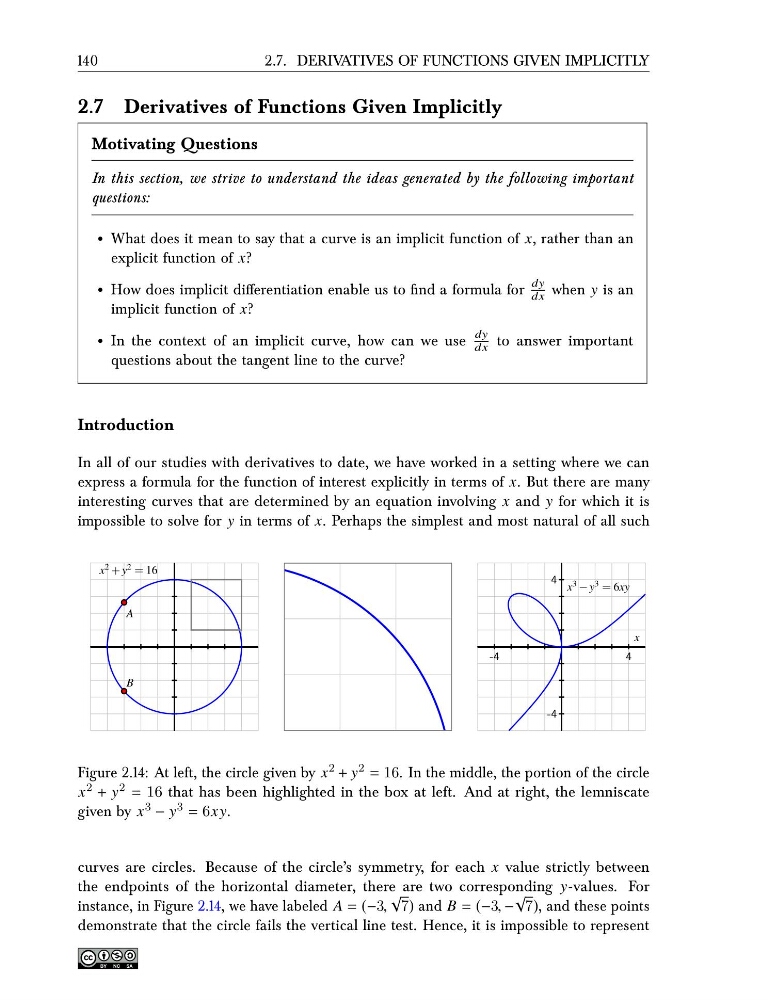
Figure 2.14: At left, the circle given by x 2 + y 2 = 16. In the middle, the portion of the circle
x 2 + y 2 = 16 that has been highlighted in the box at left. And at right, the lemniscate
given by x 3 − y 3 = 6x y.
curves are circles. Because of the circle’s symmetry, for each x value strictly between
the endpoints of the horizontal diameter, there are two corresponding y-values. For
instance, in Figure 2.14, we have labeled A = (−3,
√
7) and B = (−3, −
√
7), and these points
demonstrate that the circle fails the vertical line test. Hence, it is impossible to represent
2.7. DERIVATIVES OF FUNCTIONS GIVEN IMPLICITLY
2.7 Derivatives of Functions Given Implicitly
Motivating Questions
In this section, we strive to understand the ideas generated by the following important
questions:
• What does it mean to say that a curve is an implicit function of x, rather than an
explicit function of x?
• How does implicit differentiation enable us to find a formula for
dy
dx when y is an
implicit function of x?
• In the context of an implicit curve, how can we use
dy
dx to answer important
questions about the tangent line to the curve?
Introduction
In all of our studies with derivatives to date, we have worked in a setting where we can
express a formula for the function of interest explicitly in terms of x. But there are many
interesting curves that are determined by an equation involving x and y for which it is
impossible to solve for y in terms of x. Perhaps the simplest and most natural of all such
A
B
x 2 + y 2 = 16
-4
4
-4
4 x 3 − y 3 = 6xy
x
Figure 2.14: At left, the circle given by x 2 + y 2 = 16. In the middle, the portion of the circle
x 2 + y 2 = 16 that has been highlighted in the box at left. And at right, the lemniscate
given by x 3 − y 3 = 6x y.
curves are circles. Because of the circle’s symmetry, for each x value strictly between
the endpoints of the horizontal diameter, there are two corresponding y-values. For
instance, in Figure 2.14, we have labeled A = (−3,
√
7) and B = (−3, −
√
7), and these points
demonstrate that the circle fails the vertical line test. Hence, it is impossible to represent