

2.6. DERIVATIVES OF INVERSE FUNCTIONS
137
Solving for g ′ (x), we have g ′ (x) =
1
f ′ (g(x)) . Here we see that the slope of the tangent line to
the inverse function g at the point (x, g(x)) is precisely the reciprocal of the slope of the
tangent line to the original function f at the point (g(x), f (g(x))) = (g(x), x).
m = g ′ (b)
y = f (x)
y = g(x)
(a, b)
m = f ′ (a)
(b, a)
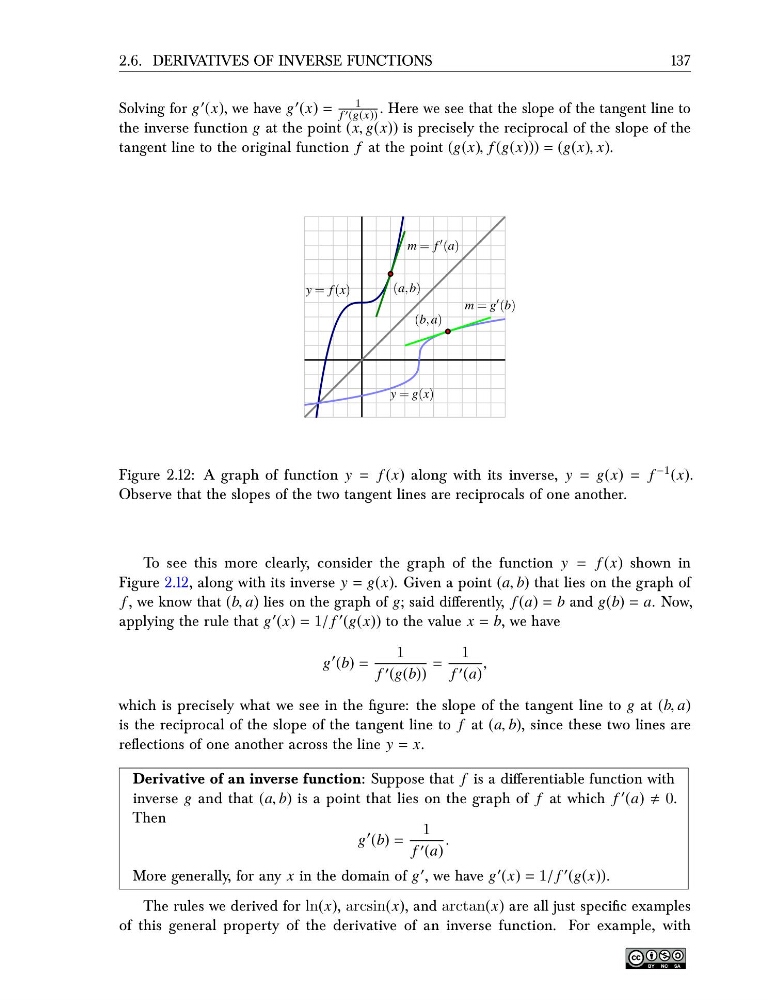
Figure 2.12: A graph of function y = f (x) along with its inverse, y = g(x) = f −1 (x).
Observe that the slopes of the two tangent lines are reciprocals of one another.
To see this more clearly, consider the graph of the function y = f (x) shown in
Figure 2.12, along with its inverse y = g(x). Given a point (a, b) that lies on the graph of
f , we know that (b, a) lies on the graph of g; said differently, f (a) = b and g(b) = a. Now,
applying the rule that g ′ (x) = 1/ f ′ (g(x)) to the value x = b, we have
g
′ (b) =
1
f ′ (g(b))
=
1
f ′ (a)
,
which is precisely what we see in the figure: the slope of the tangent line to g at (b, a)
is the reciprocal of the slope of the tangent line to f at (a, b), since these two lines are
reflections of one another across the line y = x.
Derivative of an inverse function: Suppose that f is a differentiable function with
inverse g and that (a, b) is a point that lies on the graph of f at which f ′ (a) 0.
Then
g
′ (b) =
1
f ′ (a)
.
More generally, for any x in the domain of g ′ , we have g ′ (x) = 1/ f ′ (g(x)).
The rules we derived for ln(x), arcsin(x), and arctan(x) are all just specific examples
of this general property of the derivative of an inverse function. For example, with
137
Solving for g ′ (x), we have g ′ (x) =
1
f ′ (g(x)) . Here we see that the slope of the tangent line to
the inverse function g at the point (x, g(x)) is precisely the reciprocal of the slope of the
tangent line to the original function f at the point (g(x), f (g(x))) = (g(x), x).
m = g ′ (b)
y = f (x)
y = g(x)
(a, b)
m = f ′ (a)
(b, a)
Figure 2.12: A graph of function y = f (x) along with its inverse, y = g(x) = f −1 (x).
Observe that the slopes of the two tangent lines are reciprocals of one another.
To see this more clearly, consider the graph of the function y = f (x) shown in
Figure 2.12, along with its inverse y = g(x). Given a point (a, b) that lies on the graph of
f , we know that (b, a) lies on the graph of g; said differently, f (a) = b and g(b) = a. Now,
applying the rule that g ′ (x) = 1/ f ′ (g(x)) to the value x = b, we have
g
′ (b) =
1
f ′ (g(b))
=
1
f ′ (a)
,
which is precisely what we see in the figure: the slope of the tangent line to g at (b, a)
is the reciprocal of the slope of the tangent line to f at (a, b), since these two lines are
reflections of one another across the line y = x.
Derivative of an inverse function: Suppose that f is a differentiable function with
inverse g and that (a, b) is a point that lies on the graph of f at which f ′ (a) 0.
Then
g
′ (b) =
1
f ′ (a)
.
More generally, for any x in the domain of g ′ , we have g ′ (x) = 1/ f ′ (g(x)).
The rules we derived for ln(x), arcsin(x), and arctan(x) are all just specific examples
of this general property of the derivative of an inverse function. For example, with