

2.6. DERIVATIVES OF INVERSE FUNCTIONS
135
x
1
θ
√
1 − x 2
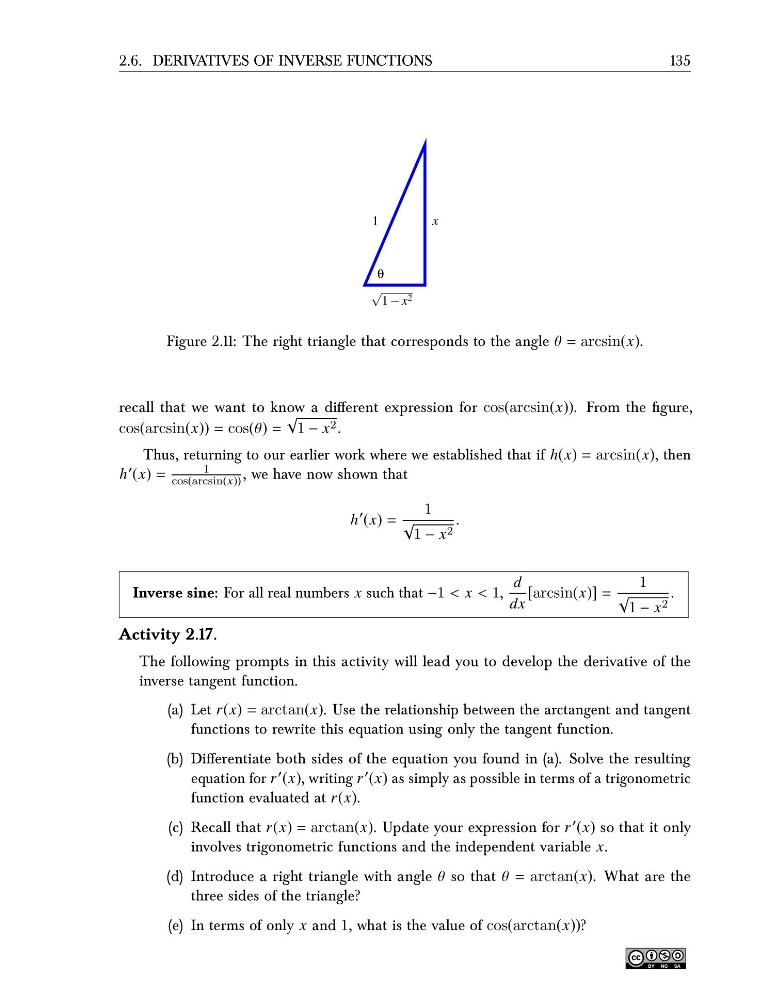
Figure 2.11: The right triangle that corresponds to the angle θ = arcsin(x).
recall that we want to know a different expression for cos(arcsin(x)). From the figure,
cos(arcsin(x)) = cos(θ) =
√
1 − x 2 .
Thus, returning to our earlier work where we established that if h(x) = arcsin(x), then
h ′ (x) =
1
cos(arcsin(x)) , we have now shown that
h
′ (x) =
1
√
1 − x 2
.
Inverse sine: For all real numbers x such that −1 < x < 1,
d
dx
[arcsin(x)] =
1
√
1 − x 2
.
Activity 2.17.
The following prompts in this activity will lead you to develop the derivative of the
inverse tangent function.
(a) Let r(x) = arctan(x). Use the relationship between the arctangent and tangent
functions to rewrite this equation using only the tangent function.
(b) Differentiate both sides of the equation you found in (a). Solve the resulting
equation for r ′ (x), writing r ′ (x) as simply as possible in terms of a trigonometric
function evaluated at r(x).
(c) Recall that r(x) = arctan(x). Update your expression for r ′ (x) so that it only
involves trigonometric functions and the independent variable x.
(d) Introduce a right triangle with angle θ so that θ = arctan(x). What are the
three sides of the triangle?
(e) In terms of only x and 1, what is the value of cos(arctan(x))?
135
x
1
θ
√
1 − x 2
Figure 2.11: The right triangle that corresponds to the angle θ = arcsin(x).
recall that we want to know a different expression for cos(arcsin(x)). From the figure,
cos(arcsin(x)) = cos(θ) =
√
1 − x 2 .
Thus, returning to our earlier work where we established that if h(x) = arcsin(x), then
h ′ (x) =
1
cos(arcsin(x)) , we have now shown that
h
′ (x) =
1
√
1 − x 2
.
Inverse sine: For all real numbers x such that −1 < x < 1,
d
dx
[arcsin(x)] =
1
√
1 − x 2
.
Activity 2.17.
The following prompts in this activity will lead you to develop the derivative of the
inverse tangent function.
(a) Let r(x) = arctan(x). Use the relationship between the arctangent and tangent
functions to rewrite this equation using only the tangent function.
(b) Differentiate both sides of the equation you found in (a). Solve the resulting
equation for r ′ (x), writing r ′ (x) as simply as possible in terms of a trigonometric
function evaluated at r(x).
(c) Recall that r(x) = arctan(x). Update your expression for r ′ (x) so that it only
involves trigonometric functions and the independent variable x.
(d) Introduce a right triangle with angle θ so that θ = arctan(x). What are the
three sides of the triangle?
(e) In terms of only x and 1, what is the value of cos(arctan(x))?