

2.6. DERIVATIVES OF INVERSE FUNCTIONS
131
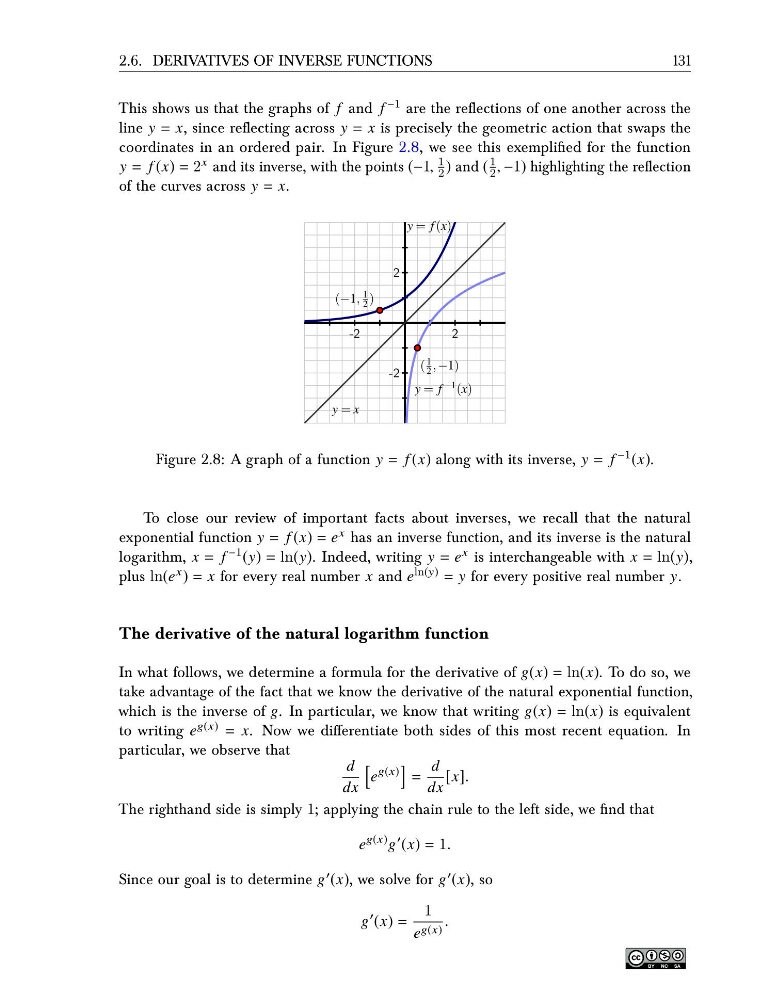
This shows us that the graphs of f and f −1 are the reflections of one another across the
line y = x, since reflecting across y = x is precisely the geometric action that swaps the
coordinates in an ordered pair. In Figure 2.8, we see this exemplified for the function
y = f (x) = 2 x and its inverse, with the points (−1,
1
2 ) and (
1
2 , −1) highlighting the reflection
of the curves across y = x.
-2
2
-2
2
y = f (x)
y = f −1 (x)
(−1,
1
2 )
(
1
2 , −1)
y = x
Figure 2.8: A graph of a function y = f (x) along with its inverse, y = f −1 (x).
To close our review of important facts about inverses, we recall that the natural
exponential function y = f (x) = e x has an inverse function, and its inverse is the natural
logarithm, x = f −1 (y) = ln(y). Indeed, writing y = e x is interchangeable with x = ln(y),
plus ln(e x ) = x for every real number x and e ln(y) = y for every positive real number y.
The derivative of the natural logarithm function
In what follows, we determine a formula for the derivative of g(x) = ln(x). To do so, we
take advantage of the fact that we know the derivative of the natural exponential function,
which is the inverse of g. In particular, we know that writing g(x) = ln(x) is equivalent
to writing e g(x) = x. Now we differentiate both sides of this most recent equation. In
particular, we observe that
d
dx
e
g(x)
=
d
dx
[x].
The righthand side is simply 1; applying the chain rule to the left side, we find that
e
g(x) g
′ (x) = 1.
Since our goal is to determine g ′ (x), we solve for g ′ (x), so
g
′ (x) =
1
e g(x) .
131
This shows us that the graphs of f and f −1 are the reflections of one another across the
line y = x, since reflecting across y = x is precisely the geometric action that swaps the
coordinates in an ordered pair. In Figure 2.8, we see this exemplified for the function
y = f (x) = 2 x and its inverse, with the points (−1,
1
2 ) and (
1
2 , −1) highlighting the reflection
of the curves across y = x.
-2
2
-2
2
y = f (x)
y = f −1 (x)
(−1,
1
2 )
(
1
2 , −1)
y = x
Figure 2.8: A graph of a function y = f (x) along with its inverse, y = f −1 (x).
To close our review of important facts about inverses, we recall that the natural
exponential function y = f (x) = e x has an inverse function, and its inverse is the natural
logarithm, x = f −1 (y) = ln(y). Indeed, writing y = e x is interchangeable with x = ln(y),
plus ln(e x ) = x for every real number x and e ln(y) = y for every positive real number y.
The derivative of the natural logarithm function
In what follows, we determine a formula for the derivative of g(x) = ln(x). To do so, we
take advantage of the fact that we know the derivative of the natural exponential function,
which is the inverse of g. In particular, we know that writing g(x) = ln(x) is equivalent
to writing e g(x) = x. Now we differentiate both sides of this most recent equation. In
particular, we observe that
d
dx
e
g(x)
=
d
dx
[x].
The righthand side is simply 1; applying the chain rule to the left side, we find that
e
g(x) g
′ (x) = 1.
Since our goal is to determine g ′ (x), we solve for g ′ (x), so
g
′ (x) =
1
e g(x) .