

126
2.5. THE CHAIN RULE
x
f (x) f ′ (x) g(x) g ′ (x)
−1
2
−5
−3
4
2
−3
4
−1
2
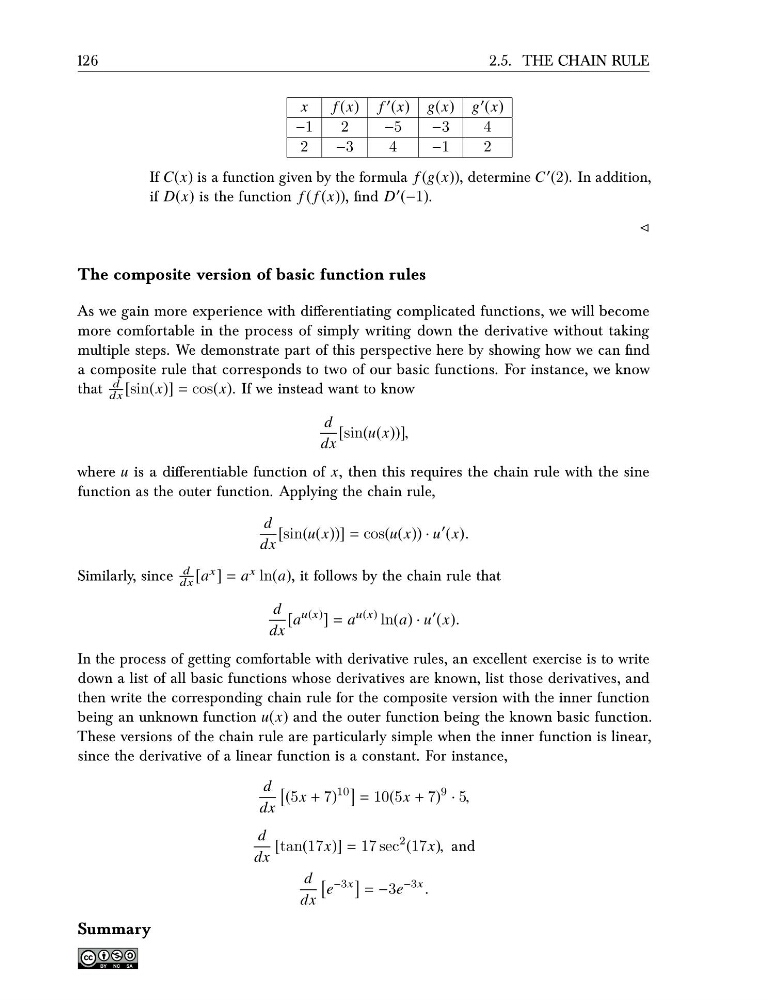
If C(x) is a function given by the formula f (g(x)), determine C ′ (2). In addition,
if D(x) is the function f ( f (x)), find D ′ (−1).
⊳
The composite version of basic function rules
As we gain more experience with differentiating complicated functions, we will become
more comfortable in the process of simply writing down the derivative without taking
multiple steps. We demonstrate part of this perspective here by showing how we can find
a composite rule that corresponds to two of our basic functions. For instance, we know
that
d
dx [sin(x)] = cos(x). If we instead want to know
d
dx
[sin(u(x))],
where u is a differentiable function of x, then this requires the chain rule with the sine
function as the outer function. Applying the chain rule,
d
dx
[sin(u(x))] = cos(u(x)) · u
′ (x).
Similarly, since
d
dx [a x ] = a x ln(a), it follows by the chain rule that
d
dx
[a
u(x) ] = a
u(x) ln(a) · u
′ (x).
In the process of getting comfortable with derivative rules, an excellent exercise is to write
down a list of all basic functions whose derivatives are known, list those derivatives, and
then write the corresponding chain rule for the composite version with the inner function
being an unknown function u(x) and the outer function being the known basic function.
These versions of the chain rule are particularly simple when the inner function is linear,
since the derivative of a linear function is a constant. For instance,
d
dx
(5x + 7)
10
= 10(5x + 7)
9 · 5,
d
dx
[tan(17x)] = 17 sec
2 (17x), and
d
dx
e
−3x
= −3e
−3x .
Summary
2.5. THE CHAIN RULE
x
f (x) f ′ (x) g(x) g ′ (x)
−1
2
−5
−3
4
2
−3
4
−1
2
If C(x) is a function given by the formula f (g(x)), determine C ′ (2). In addition,
if D(x) is the function f ( f (x)), find D ′ (−1).
⊳
The composite version of basic function rules
As we gain more experience with differentiating complicated functions, we will become
more comfortable in the process of simply writing down the derivative without taking
multiple steps. We demonstrate part of this perspective here by showing how we can find
a composite rule that corresponds to two of our basic functions. For instance, we know
that
d
dx [sin(x)] = cos(x). If we instead want to know
d
dx
[sin(u(x))],
where u is a differentiable function of x, then this requires the chain rule with the sine
function as the outer function. Applying the chain rule,
d
dx
[sin(u(x))] = cos(u(x)) · u
′ (x).
Similarly, since
d
dx [a x ] = a x ln(a), it follows by the chain rule that
d
dx
[a
u(x) ] = a
u(x) ln(a) · u
′ (x).
In the process of getting comfortable with derivative rules, an excellent exercise is to write
down a list of all basic functions whose derivatives are known, list those derivatives, and
then write the corresponding chain rule for the composite version with the inner function
being an unknown function u(x) and the outer function being the known basic function.
These versions of the chain rule are particularly simple when the inner function is linear,
since the derivative of a linear function is a constant. For instance,
d
dx
(5x + 7)
10
= 10(5x + 7)
9 · 5,
d
dx
[tan(17x)] = 17 sec
2 (17x), and
d
dx
e
−3x
= −3e
−3x .
Summary