

2.4. DERIVATIVES OF OTHER TRIGONOMETRIC FUNCTIONS
113
2.4 Derivatives of other trigonometric functions
Motivating Questions
In this section, we strive to understand the ideas generated by the following important
questions:
• What are the derivatives of the tangent, cotangent, secant, and cosecant functions?
• How do the derivatives of tan(x), cot(x), sec(x), and csc(x) combine with other
derivative rules we have developed to expand the library of functions we can
quickly differentiate?
Introduction
One of the powerful themes in trigonometry is that the entire subject emanates from a
very simple idea: locating a point on the unit circle.
1
θ
(x, y)
sin(θ )
cos(θ )
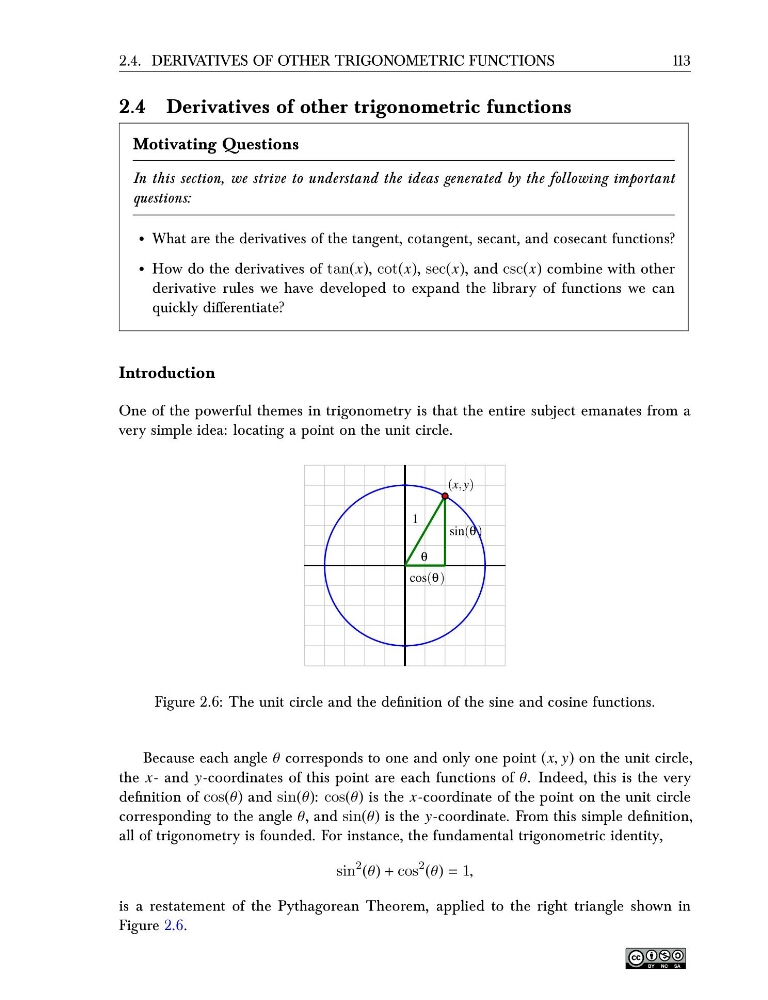
Figure 2.6: The unit circle and the definition of the sine and cosine functions.
Because each angle θ corresponds to one and only one point (x, y) on the unit circle,
the x- and y-coordinates of this point are each functions of θ. Indeed, this is the very
definition of cos(θ) and sin(θ): cos(θ) is the x-coordinate of the point on the unit circle
corresponding to the angle θ, and sin(θ) is the y-coordinate. From this simple definition,
all of trigonometry is founded. For instance, the fundamental trigonometric identity,
sin
2 (θ) + cos
2 (θ) = 1,
is a restatement of the Pythagorean Theorem, applied to the right triangle shown in
Figure 2.6.
113
2.4 Derivatives of other trigonometric functions
Motivating Questions
In this section, we strive to understand the ideas generated by the following important
questions:
• What are the derivatives of the tangent, cotangent, secant, and cosecant functions?
• How do the derivatives of tan(x), cot(x), sec(x), and csc(x) combine with other
derivative rules we have developed to expand the library of functions we can
quickly differentiate?
Introduction
One of the powerful themes in trigonometry is that the entire subject emanates from a
very simple idea: locating a point on the unit circle.
1
θ
(x, y)
sin(θ )
cos(θ )
Figure 2.6: The unit circle and the definition of the sine and cosine functions.
Because each angle θ corresponds to one and only one point (x, y) on the unit circle,
the x- and y-coordinates of this point are each functions of θ. Indeed, this is the very
definition of cos(θ) and sin(θ): cos(θ) is the x-coordinate of the point on the unit circle
corresponding to the angle θ, and sin(θ) is the y-coordinate. From this simple definition,
all of trigonometry is founded. For instance, the fundamental trigonometric identity,
sin
2 (θ) + cos
2 (θ) = 1,
is a restatement of the Pythagorean Theorem, applied to the right triangle shown in
Figure 2.6.