

2.3. THE PRODUCT AND QUOTIENT RULES
111
(d) Estimate the value of r(2.06) (where r is the function defined in (c)) by using
the local linearization of r at the point (2, r(2)).
2. Consider the functions r(t) = t t and s(t) = arccos(t), for which you are given the facts
that r ′ (t) = t t (ln(t) + 1) and s ′ (t) = −
1
√
1−t 2 . Do not be concerned with where these
derivative formulas come from. We restrict our interest in both functions to the domain
0 < t < 1.
(a) Let w(t) = t t arccos(t). Determine w ′ (t).
(b) Find an equation for the tangent line to y = w(t) at the point (
1
2 , w(
1
2 )).
(c) Let v(t) =
t t
arccos(t) . Is v increasing or decreasing at the instant t =
1
2 ? Why?
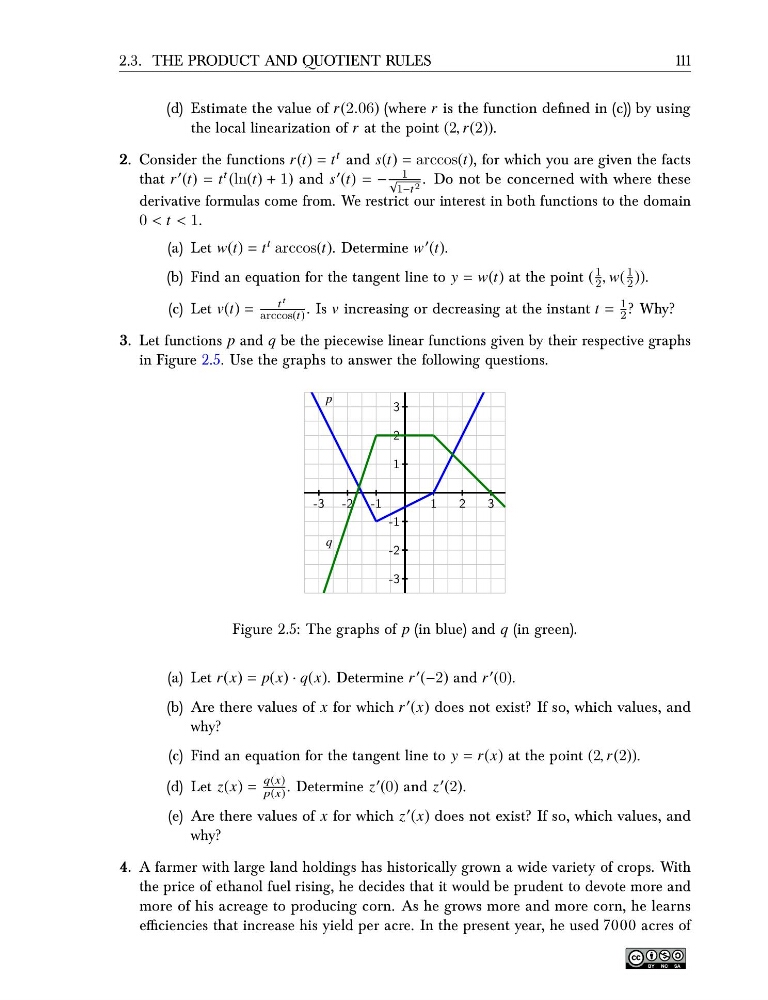
3. Let functions p and q be the piecewise linear functions given by their respective graphs
in Figure 2.5. Use the graphs to answer the following questions.
-3 -2 -1
1
2
3
-3
-2
-1
1
2
3
p
q
Figure 2.5: The graphs of p (in blue) and q (in green).
(a) Let r(x) = p(x) · q(x). Determine r ′ (−2) and r ′ (0).
(b) Are there values of x for which r ′ (x) does not exist? If so, which values, and
why?
(c) Find an equation for the tangent line to y = r(x) at the point (2, r(2)).
(d) Let z(x) =
q(x)
p(x) . Determine z ′ (0) and z ′ (2).
(e) Are there values of x for which z ′ (x) does not exist? If so, which values, and
why?
4. A farmer with large land holdings has historically grown a wide variety of crops. With
the price of ethanol fuel rising, he decides that it would be prudent to devote more and
more of his acreage to producing corn. As he grows more and more corn, he learns
efficiencies that increase his yield per acre. In the present year, he used 7000 acres of
111
(d) Estimate the value of r(2.06) (where r is the function defined in (c)) by using
the local linearization of r at the point (2, r(2)).
2. Consider the functions r(t) = t t and s(t) = arccos(t), for which you are given the facts
that r ′ (t) = t t (ln(t) + 1) and s ′ (t) = −
1
√
1−t 2 . Do not be concerned with where these
derivative formulas come from. We restrict our interest in both functions to the domain
0 < t < 1.
(a) Let w(t) = t t arccos(t). Determine w ′ (t).
(b) Find an equation for the tangent line to y = w(t) at the point (
1
2 , w(
1
2 )).
(c) Let v(t) =
t t
arccos(t) . Is v increasing or decreasing at the instant t =
1
2 ? Why?
3. Let functions p and q be the piecewise linear functions given by their respective graphs
in Figure 2.5. Use the graphs to answer the following questions.
-3 -2 -1
1
2
3
-3
-2
-1
1
2
3
p
q
Figure 2.5: The graphs of p (in blue) and q (in green).
(a) Let r(x) = p(x) · q(x). Determine r ′ (−2) and r ′ (0).
(b) Are there values of x for which r ′ (x) does not exist? If so, which values, and
why?
(c) Find an equation for the tangent line to y = r(x) at the point (2, r(2)).
(d) Let z(x) =
q(x)
p(x) . Determine z ′ (0) and z ′ (2).
(e) Are there values of x for which z ′ (x) does not exist? If so, which values, and
why?
4. A farmer with large land holdings has historically grown a wide variety of crops. With
the price of ethanol fuel rising, he decides that it would be prudent to devote more and
more of his acreage to producing corn. As he grows more and more corn, he learns
efficiencies that increase his yield per acre. In the present year, he used 7000 acres of