

2.2. THE SINE AND COSINE FUNCTIONS
101
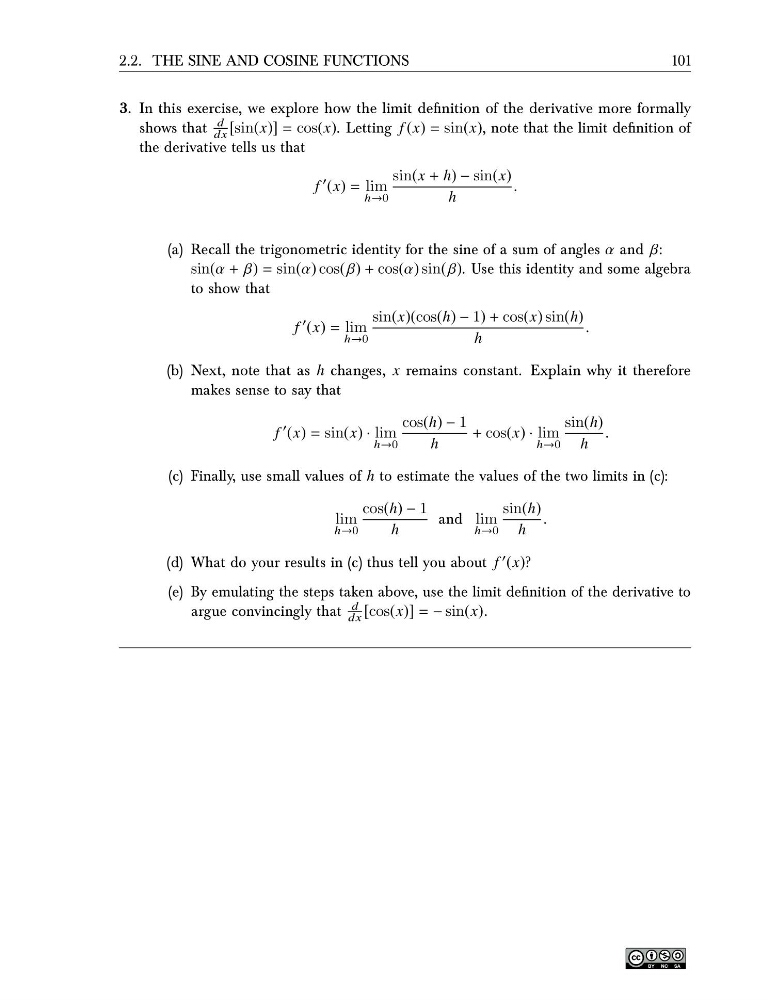
3. In this exercise, we explore how the limit definition of the derivative more formally
shows that
d
dx [sin(x)] = cos(x). Letting f (x) = sin(x), note that the limit definition of
the derivative tells us that
f
′ (x) = lim
h→0
sin(x + h) − sin(x)
h
.
(a) Recall the trigonometric identity for the sine of a sum of angles α and β:
sin(α + β) = sin(α) cos( β) + cos(α) sin( β). Use this identity and some algebra
to show that
f
′ (x) = lim
h→0
sin(x)(cos(h) − 1) + cos(x) sin(h)
h
.
(b) Next, note that as h changes, x remains constant. Explain why it therefore
makes sense to say that
f
′ (x) = sin(x) · lim
h→0
cos(h) − 1
h
+ cos(x) · lim
h→0
sin(h)
h
.
(c) Finally, use small values of h to estimate the values of the two limits in (c):
lim
h→0
cos(h) − 1
h
and lim
h→0
sin(h)
h
.
(d) What do your results in (c) thus tell you about f ′ (x)?
(e) By emulating the steps taken above, use the limit definition of the derivative to
argue convincingly that
d
dx [cos(x)] = − sin(x).
101
3. In this exercise, we explore how the limit definition of the derivative more formally
shows that
d
dx [sin(x)] = cos(x). Letting f (x) = sin(x), note that the limit definition of
the derivative tells us that
f
′ (x) = lim
h→0
sin(x + h) − sin(x)
h
.
(a) Recall the trigonometric identity for the sine of a sum of angles α and β:
sin(α + β) = sin(α) cos( β) + cos(α) sin( β). Use this identity and some algebra
to show that
f
′ (x) = lim
h→0
sin(x)(cos(h) − 1) + cos(x) sin(h)
h
.
(b) Next, note that as h changes, x remains constant. Explain why it therefore
makes sense to say that
f
′ (x) = sin(x) · lim
h→0
cos(h) − 1
h
+ cos(x) · lim
h→0
sin(h)
h
.
(c) Finally, use small values of h to estimate the values of the two limits in (c):
lim
h→0
cos(h) − 1
h
and lim
h→0
sin(h)
h
.
(d) What do your results in (c) thus tell you about f ′ (x)?
(e) By emulating the steps taken above, use the limit definition of the derivative to
argue convincingly that
d
dx [cos(x)] = − sin(x).