

84
1.8. THE TANGENT LINE APPROXIMATION
(a) What are the values of p(3) and p ′ (3)? Why?
(b) Estimate the value of p(2.79).
(c) Suppose that p ′′ (3) = 0 and you know that p ′′ (x) < 0 for x < 3. Is your
estimate in (b) too large or too small?
(d) Suppose that p ′′ (x) > 0 for x > 3. Use this fact and the additional information
above to sketch an accurate graph of y = p(x) near x = 3. Include a sketch of
y = L(x) in your work.
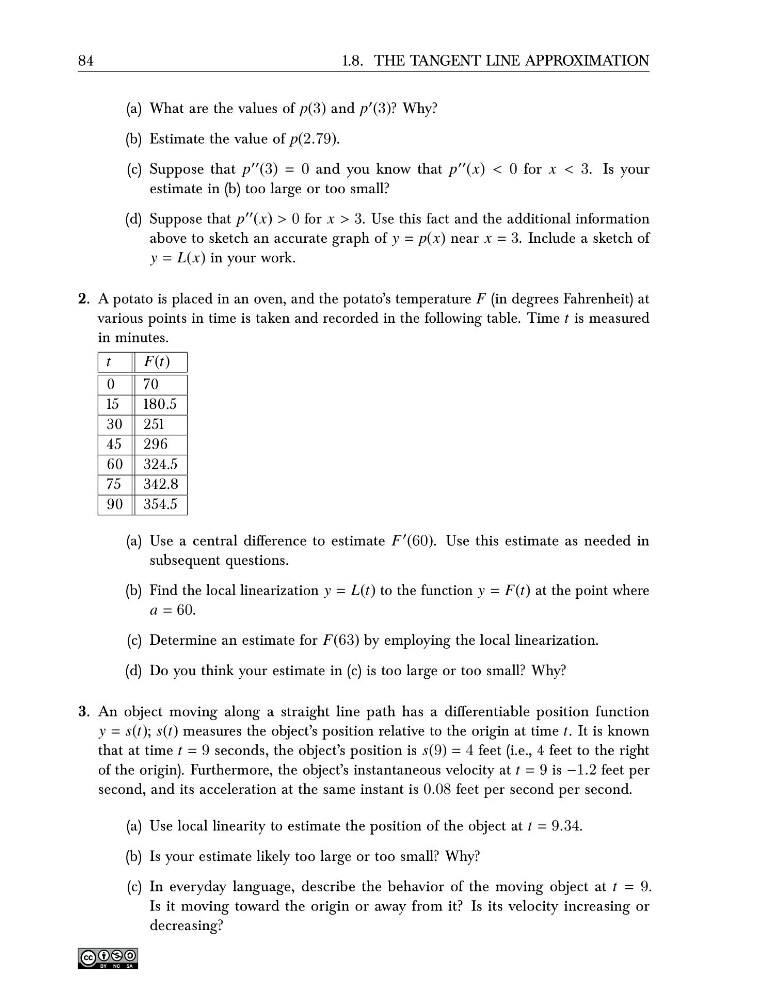
2. A potato is placed in an oven, and the potato’s temperature F (in degrees Fahrenheit) at
various points in time is taken and recorded in the following table. Time t is measured
in minutes.
t
F(t)
0
70
15
180.5
30 251
45 296
60 324.5
75 342.8
90 354.5
(a) Use a central difference to estimate F ′ (60). Use this estimate as needed in
subsequent questions.
(b) Find the local linearization y = L(t) to the function y = F(t) at the point where
a = 60.
(c) Determine an estimate for F(63) by employing the local linearization.
(d) Do you think your estimate in (c) is too large or too small? Why?
3. An object moving along a straight line path has a differentiable position function
y = s(t); s(t) measures the object’s position relative to the origin at time t. It is known
that at time t = 9 seconds, the object’s position is s(9) = 4 feet (i.e., 4 feet to the right
of the origin). Furthermore, the object’s instantaneous velocity at t = 9 is −1.2 feet per
second, and its acceleration at the same instant is 0.08 feet per second per second.
(a) Use local linearity to estimate the position of the object at t = 9.34.
(b) Is your estimate likely too large or too small? Why?
(c) In everyday language, describe the behavior of the moving object at t = 9.
Is it moving toward the origin or away from it? Is its velocity increasing or
decreasing?
1.8. THE TANGENT LINE APPROXIMATION
(a) What are the values of p(3) and p ′ (3)? Why?
(b) Estimate the value of p(2.79).
(c) Suppose that p ′′ (3) = 0 and you know that p ′′ (x) < 0 for x < 3. Is your
estimate in (b) too large or too small?
(d) Suppose that p ′′ (x) > 0 for x > 3. Use this fact and the additional information
above to sketch an accurate graph of y = p(x) near x = 3. Include a sketch of
y = L(x) in your work.
2. A potato is placed in an oven, and the potato’s temperature F (in degrees Fahrenheit) at
various points in time is taken and recorded in the following table. Time t is measured
in minutes.
t
F(t)
0
70
15
180.5
30 251
45 296
60 324.5
75 342.8
90 354.5
(a) Use a central difference to estimate F ′ (60). Use this estimate as needed in
subsequent questions.
(b) Find the local linearization y = L(t) to the function y = F(t) at the point where
a = 60.
(c) Determine an estimate for F(63) by employing the local linearization.
(d) Do you think your estimate in (c) is too large or too small? Why?
3. An object moving along a straight line path has a differentiable position function
y = s(t); s(t) measures the object’s position relative to the origin at time t. It is known
that at time t = 9 seconds, the object’s position is s(9) = 4 feet (i.e., 4 feet to the right
of the origin). Furthermore, the object’s instantaneous velocity at t = 9 is −1.2 feet per
second, and its acceleration at the same instant is 0.08 feet per second per second.
(a) Use local linearity to estimate the position of the object at t = 9.34.
(b) Is your estimate likely too large or too small? Why?
(c) In everyday language, describe the behavior of the moving object at t = 9.
Is it moving toward the origin or away from it? Is its velocity increasing or
decreasing?