

86
GAUGE FIELDS AND STRINGS
-► S^. It is known that such maps can be classified by integers q
which define the number of times the second sphere is covered by the
first one. The simplest example of the g-map is described by the
formulas:
»9 = x%(p = qcp (mod 2n)
(6.2)
Here (S, (p) and (5,
are polar and azimuthal angles for the first and
the second sphere. In this formula q must be integer since otherwise the
map would be discontinuous. For the general case the number of
coverings (or topological charge) is defined by:
R = 4n
d(p
HQ •
dd sin S —- — -
(p)
(6.3)
(5(3, (p)/5(3, (p) = ( d 9 / d 9 ) ( d ( p / d ( p ) — ( d § / d ( p ) ( d ( p / d ( p ) is the Jacobian for
the mapping under consideration). It is easy to check that (6.3) can be
rewritten in a more invariant form. For the mapping n = n{x), /i^ = 1:
^
d^xn‘ld^nd,n]e^
(6.4)
Here
is the standard antisymmetric tensor. This formula is checked
by the direct substitution of n = (cos 3, sin 3 cos
sin 3 sin 0) into
(6.4) after which we obtain (6.3). We wish now to minimize the classical
action in the sector with given q. This problem is simplified by the
following trick. Let us consider the identity:
(5^/1 +
X 5v/i])^ d^x
(d^n)^ d^x -
X d ^ n ] d ^ x
(6.5)
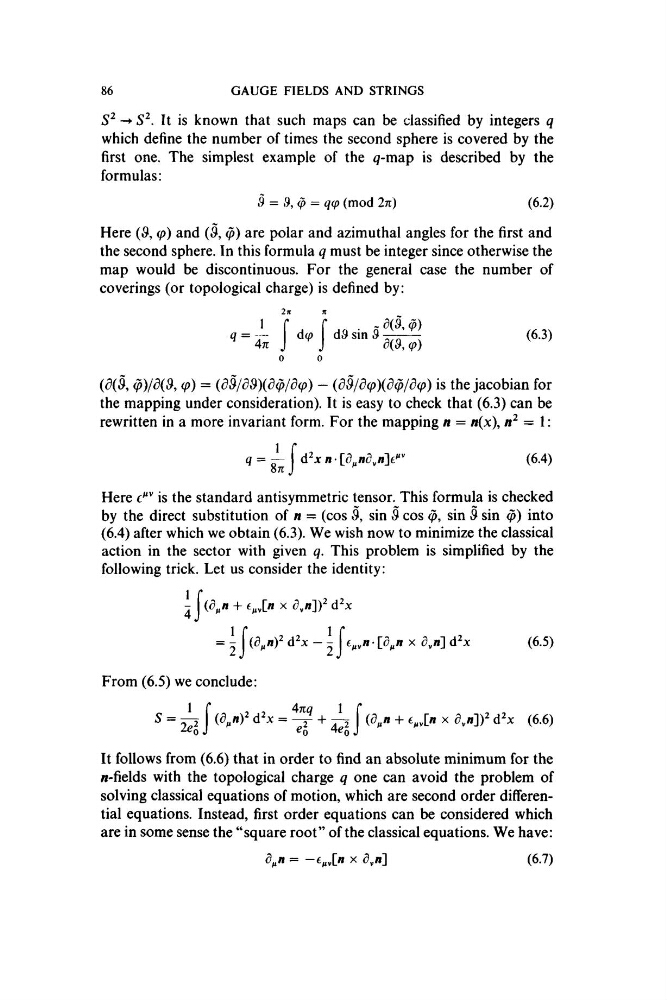
From (6.5) we conclude:
(d.ny d^x = ^ +
(d^n + 6^^[/i X d^n]y d^x (6.6)
It follows from (6.6) that in order to find an absolute minimum for the
/i-fields with the topological charge q one can avoid the problem of
solving classical equations of motion, which are second order differential equations. Instead, first order equations can be considered which
are in some sense the “square root” of the classical equations. We have:
d^n = -¿In X d^n]
(6.7)
GAUGE FIELDS AND STRINGS
-► S^. It is known that such maps can be classified by integers q
which define the number of times the second sphere is covered by the
first one. The simplest example of the g-map is described by the
formulas:
»9 = x%(p = qcp (mod 2n)
(6.2)
Here (S, (p) and (5,
are polar and azimuthal angles for the first and
the second sphere. In this formula q must be integer since otherwise the
map would be discontinuous. For the general case the number of
coverings (or topological charge) is defined by:
R = 4n
d(p
HQ •
dd sin S —- — -
(p)
(6.3)
(5(3, (p)/5(3, (p) = ( d 9 / d 9 ) ( d ( p / d ( p ) — ( d § / d ( p ) ( d ( p / d ( p ) is the Jacobian for
the mapping under consideration). It is easy to check that (6.3) can be
rewritten in a more invariant form. For the mapping n = n{x), /i^ = 1:
^
d^xn‘ld^nd,n]e^
(6.4)
Here
is the standard antisymmetric tensor. This formula is checked
by the direct substitution of n = (cos 3, sin 3 cos
sin 3 sin 0) into
(6.4) after which we obtain (6.3). We wish now to minimize the classical
action in the sector with given q. This problem is simplified by the
following trick. Let us consider the identity:
(5^/1 +
X 5v/i])^ d^x
(d^n)^ d^x -
X d ^ n ] d ^ x
(6.5)
From (6.5) we conclude:
(d.ny d^x = ^ +
(d^n + 6^^[/i X d^n]y d^x (6.6)
It follows from (6.6) that in order to find an absolute minimum for the
/i-fields with the topological charge q one can avoid the problem of
solving classical equations of motion, which are second order differential equations. Instead, first order equations can be considered which
are in some sense the “square root” of the classical equations. We have:
d^n = -¿In X d^n]
(6.7)