

84
GAUGE FIELDS AND STRINGS
After melting we have fi = 0. All these nontrivial constants, k, Ps, p, etc.,
can be called, following V. L. Berezinsky, transverse rigidities. They can
be formally defined as residues at the massless poles of corresponding
polarization operators and therefore exist only in the broken symmetry
phase. A subtle point is that, as we mentioned in Chapter 1, in the case
of gauge systems, and in ^ = 2 global systems, the order parameters are
zero and there are no poles in the Green’s functions. However, there are
poles in the corresponding polarization operators and it is these poles
which determine the physics of the systems.
In Non-Abelian cases with global symmetries it is quite straightforward to introduce an analogue of the superfluid density. If we take,
for instance, the case of the /i-field we can examine its response to an
external triplet vector field:
e -
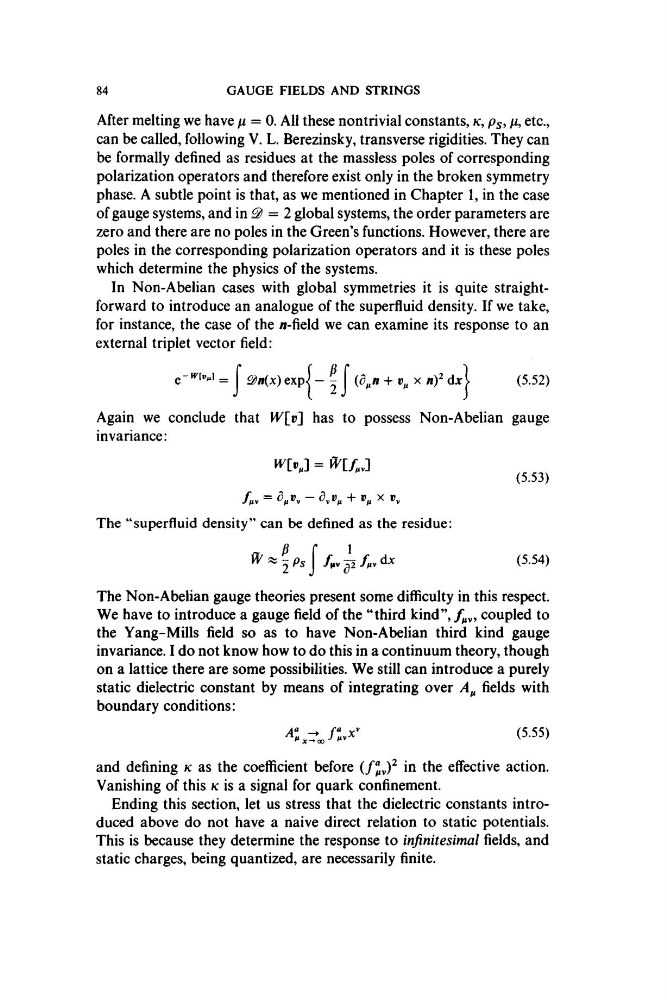
= j &n(x) e x p | (d^n + v^ x nf dx:| (5.52)
Again we conclude that W[y)] has to possess Non-Abelian gauge
invariance:
fnv —
The “ superfluid d en sity” can be defined as the residue:
W : ; Ps
Í
1
ffiv dx
(5.53)
(5.54)
The Non-Abelian gauge theories present some difficulty in this respect.
We have to introduce a gauge field of the “third kind”,/^^, coupled to
the Yang-Mills field so as to have Non-Abelian third kind gauge
invariance. I do not know how to do this in a continuum theory, though
on a lattice there are some possibilities. We still can introduce a purely
static dielectric constant by means of integrating over
fields with
boundary conditions:
(5.55)
and defining k as the coefficient before (/"v)^ in the effective action.
Vanishing of this k is a signal for quark confinement.
Ending this section, let us stress that the dielectric constants introduced above do not have a naive direct relation to static potentials.
This is because they determine the response to infinitesimal fields, and
static charges, being quantized, are necessarily finite.
GAUGE FIELDS AND STRINGS
After melting we have fi = 0. All these nontrivial constants, k, Ps, p, etc.,
can be called, following V. L. Berezinsky, transverse rigidities. They can
be formally defined as residues at the massless poles of corresponding
polarization operators and therefore exist only in the broken symmetry
phase. A subtle point is that, as we mentioned in Chapter 1, in the case
of gauge systems, and in ^ = 2 global systems, the order parameters are
zero and there are no poles in the Green’s functions. However, there are
poles in the corresponding polarization operators and it is these poles
which determine the physics of the systems.
In Non-Abelian cases with global symmetries it is quite straightforward to introduce an analogue of the superfluid density. If we take,
for instance, the case of the /i-field we can examine its response to an
external triplet vector field:
e -
= j &n(x) e x p | (d^n + v^ x nf dx:| (5.52)
Again we conclude that W[y)] has to possess Non-Abelian gauge
invariance:
fnv —
The “ superfluid d en sity” can be defined as the residue:
W : ; Ps
Í
1
ffiv dx
(5.53)
(5.54)
The Non-Abelian gauge theories present some difficulty in this respect.
We have to introduce a gauge field of the “third kind”,/^^, coupled to
the Yang-Mills field so as to have Non-Abelian third kind gauge
invariance. I do not know how to do this in a continuum theory, though
on a lattice there are some possibilities. We still can introduce a purely
static dielectric constant by means of integrating over
fields with
boundary conditions:
(5.55)
and defining k as the coefficient before (/"v)^ in the effective action.
Vanishing of this k is a signal for quark confinement.
Ending this section, let us stress that the dielectric constants introduced above do not have a naive direct relation to static potentials.
This is because they determine the response to infinitesimal fields, and
static charges, being quantized, are necessarily finite.