

QUARK CONFINEMENT
81
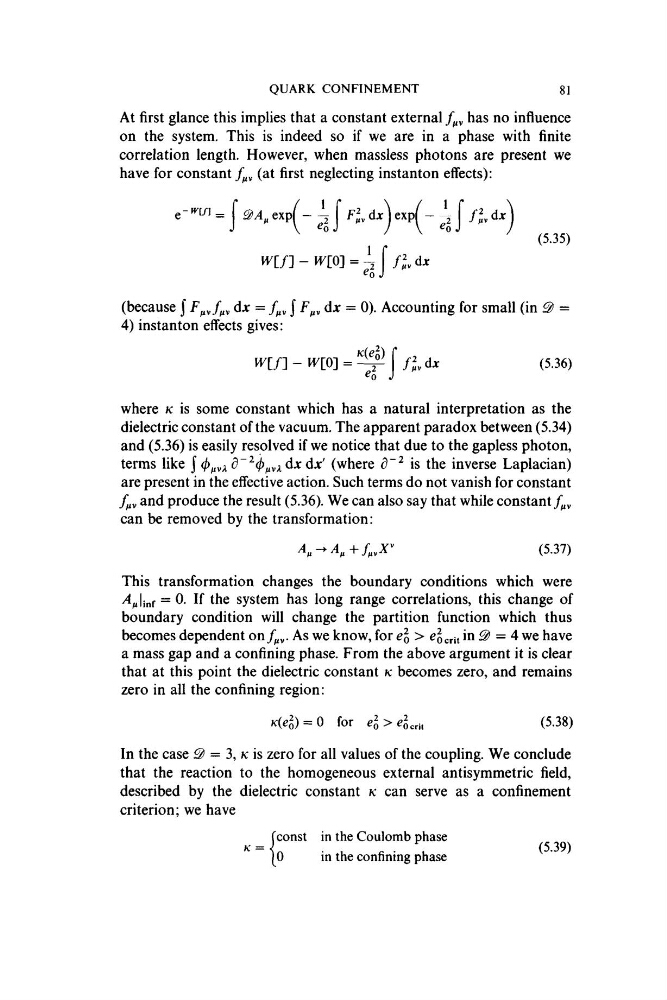
At first glance this implies that a constant external
has no influence
on the system. This is indeed so if we are in a phase with finite
correlation length. However, when massless photons are present we
have for constant
(at first neglecting instanton effects):
.-mn
exp|
d x
fl.dx
w in - w^[o] =
fi.dx
(5.35)
(because j
dx =
J
dx = 0). Accounting for small (in ,
4) instanton effects gives:
^ U i
K(ei)
IF[0] =
/¿V dx
(5.36)
where k is some constant which has a natural interpretation as the
dielectric constant of the vacuum. The apparent paradox between (5.34)
and (5.36) is easily resolved if we notice that due to the gapless photon,
terms like j (¡)^^;^d~^(l)^^;^dx dx' (where 5“ ^ is the inverse Laplacian)
are present in the effective action. Such terms do not vanish for constant
and produce the result (5.36). We can also say that while constant
can be removed by the transformation:
(5.37)
This transformation changes the boundary conditions which were
If the system has long range correlations, this change of
boundary condition will change the partition function which thus
becomes dependent on
As we know, for > ^ocrit in ^ = 4 we have
a mass gap and a confining phase. From the above argument it is clear
that at this point the dielectric constant k becomes zero, and remains
zero in all the confining region:
K{el) = 0 for el > e^rit
(5.38)
In the case ^ = 3, fc is zero for all values of the coupling. We conclude
that the reaction to the homogeneous external antisymmetric field,
described by the dielectric constant k can serve as a confinement
criterion; we have
[const in the Coulomb phase
| 0
in the confining phase
(5.39)
81
At first glance this implies that a constant external
has no influence
on the system. This is indeed so if we are in a phase with finite
correlation length. However, when massless photons are present we
have for constant
(at first neglecting instanton effects):
.-mn
exp|
d x
fl.dx
w in - w^[o] =
fi.dx
(5.35)
(because j
dx =
J
dx = 0). Accounting for small (in ,
4) instanton effects gives:
^ U i
K(ei)
IF[0] =
/¿V dx
(5.36)
where k is some constant which has a natural interpretation as the
dielectric constant of the vacuum. The apparent paradox between (5.34)
and (5.36) is easily resolved if we notice that due to the gapless photon,
terms like j (¡)^^;^d~^(l)^^;^dx dx' (where 5“ ^ is the inverse Laplacian)
are present in the effective action. Such terms do not vanish for constant
and produce the result (5.36). We can also say that while constant
can be removed by the transformation:
(5.37)
This transformation changes the boundary conditions which were
If the system has long range correlations, this change of
boundary condition will change the partition function which thus
becomes dependent on
As we know, for > ^ocrit in ^ = 4 we have
a mass gap and a confining phase. From the above argument it is clear
that at this point the dielectric constant k becomes zero, and remains
zero in all the confining region:
K{el) = 0 for el > e^rit
(5.38)
In the case ^ = 3, fc is zero for all values of the coupling. We conclude
that the reaction to the homogeneous external antisymmetric field,
described by the dielectric constant k can serve as a confinement
criterion; we have
[const in the Coulomb phase
| 0
in the confining phase
(5.39)