

CHAPTER 5
Quark Confinement, Superfluidity,
Elasticity. Criteria and Analogies
In the previous chapter we were mainly interested in the influence of
instantons on the mass gap. Here we shall present more direct criteria
for confinement by computation of the electric force between charges
and the dielectric permeability of the vacuum. We shall also stress
analogies with some phenomena in solid state physics.
Let us begin from the general expression for the static potential valid
in both the Abelian and the Non-Abelian cases. The main idea is the
following. We have seen in Chapter 3 that the eigenstates of a gauge
Hamiltonian can be divided into sectors, containing static charges at
points jCi,...,
with colour spins (for the SU(2) group as an example)
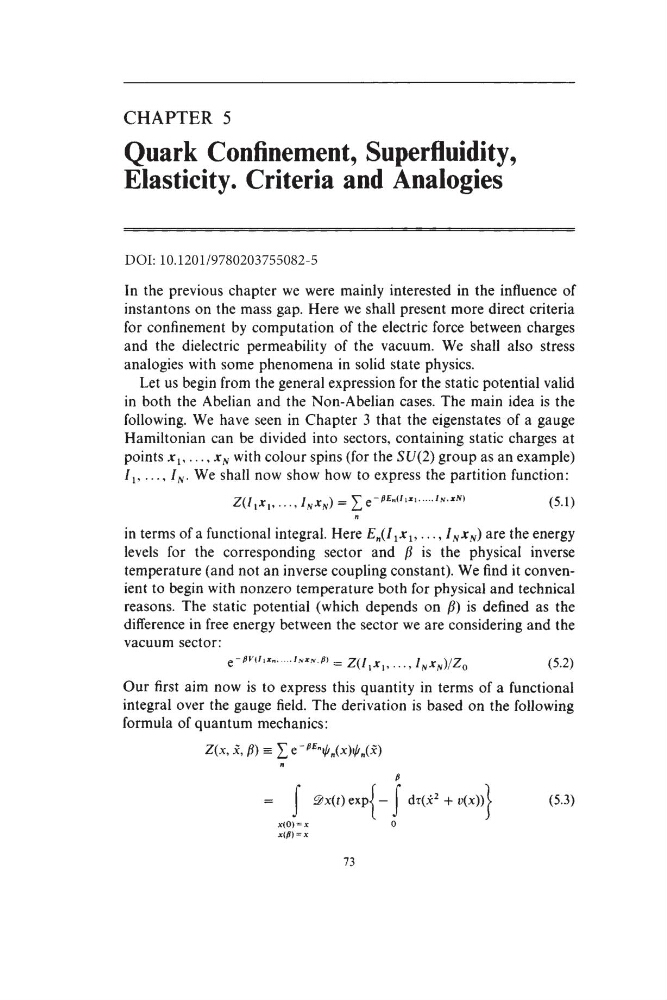
/i, ..., /^. We shall now show how to express the partition function:
,In,xN )
(5.1)
in terms of a functional integral. Here
...,
are the energy
levels for the corresponding sector and
is the physical inverse
temperature (and not an inverse coupling constant). We find it convenient to begin with nonzero temperature both for physical and technical
reasons. The static potential (which depends on p) is defined as the
difference in free energy between the sector we are considering and the
vacuum sector:
....= Z(/,JC„ ..., /^jcJ/Zo
(5.2)
Our first aim now is to express this quantity in terms of a functional
integral over the gauge field. The derivation is based on the following
formula of quantum mechanics :
Z(x, X,
^ x (0 exp
x(0) = x
x (f i ) = x
P
i
d r(x ^ -I- r(x ))
(5.3)
73
DOI: 10.1201/9780203755082-5
Quark Confinement, Superfluidity,
Elasticity. Criteria and Analogies
In the previous chapter we were mainly interested in the influence of
instantons on the mass gap. Here we shall present more direct criteria
for confinement by computation of the electric force between charges
and the dielectric permeability of the vacuum. We shall also stress
analogies with some phenomena in solid state physics.
Let us begin from the general expression for the static potential valid
in both the Abelian and the Non-Abelian cases. The main idea is the
following. We have seen in Chapter 3 that the eigenstates of a gauge
Hamiltonian can be divided into sectors, containing static charges at
points jCi,...,
with colour spins (for the SU(2) group as an example)
/i, ..., /^. We shall now show how to express the partition function:
,In,xN )
(5.1)
in terms of a functional integral. Here
...,
are the energy
levels for the corresponding sector and
is the physical inverse
temperature (and not an inverse coupling constant). We find it convenient to begin with nonzero temperature both for physical and technical
reasons. The static potential (which depends on p) is defined as the
difference in free energy between the sector we are considering and the
vacuum sector:
....= Z(/,JC„ ..., /^jcJ/Zo
(5.2)
Our first aim now is to express this quantity in terms of a functional
integral over the gauge field. The derivation is based on the following
formula of quantum mechanics :
Z(x, X,
^ x (0 exp
x(0) = x
x (f i ) = x
P
i
d r(x ^ -I- r(x ))
(5.3)
73
DOI: 10.1201/9780203755082-5