

60
GAUGE FIELDS AND STRINGS
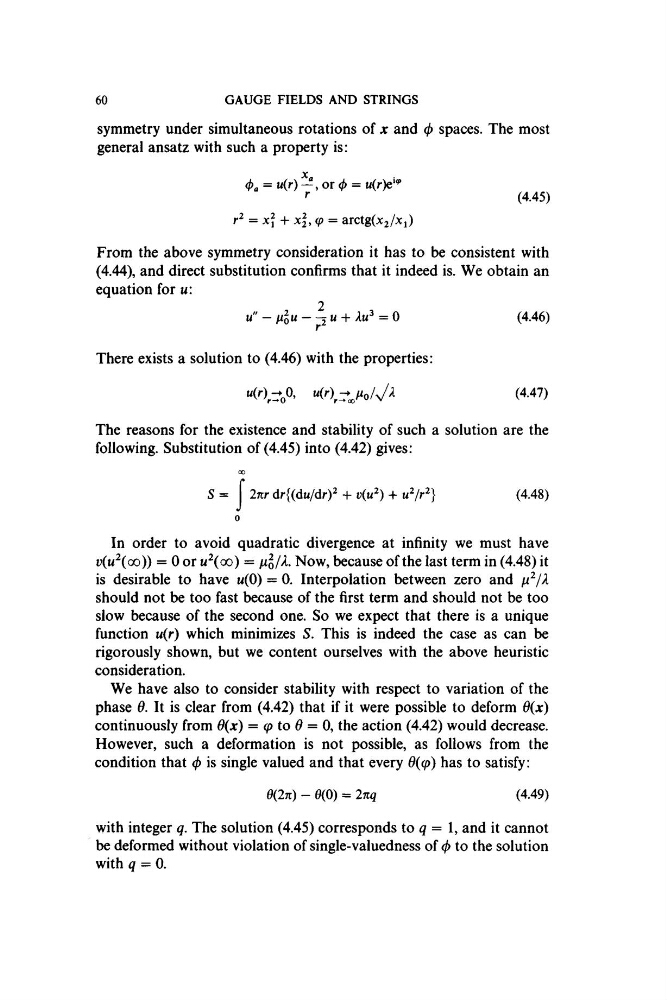
symmetry under simultaneous rotations of x and 0 spaces. The most
general ansatz with such a property is:
0a = w (r )y ,o r 0 = u(r)Q^^
= x j
x j , (p = arctg(x2/xj)
(4.45)
From the above symmetry consideration it has to be consistent with
(4.44), and direct substitution confirms that it indeed is. We obtain an
equation for u:
u" — fllu ---- 2 ^
~ ^
There exists a solution to (4.46) with the properties:
(4.46)
(4.47)
The reasons for the existence and stability of such a solution are the
following. Substitution of (4.45) into (4.42) gives:
S =
27rr dr{(du/dr)^ -f v{u^) + u^r^}
(4.48)
In order to avoid quadratic divergence at infinity we must have
v(u\oo)) = 0 or M^(oo) = jUoM- Now, because of the last term in (4.48) it
is desirable to have u(0) = 0. Interpolation between zero and
should not be too fast because of the first term and should not be too
slow because of the second one. So we expect that there is a unique
function u(r) which minimizes S. This is indeed the case as can be
rigorously shown, but we content ourselves with the above heuristic
consideration.
We have also to consider stability with respect to variation of the
phase 9. It is clear from (4.42) that if it were possible to deform 0(jc)
continuously from 9(x) = q > to 6 = 0, the action (4.42) would decrease.
However, such a deformation is not possible, as follows from the
condition that 0 is single valued and that every 6(q)) has to satisfy:
e(2n) - 6(0) = 2nq
(4.49)
with integer q. The solution (4.45) corresponds to q = 1, and it cannot
be deformed without violation of single-valuedness of 0 to the solution
with ^ = 0.
GAUGE FIELDS AND STRINGS
symmetry under simultaneous rotations of x and 0 spaces. The most
general ansatz with such a property is:
0a = w (r )y ,o r 0 = u(r)Q^^
= x j
x j , (p = arctg(x2/xj)
(4.45)
From the above symmetry consideration it has to be consistent with
(4.44), and direct substitution confirms that it indeed is. We obtain an
equation for u:
u" — fllu ---- 2 ^
~ ^
There exists a solution to (4.46) with the properties:
(4.46)
(4.47)
The reasons for the existence and stability of such a solution are the
following. Substitution of (4.45) into (4.42) gives:
S =
27rr dr{(du/dr)^ -f v{u^) + u^r^}
(4.48)
In order to avoid quadratic divergence at infinity we must have
v(u\oo)) = 0 or M^(oo) = jUoM- Now, because of the last term in (4.48) it
is desirable to have u(0) = 0. Interpolation between zero and
should not be too fast because of the first term and should not be too
slow because of the second one. So we expect that there is a unique
function u(r) which minimizes S. This is indeed the case as can be
rigorously shown, but we content ourselves with the above heuristic
consideration.
We have also to consider stability with respect to variation of the
phase 9. It is clear from (4.42) that if it were possible to deform 0(jc)
continuously from 9(x) = q > to 6 = 0, the action (4.42) would decrease.
However, such a deformation is not possible, as follows from the
condition that 0 is single valued and that every 6(q)) has to satisfy:
e(2n) - 6(0) = 2nq
(4.49)
with integer q. The solution (4.45) corresponds to q = 1, and it cannot
be deformed without violation of single-valuedness of 0 to the solution
with ^ = 0.