

THE STRONG COUPLING EXPANSION
39
Therefore, as in the Ising case, we have an elementary excitation with
energy depending on quasimomentum. The gap is nonzero in any finite
order in PiPo- However, again we expect a phase transition to occur.
Let us clarify the nature of the large
phase. While for small
we
had an almost decoupled set of rotators, for large P^Pq all these rotators
are tightly bound. If we consider them as something like a rigid body,
then the excitation spectrum will be
E = L^/2I
(3.25)
where L = Y,yly is the total angular momentum and / is the moment of
inertia. In the tightly bound phase we should have I ^ N where N is the
number of rotators. If the rotators are weakly coupled, then / ^ 1 (each
one rotates separately). The phase transition in PqP^ corresponds to the
change between these two regimes. In the small P^Pq phase we have a
gap in the spectrum and in the large P^Pq phase the gap is absent (as
N oo). In the next chapter we shall explore this phase transition in
more detail.
The Non-Abelian case in the strong coupling region is not much
different from the above. We have (in the case of the n-field) the
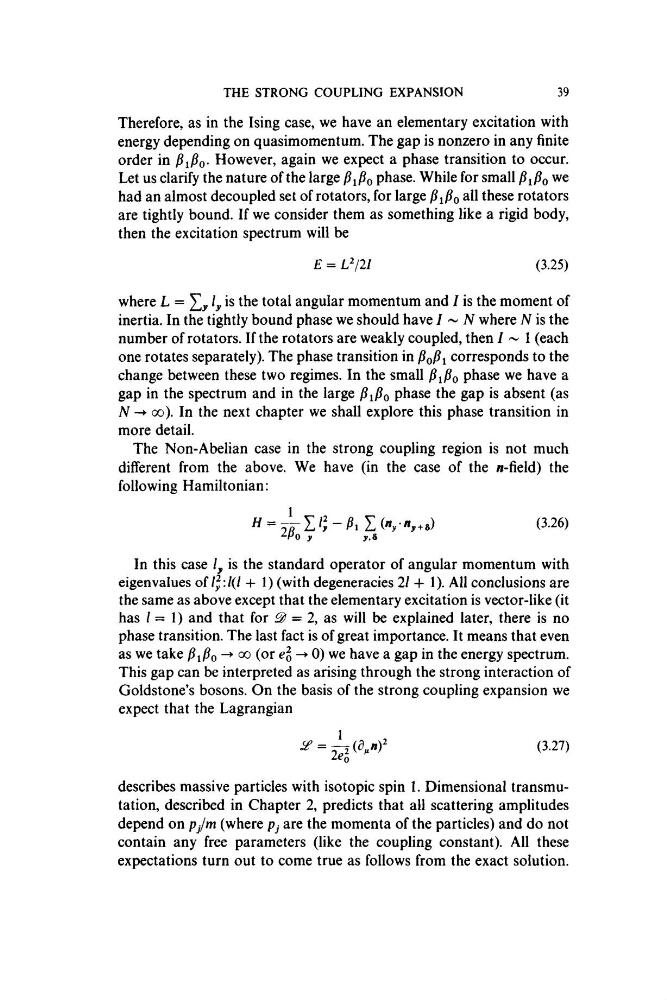
following Hamiltonian:
^Po y
y,&
(3.26)
In this case ly is the standard operator of angular momentum with
eigenvalues of /^ :/(/ -h 1) (with degeneracies 21 -h 1). All conclusions are
the same as above except that the elementary excitation is vector-like (it
has / = 1) and that for ^ = 2, as will be explained later, there is no
phase transition. The last fact is of great importance. It means that even
as we take P^Pq-^ co (ov e l 0) we have a gap in the energy spectrum.
This gap can be interpreted as arising through the strong interaction of
Goldstone’s bosons. On the basis of the strong coupling expansion we
expect that the Lagrangian
(3.27)
describes massive particles with isotopic spin 1. Dimensional transmutation, described in Chapter 2, predicts that all scattering amplitudes
depend on pj/m (where pj are the momenta of the particles) and do not
contain any free parameters (like the coupling constant). All these
expectations turn out to come true as follows from the exact solution.
39
Therefore, as in the Ising case, we have an elementary excitation with
energy depending on quasimomentum. The gap is nonzero in any finite
order in PiPo- However, again we expect a phase transition to occur.
Let us clarify the nature of the large
phase. While for small
we
had an almost decoupled set of rotators, for large P^Pq all these rotators
are tightly bound. If we consider them as something like a rigid body,
then the excitation spectrum will be
E = L^/2I
(3.25)
where L = Y,yly is the total angular momentum and / is the moment of
inertia. In the tightly bound phase we should have I ^ N where N is the
number of rotators. If the rotators are weakly coupled, then / ^ 1 (each
one rotates separately). The phase transition in PqP^ corresponds to the
change between these two regimes. In the small P^Pq phase we have a
gap in the spectrum and in the large P^Pq phase the gap is absent (as
N oo). In the next chapter we shall explore this phase transition in
more detail.
The Non-Abelian case in the strong coupling region is not much
different from the above. We have (in the case of the n-field) the
following Hamiltonian:
^Po y
y,&
(3.26)
In this case ly is the standard operator of angular momentum with
eigenvalues of /^ :/(/ -h 1) (with degeneracies 21 -h 1). All conclusions are
the same as above except that the elementary excitation is vector-like (it
has / = 1) and that for ^ = 2, as will be explained later, there is no
phase transition. The last fact is of great importance. It means that even
as we take P^Pq-^ co (ov e l 0) we have a gap in the energy spectrum.
This gap can be interpreted as arising through the strong interaction of
Goldstone’s bosons. On the basis of the strong coupling expansion we
expect that the Lagrangian
(3.27)
describes massive particles with isotopic spin 1. Dimensional transmutation, described in Chapter 2, predicts that all scattering amplitudes
depend on pj/m (where pj are the momenta of the particles) and do not
contain any free parameters (like the coupling constant). All these
expectations turn out to come true as follows from the exact solution.