

THE STRONG COUPLING EXPANSION
3.2 Continuous Global Symmetry
37
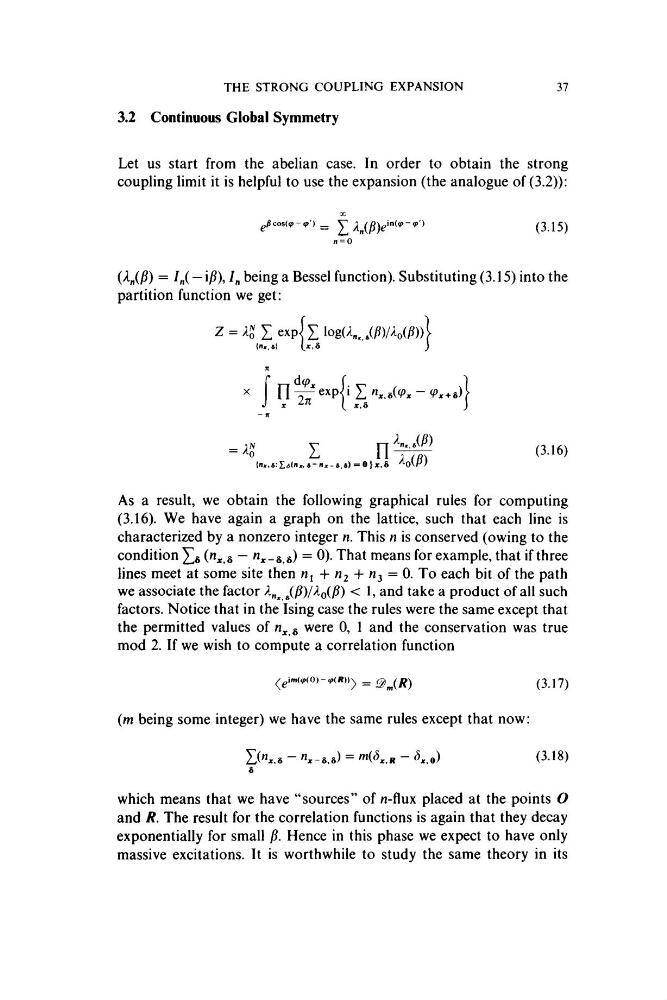
Let us start from the abelian case. In order to obtain the strong
coupling limit it is helpful to use the expansion (the analogue of (3.2)):
cos( I W '
n((p-(p')
(3.15)
(2„(jS) = /„( —i)?), /„ being a Bessel function). Substituting (3.15) into the
partition function we get:
Z = 4 X exp-} X log(/l„.,.(^)Mo(^))
{«x,ô}
n ^ exp-Ji X
— Aq
E
{nx,8:I<5(/ix, 8n
'nx-8,8) = 0}x,6 ^ o i P )
(3.16)
As a result, we obtain the following graphical rules for computing
(3.16). We have again a graph on the lattice, such that each line is
characterized by a nonzero integer n. This n is conserved (owing to the
condition Y,6 (”x,8 ~
= ^)- That means for example, that if three
lines meet at some site then
+ ri2
= 0. To each bit of the path
we associate the factor
< T and take a product of all such
factors. Notice that in the Ising case the rules were the same except that
the permitted values of
were 0, 1 and the conservation was true
mod 2. If we wish to compute a correlation function
^^im «p(0)-cp(R))y _
(3
(m being some integer) we have the same rules except that now:
Z("x,a
6
(3.18)
which means that we have “sources” of n-flux placed at the points O
and R. The result for the correlation functions is again that they decay
exponentially for small jS. Hence in this phase we expect to have only
massive excitations. It is worthwhile to study the same theory in its
3.2 Continuous Global Symmetry
37
Let us start from the abelian case. In order to obtain the strong
coupling limit it is helpful to use the expansion (the analogue of (3.2)):
cos( I W '
n((p-(p')
(3.15)
(2„(jS) = /„( —i)?), /„ being a Bessel function). Substituting (3.15) into the
partition function we get:
Z = 4 X exp-} X log(/l„.,.(^)Mo(^))
{«x,ô}
n ^ exp-Ji X
— Aq
E
{nx,8:I<5(/ix, 8n
'nx-8,8) = 0}x,6 ^ o i P )
(3.16)
As a result, we obtain the following graphical rules for computing
(3.16). We have again a graph on the lattice, such that each line is
characterized by a nonzero integer n. This n is conserved (owing to the
condition Y,6 (”x,8 ~
= ^)- That means for example, that if three
lines meet at some site then
+ ri2
= 0. To each bit of the path
we associate the factor
< T and take a product of all such
factors. Notice that in the Ising case the rules were the same except that
the permitted values of
were 0, 1 and the conservation was true
mod 2. If we wish to compute a correlation function
^^im «p(0)-cp(R))y _
(3
(m being some integer) we have the same rules except that now:
Z("x,a
6
(3.18)
which means that we have “sources” of n-flux placed at the points O
and R. The result for the correlation functions is again that they decay
exponentially for small jS. Hence in this phase we expect to have only
massive excitations. It is worthwhile to study the same theory in its