

30
GAUGE FIELDS AND STRINGS
orthogonal to ajf \ i.e. for which
Tr
d^x = 0
Since w is arbitrary, we find that
must satisfy:
= 0
(2.57)
(2.58)
This is the analogue of the Lorentz gauge of QED. A more convenient
gauge for us will be the Feynman gauge which corresponds to adding
the term (V^a;^)^ directly to (2.55) (thus cancelling the last term in this
expression). As is well known one has to augment the gauge-fixing term
with the ghost determinant which in the case of the Feynman and
Lorentz gauges is just Det(V^). The net result is:
^{A) = ^ -Sci(A) i
Det(V^)
X exp^^Tr | ((V^a.r + 2F^, •
^v]) d^x
(2.59)
The meaning of each of the terms in (2.59) is very transparent. If it were
not for the term
u J , we would have just four independent fields
integration over which gives [D e f ^/^(V^)]^ This is multiplied by
the Det(V^) thus resulting in [Det" ^^^(V^)]^. This result implies that we
have not four but two physical polarizations for the field which is as
it should be. The role of the ghost determinant is seen to take care of
this cancellation of the two unphysical polarizations. The last term in
(2.59) describes the interaction of the external field
with the spin of
the gluons a^. So we can say that we have, first of all, two kinds of
charged particles moving in the external magnetic field
This results
in Landau diamagnetism (interaction of the magnetic field with the
orbital motion) which we shall compute in a moment. Alone, this effect
would give the screening of effective charge known as “zero charge”.
However we also have the direct interaction of F^^ with the spin, which
gives rise to Pauli paramagnetism. This effect turns out (as we shall see
below) to be stronger then the first one and as a consequence we end up
with the asymptotically free situation.
To within logarithmic accuracy the two above mentioned effects can
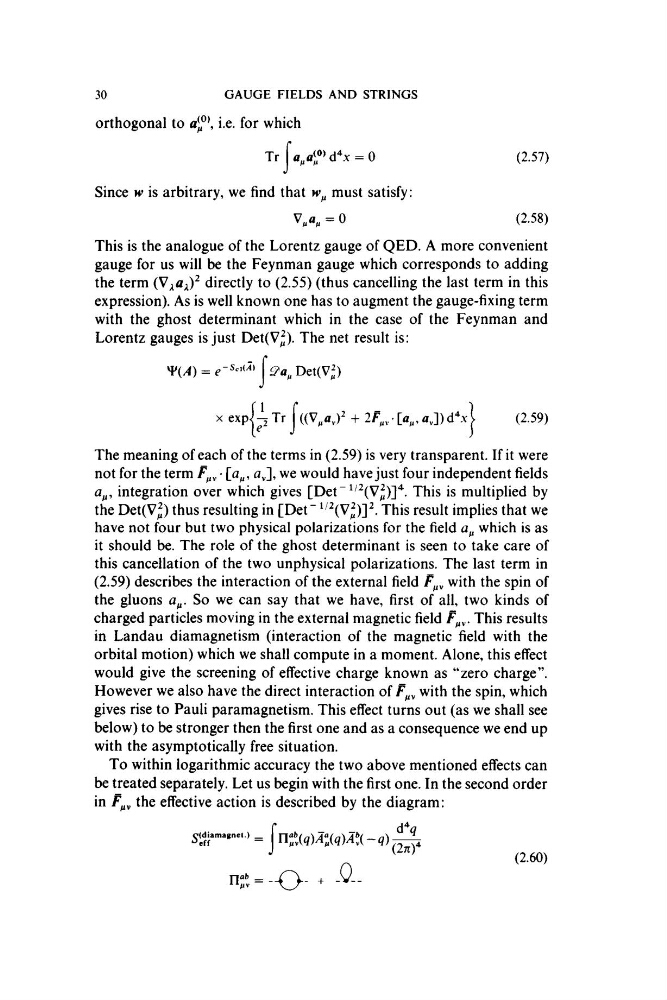
be treated separately. Let us begin with the first one. In the second order
in
the effective action is described by the diagram:
^(diam agnet.) _ ni>:(q)AHq)A':(-q)
Qn)*
n “ - o -
. a
(2.60)
GAUGE FIELDS AND STRINGS
orthogonal to ajf \ i.e. for which
Tr
d^x = 0
Since w is arbitrary, we find that
must satisfy:
= 0
(2.57)
(2.58)
This is the analogue of the Lorentz gauge of QED. A more convenient
gauge for us will be the Feynman gauge which corresponds to adding
the term (V^a;^)^ directly to (2.55) (thus cancelling the last term in this
expression). As is well known one has to augment the gauge-fixing term
with the ghost determinant which in the case of the Feynman and
Lorentz gauges is just Det(V^). The net result is:
^{A) = ^ -Sci(A) i
Det(V^)
X exp^^Tr | ((V^a.r + 2F^, •
^v]) d^x
(2.59)
The meaning of each of the terms in (2.59) is very transparent. If it were
not for the term
u J , we would have just four independent fields
integration over which gives [D e f ^/^(V^)]^ This is multiplied by
the Det(V^) thus resulting in [Det" ^^^(V^)]^. This result implies that we
have not four but two physical polarizations for the field which is as
it should be. The role of the ghost determinant is seen to take care of
this cancellation of the two unphysical polarizations. The last term in
(2.59) describes the interaction of the external field
with the spin of
the gluons a^. So we can say that we have, first of all, two kinds of
charged particles moving in the external magnetic field
This results
in Landau diamagnetism (interaction of the magnetic field with the
orbital motion) which we shall compute in a moment. Alone, this effect
would give the screening of effective charge known as “zero charge”.
However we also have the direct interaction of F^^ with the spin, which
gives rise to Pauli paramagnetism. This effect turns out (as we shall see
below) to be stronger then the first one and as a consequence we end up
with the asymptotically free situation.
To within logarithmic accuracy the two above mentioned effects can
be treated separately. Let us begin with the first one. In the second order
in
the effective action is described by the diagram:
^(diam agnet.) _ ni>:(q)AHq)A':(-q)
Qn)*
n “ - o -
. a
(2.60)