

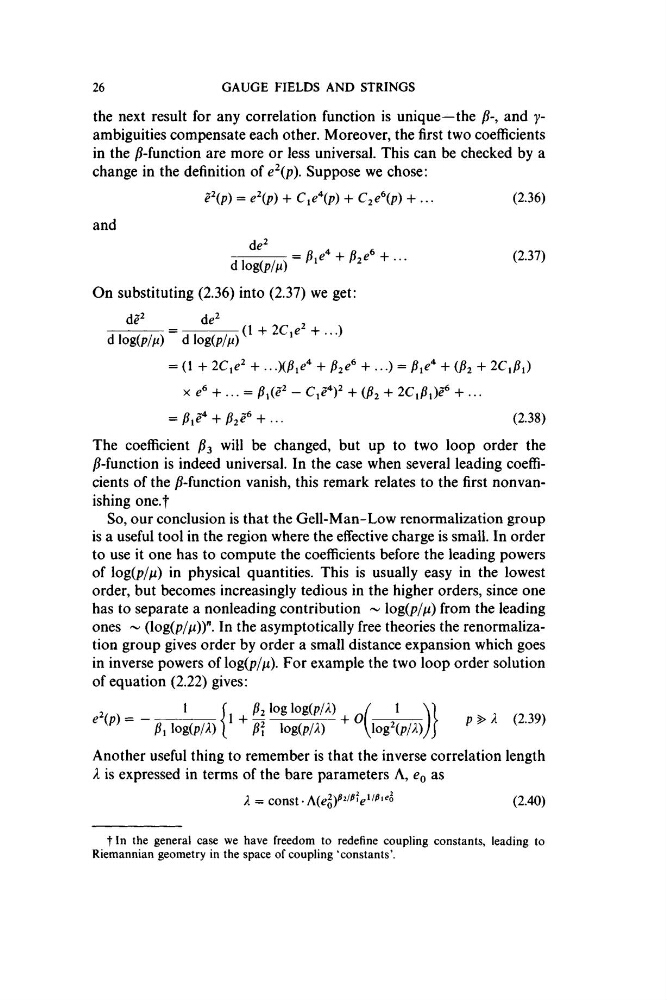
26
GAUGE FIELDS AND STRINGS
the next result for any correlation function is unique—the jS-, and yambiguities compensate each other. Moreover, the first two coefficients
in the j9-function are more or less universal. This can be checked by a
change in the definition of e^{p). Suppose we chose:
e\p) = e\p) + C,e\p) + C^e\p) + ...
and
d Xogipjp)
=
+ ^2^^ + ••
(2.36)
(2.37)
On substituting (2.36) into (2.37) we get:
de^
de^
2
d log(p///) d log(p/p)
= (1 + 2Ci^2 + ..
+
+ ,..) =
+ 2CJ,)
X
+ ... = p,(e^ -
+ (^2 + 2 C,P,)e^ + ...
= P,t-\-P2e^ + ...
(2.38)
The coefficient JS3 will be changed, but up to two loop order the
j?-function is indeed universal. In the case when several leading coefficients of the ^-function vanish, this remark relates to the first nonvanishing one.f
So, our conclusion is that the Gell-Man-Low renormalization group
is a useful tool in the region where the effective charge is small. In order
to use it one has to compute the coefficients before the leading powers
of log(p/p) in physical quantities. This is usually easy in the lowest
order, but becomes increasingly tedious in the higher orders, since one
has to separate a nonleading contribution
log(p/p) from the leading
ones ^ (log(p/p))". In the asymptotically free theories the renormalization group gives order by order a small distance expansion which goes
in inverse powers of log(p/p). For example the two loop order solution
of equation (2.22) gives:
eHp) = -
1
log l o g y ) ^
)?, \og(p/A) I
Pi log(p/A)
1
\og\p/A)
p> X (2.39)
Another useful thing to remember is that the inverse correlation length
A is expressed in terms of the bare parameters A, C q as
A = const • A(Co)^^^^‘c^^^‘^o
(2.40)
t In the general case we have freedom to redefine coupling constants, leading to
Riemannian geometry in the space of coupling ‘constants’.
GAUGE FIELDS AND STRINGS
the next result for any correlation function is unique—the jS-, and yambiguities compensate each other. Moreover, the first two coefficients
in the j9-function are more or less universal. This can be checked by a
change in the definition of e^{p). Suppose we chose:
e\p) = e\p) + C,e\p) + C^e\p) + ...
and
d Xogipjp)
=
+ ^2^^ + ••
(2.36)
(2.37)
On substituting (2.36) into (2.37) we get:
de^
de^
2
d log(p///) d log(p/p)
= (1 + 2Ci^2 + ..
+
+ ,..) =
+ 2CJ,)
X
+ ... = p,(e^ -
+ (^2 + 2 C,P,)e^ + ...
= P,t-\-P2e^ + ...
(2.38)
The coefficient JS3 will be changed, but up to two loop order the
j?-function is indeed universal. In the case when several leading coefficients of the ^-function vanish, this remark relates to the first nonvanishing one.f
So, our conclusion is that the Gell-Man-Low renormalization group
is a useful tool in the region where the effective charge is small. In order
to use it one has to compute the coefficients before the leading powers
of log(p/p) in physical quantities. This is usually easy in the lowest
order, but becomes increasingly tedious in the higher orders, since one
has to separate a nonleading contribution
log(p/p) from the leading
ones ^ (log(p/p))". In the asymptotically free theories the renormalization group gives order by order a small distance expansion which goes
in inverse powers of log(p/p). For example the two loop order solution
of equation (2.22) gives:
eHp) = -
1
log l o g y ) ^
)?, \og(p/A) I
Pi log(p/A)
1
\og\p/A)
p> X (2.39)
Another useful thing to remember is that the inverse correlation length
A is expressed in terms of the bare parameters A, C q as
A = const • A(Co)^^^^‘c^^^‘^o
(2.40)
t In the general case we have freedom to redefine coupling constants, leading to
Riemannian geometry in the space of coupling ‘constants’.