

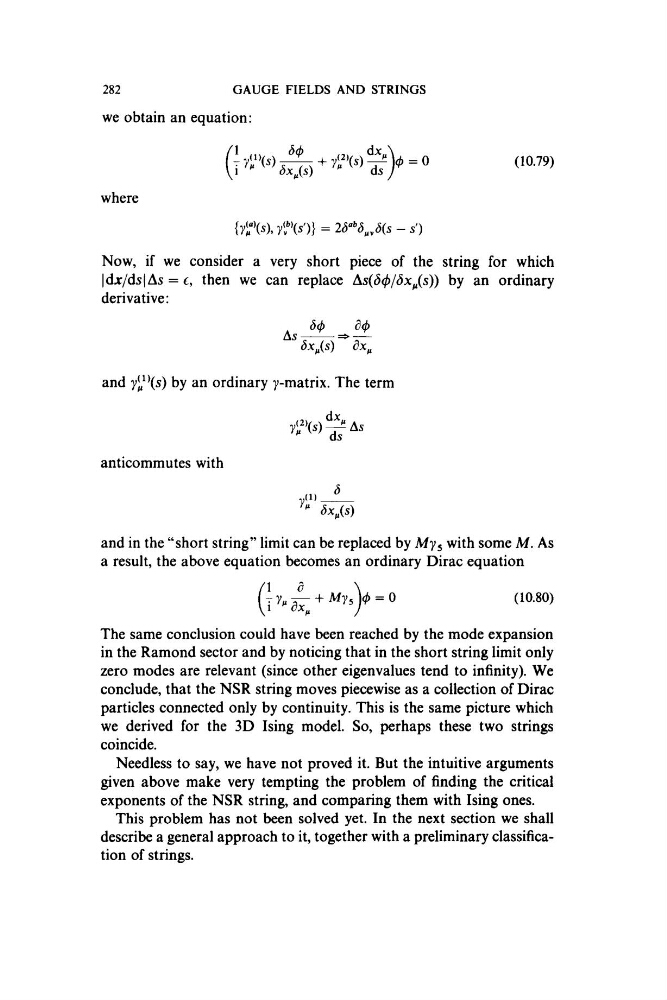
we obtain an equation:
282
GAUGE FIELDS AND STRINGS
(10.79)
where
{y[%Xy^^\sl} = 2S^%^S{s-s')
Now, if we consider a very short piece of the string for which
|dx/ds|As = 6, then we can replace As(50/(5x^(s)) by an ordinary
derivative:
As
0
Sx^(s) dx^
and y]^\s) by an ordinary y-matrix. The term
anticommutes with
y<‘’ SxJs)
and in the “short string” limit can be replaced by My^ with some M. As
a result, the above equation becomes an ordinary Dirac equation
y = o
(10.80)
The same conclusion could have been reached by the mode expansion
in the Ramond sector and by noticing that in the short string limit only
zero modes are relevant (since other eigenvalues tend to infinity). We
conclude, that the NSR string moves piecewise as a collection of Dirac
particles connected only by continuity. This is the same picture which
we derived for the 3D Ising model. So, perhaps these two strings
coincide.
Needless to say, we have not proved it. But the intuitive arguments
given above make very tempting the problem of finding the critical
exponents of the NSR string, and comparing them with Ising ones.
This problem has not been solved yet. In the next section we shall
describe a general approach to it, together with a preliminary classification of strings.
282
GAUGE FIELDS AND STRINGS
(10.79)
where
{y[%Xy^^\sl} = 2S^%^S{s-s')
Now, if we consider a very short piece of the string for which
|dx/ds|As = 6, then we can replace As(50/(5x^(s)) by an ordinary
derivative:
As
0
Sx^(s) dx^
and y]^\s) by an ordinary y-matrix. The term
anticommutes with
y<‘’ SxJs)
and in the “short string” limit can be replaced by My^ with some M. As
a result, the above equation becomes an ordinary Dirac equation
y = o
(10.80)
The same conclusion could have been reached by the mode expansion
in the Ramond sector and by noticing that in the short string limit only
zero modes are relevant (since other eigenvalues tend to infinity). We
conclude, that the NSR string moves piecewise as a collection of Dirac
particles connected only by continuity. This is the same picture which
we derived for the 3D Ising model. So, perhaps these two strings
coincide.
Needless to say, we have not proved it. But the intuitive arguments
given above make very tempting the problem of finding the critical
exponents of the NSR string, and comparing them with Ising ones.
This problem has not been solved yet. In the next section we shall
describe a general approach to it, together with a preliminary classification of strings.