

STATISTICAL MECHANICS AND QUANTUM FIELD THEORY
17
(where V is the volume of our system), all of which is quite analogous to
what we have in the case (1.49) and (1.51). If ^ = 4, then for large P we
have the theory of free photons. We see that these photons are in some
sense Goldstone fields associated with gauge invariance, although this
gauge invariance is never strictly broken. As we decrease )?, at some
we shall have a phase transition due to instanton effects. For P < P^ the
theory will contain only massive excitations. For ^ = 3 the situation is
even more interesting. It will be shown that in this case nonperturbative
effects extinguish the photons for all P and we have only one, massive
phase. Therefore, the formal continuum limit (1.51) for ^ = 3 has
nothing to do with reality. This is just one of many examples in which
owing to quantum corrections the effective Lagrangian differs drastically from the classical one.
It remains to say here that for ^ = 2 the gauge model is trivial and
for ^ > 4 it presumably has a first order phase transition.
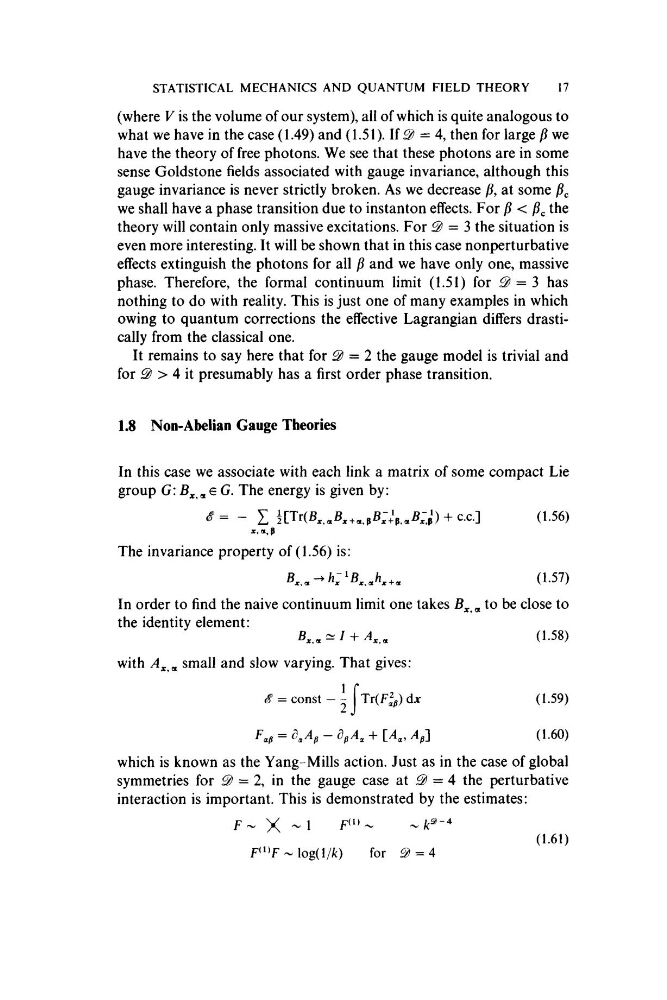
1.8 Non-Abelian Gauge Theories
In this case we associate with each link a matrix of some compact Lie
group
The energy is given by:
(1.56)
= -
Z
+ C.C.]
X, a , p
The invariance property of (1.56) is:
B, ■K
(1.57)
In order to find the naive continuum limit one takes
, to be close to
the identity element:
B , . , ^ I +
(1.58)
with
small and slow varying. That gives:
= const - ^ Tr(ff^) dx
(1.59)
+ lA,, A^-]
(1.60)
which is known as the Yang-Mills action. Just as in the case of global
symmetries for ^ = 2, in the gauge case at ^ = 4 the perturbative
interaction is important. This is demonstrated by the estimates:
f ^ X ~ 1
T"* ~
~
f*"F ~ log(lA )
for & = 4
( 1.61)
17
(where V is the volume of our system), all of which is quite analogous to
what we have in the case (1.49) and (1.51). If ^ = 4, then for large P we
have the theory of free photons. We see that these photons are in some
sense Goldstone fields associated with gauge invariance, although this
gauge invariance is never strictly broken. As we decrease )?, at some
we shall have a phase transition due to instanton effects. For P < P^ the
theory will contain only massive excitations. For ^ = 3 the situation is
even more interesting. It will be shown that in this case nonperturbative
effects extinguish the photons for all P and we have only one, massive
phase. Therefore, the formal continuum limit (1.51) for ^ = 3 has
nothing to do with reality. This is just one of many examples in which
owing to quantum corrections the effective Lagrangian differs drastically from the classical one.
It remains to say here that for ^ = 2 the gauge model is trivial and
for ^ > 4 it presumably has a first order phase transition.
1.8 Non-Abelian Gauge Theories
In this case we associate with each link a matrix of some compact Lie
group
The energy is given by:
(1.56)
= -
Z
+ C.C.]
X, a , p
The invariance property of (1.56) is:
B, ■K
(1.57)
In order to find the naive continuum limit one takes
, to be close to
the identity element:
B , . , ^ I +
(1.58)
with
small and slow varying. That gives:
= const - ^ Tr(ff^) dx
(1.59)
+ lA,, A^-]
(1.60)
which is known as the Yang-Mills action. Just as in the case of global
symmetries for ^ = 2, in the gauge case at ^ = 4 the perturbative
interaction is important. This is demonstrated by the estimates:
f ^ X ~ 1
T"* ~
~
f*"F ~ log(lA )
for & = 4
( 1.61)