

264
GAUGE FIELDS AND STRINGS
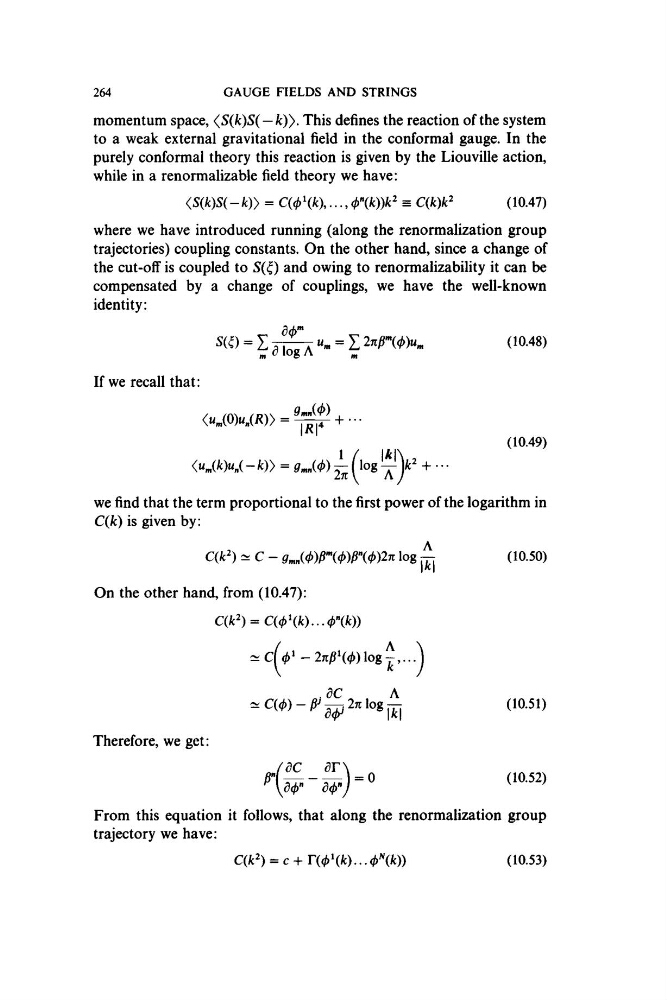
momentum space,. This defines the reaction of the system
to a weak external gravitational field in the conformal gauge. In the
purely conformal theory this reaction is given by the Liouville action,
while in a renormalizable field theory we have:
(S(k)S(-k)} = C{(t)\kl..., (t>\k))e = C(k)k^
(10.47)
where we have introduced running (along the renormalization group
trajectories) coupling constants. On the other hand, since a change of
the cut-off is coupled to S(0 and owing to renormalizability it can be
compensated by a change of couplings, we have the well-known
identity:
(10.48)
If we recall that:
<«„(0KW> = ^
+ -
) ^ flog + • ■ •
(10.49)
we find that the term proportional to the first power of the logarithm in
C(k) is given by:
C(fe^) ^ C - gj,4>)n)ß\)2n log \k\
On the other hand, from (10.47):
C(e) = C(\k)...4,\k))
^c((l>^ -2nß^i)log
Therefore, we get:
. dC
A
. C ( 0 ) - ^ ^ ^ 2 . 1 o g -
0
(10.50)
(10.51)
(10.52)
From this equation it follows, that along the renormalization group
trajectory we have:
C(/c2) = c + r((l>\k)... (I>\k))
(10.53)
GAUGE FIELDS AND STRINGS
momentum space,
to a weak external gravitational field in the conformal gauge. In the
purely conformal theory this reaction is given by the Liouville action,
while in a renormalizable field theory we have:
(S(k)S(-k)} = C{(t)\kl..., (t>\k))e = C(k)k^
(10.47)
where we have introduced running (along the renormalization group
trajectories) coupling constants. On the other hand, since a change of
the cut-off is coupled to S(0 and owing to renormalizability it can be
compensated by a change of couplings, we have the well-known
identity:
(10.48)
If we recall that:
<«„(0KW> = ^
+ -
(10.49)
we find that the term proportional to the first power of the logarithm in
C(k) is given by:
C(fe^) ^ C - gj,4>)n
On the other hand, from (10.47):
C(e) = C(
^c((l>^ -2nß^i
Therefore, we get:
. dC
A
. C ( 0 ) - ^ ^ ^ 2 . 1 o g -
0
(10.50)
(10.51)
(10.52)
From this equation it follows, that along the renormalization group
trajectory we have:
C(/c2) = c + r((l>\k)... (I>\k))
(10.53)