

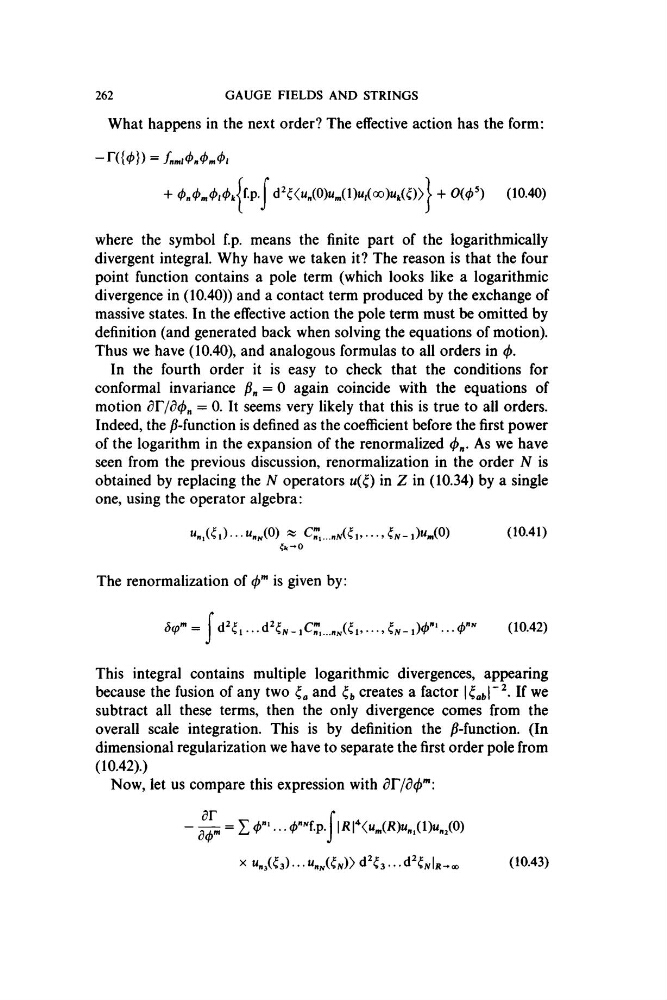
What happens in the next order? The effective action has the form:
262
GAUGE FIELDS AND STRINGS
d^i<«„(0)u M(cx)K(i)> ^ + 0(0^) (10.40)
where the symbol f.p. means the finite part of the logarithmically
divergent integral. Why have we taken it? The reason is that the four
point function contains a pole term (which looks like a logarithmic
divergence in (10.40)) and a contact term produced by the exchange of
massive states. In the effective action the pole term must be omitted by
definition (and generated back when solving the equations of motion).
Thus we have (10.40), and analogous formulas to all orders in (¡).
In the fourth order it is easy to check that the conditions for
conformal invariance P„ = 0 again coincide with the equations of
motion dr/d(f)„ = 0. It seems very likely that this is true to all orders.
Indeed, the )5-function is defined as the coefficient before the first power
of the logarithm in the expansion of the renormalized (¡)„. As we have
seen from the previous discussion, renormalization in the order N is
obtained by replacing the N operators u(^) in Z in (10.34) by a single
one, using the operator algebra:
^ C-..„^(ii,...,i^_0ti«(0)
(10.41)
The renormalization of
is given by:
=
)"*... r
(10.42)
This integral contains multiple logarithmic divergences, appearing
because the fusion of any two and creates a factor \iab\~^' If we
subtract all these terms, then the only divergence comes from the
overall scale integration. This is by definition the jS-function. (In
dimensional regularization we have to separate the first order pole from
(10.42).)
Now, let us compare this expression with
dr
0 ^
X kMî) ■ ■ •
(10.43)
262
GAUGE FIELDS AND STRINGS
d^i<«„(0)u M(cx)K(i)> ^ + 0(0^) (10.40)
where the symbol f.p. means the finite part of the logarithmically
divergent integral. Why have we taken it? The reason is that the four
point function contains a pole term (which looks like a logarithmic
divergence in (10.40)) and a contact term produced by the exchange of
massive states. In the effective action the pole term must be omitted by
definition (and generated back when solving the equations of motion).
Thus we have (10.40), and analogous formulas to all orders in (¡).
In the fourth order it is easy to check that the conditions for
conformal invariance P„ = 0 again coincide with the equations of
motion dr/d(f)„ = 0. It seems very likely that this is true to all orders.
Indeed, the )5-function is defined as the coefficient before the first power
of the logarithm in the expansion of the renormalized (¡)„. As we have
seen from the previous discussion, renormalization in the order N is
obtained by replacing the N operators u(^) in Z in (10.34) by a single
one, using the operator algebra:
^ C-..„^(ii,...,i^_0ti«(0)
(10.41)
The renormalization of
is given by:
=
)"*... r
(10.42)
This integral contains multiple logarithmic divergences, appearing
because the fusion of any two and creates a factor \iab\~^' If we
subtract all these terms, then the only divergence comes from the
overall scale integration. This is by definition the jS-function. (In
dimensional regularization we have to separate the first order pole from
(10.42).)
Now, let us compare this expression with
dr
0 ^
X kMî) ■ ■ •
(10.43)