

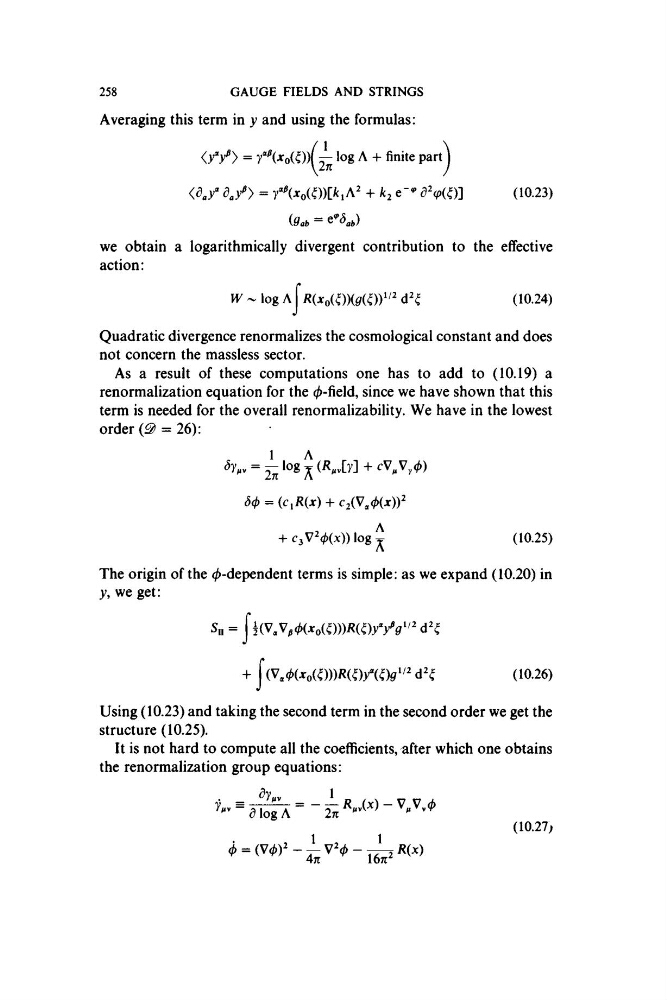
Averaging this term in y and using the formulas:
< / / > =
log ^ + finite part
<5«/ 8y> =
e-«- d^q>(m
(d a b —
258
GAUGE FIELDS AND STRINGS
(10.23)
we obtain a logarithmically divergent contribution to the effective
action:
IF - log A R(xo(mg(i)r^ d^i
(10.24)
Quadratic divergence renormalizes the cosmological constant and does
not concern the massless sector.
As a result of these computations one has to add to (10.19) a
renormalization equation for the 0-field, since we have shown that this
term is needed for the overall renormalizability. We have in the lowest
order ( ^ = 26):
^
^
Vy(/>)
S(t> = (c,R(x) + C2(VM x)y
-f C3VV(x)) log^
(10.25)
The origin of the ^-dependent terms is simple: as we expand (10.20) in
y, we get:
s„ = ji(V,V^0(Xo(i)))/?(O//3‘''
+ 1
d^i
(10.26)
Using (10.23) and taking the second term in the second order we get the
structure (10.25).
It is not hard to compute all the coefficients, after which one obtains
the renormalization group equations:
dy^
_ ^ifiv _
1
d log A
2n
(10.27;
< / / > =
log ^ + finite part
<5«/ 8y> =
e-«- d^q>(m
(d a b —
258
GAUGE FIELDS AND STRINGS
(10.23)
we obtain a logarithmically divergent contribution to the effective
action:
IF - log A R(xo(mg(i)r^ d^i
(10.24)
Quadratic divergence renormalizes the cosmological constant and does
not concern the massless sector.
As a result of these computations one has to add to (10.19) a
renormalization equation for the 0-field, since we have shown that this
term is needed for the overall renormalizability. We have in the lowest
order ( ^ = 26):
^
^
Vy(/>)
S(t> = (c,R(x) + C2(VM x)y
-f C3VV(x)) log^
(10.25)
The origin of the ^-dependent terms is simple: as we expand (10.20) in
y, we get:
s„ = ji(V,V^0(Xo(i)))/?(O//3‘''
+ 1
d^i
(10.26)
Using (10.23) and taking the second term in the second order we get the
structure (10.25).
It is not hard to compute all the coefficients, after which one obtains
the renormalization group equations:
dy^
_ ^ifiv _
1
d log A
2n
(10.27;