

QUANTUM STRINGS AND RANDOM SURFACES
251
Other words, we projected onto the sector even under
This
projection eliminated the tachyon with its vertex :(pjZ5)e‘^ *:; also it is
clearly self-consistent. But what is its true origin?
Let us discuss first, how to make this projection in terms of functional
integrals. If we are interested in the partition function:
Z = Tre"^"^® =
expl
^ •# d ad T Z^ (9.434)
(where
is the Neveu-Schwarz hamiltonian), then the integral in
(9.434) must be formulated on a torus, with time periodicity jS and space
periodicity 2n. The usual boundary conditions will be antiperiodic in
both directions; we have already explained that space antiperiodicity
implies consideration of NS-excitations, while the time antiperiodicity
is the standard thing needed for the description of the partition
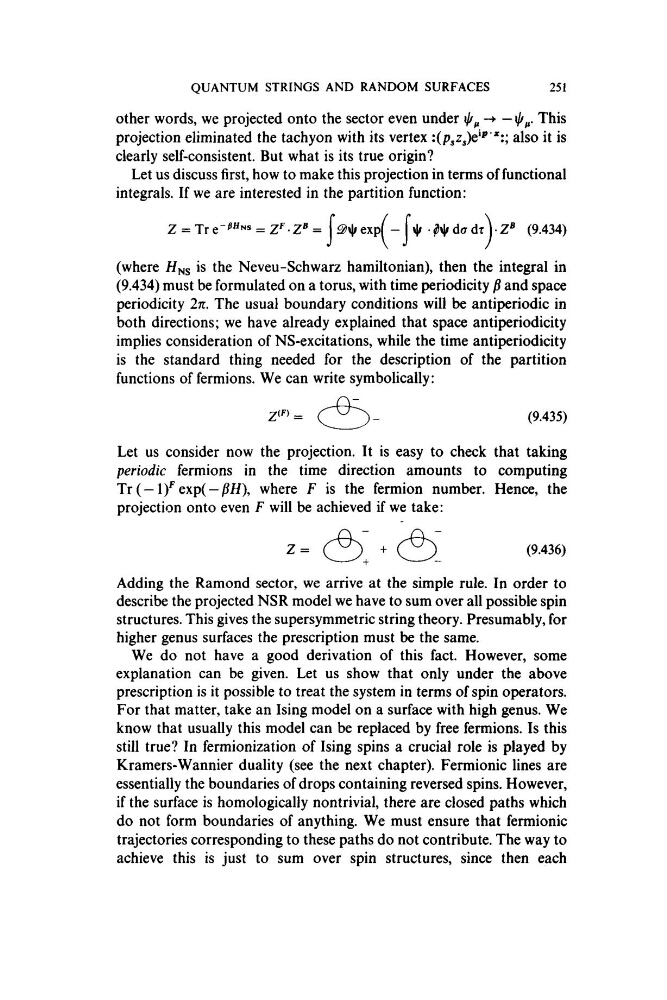
functions of fermions. We can write symbolically:
Z(U = c ^ -
(9.435)
Let us consider now the projection. It is easy to check that taking
periodic fermions in the time direction amounts to computing
T r ( —1)^exp( —jSH), where F is the fermion number. Hence, the
projection onto even F will be achieved if we take:
A *
(9.436)
Adding the Ramond sector, we arrive at the simple rule. In order to
describe the projected NSR model we have to sum over all possible spin
structures. This gives the supersymmetric string theory. Presumably, for
higher genus surfaces the prescription must be the same.
We do not have a good derivation of this fact. However, some
explanation can be given. Let us show that only under the above
prescription is it possible to treat the system in terms of spin operators.
For that matter, take an Ising model on a surface with high genus. We
know that usually this model can be replaced by free fermions. Is this
still true? In fermionization of Ising spins a crucial role is played by
Kramers-Wannier duality (see the next chapter). Fermionic lines are
essentially the boundaries of drops containing reversed spins. However,
if the surface is homologically nontrivial, there are closed paths which
do not form boundaries of anything. We must ensure that fermionic
trajectories corresponding to these paths do not contribute. The way to
achieve this is just to sum over spin structures, since then each
251
Other words, we projected onto the sector even under
This
projection eliminated the tachyon with its vertex :(pjZ5)e‘^ *:; also it is
clearly self-consistent. But what is its true origin?
Let us discuss first, how to make this projection in terms of functional
integrals. If we are interested in the partition function:
Z = Tre"^"^® =
expl
^ •# d ad T Z^ (9.434)
(where
is the Neveu-Schwarz hamiltonian), then the integral in
(9.434) must be formulated on a torus, with time periodicity jS and space
periodicity 2n. The usual boundary conditions will be antiperiodic in
both directions; we have already explained that space antiperiodicity
implies consideration of NS-excitations, while the time antiperiodicity
is the standard thing needed for the description of the partition
functions of fermions. We can write symbolically:
Z(U = c ^ -
(9.435)
Let us consider now the projection. It is easy to check that taking
periodic fermions in the time direction amounts to computing
T r ( —1)^exp( —jSH), where F is the fermion number. Hence, the
projection onto even F will be achieved if we take:
A *
(9.436)
Adding the Ramond sector, we arrive at the simple rule. In order to
describe the projected NSR model we have to sum over all possible spin
structures. This gives the supersymmetric string theory. Presumably, for
higher genus surfaces the prescription must be the same.
We do not have a good derivation of this fact. However, some
explanation can be given. Let us show that only under the above
prescription is it possible to treat the system in terms of spin operators.
For that matter, take an Ising model on a surface with high genus. We
know that usually this model can be replaced by free fermions. Is this
still true? In fermionization of Ising spins a crucial role is played by
Kramers-Wannier duality (see the next chapter). Fermionic lines are
essentially the boundaries of drops containing reversed spins. However,
if the surface is homologically nontrivial, there are closed paths which
do not form boundaries of anything. We must ensure that fermionic
trajectories corresponding to these paths do not contribute. The way to
achieve this is just to sum over spin structures, since then each