

QUANTUM STRINGS AND RANDOM SURFACES
249
We see that the role of spin operators is to shift us from half-integer
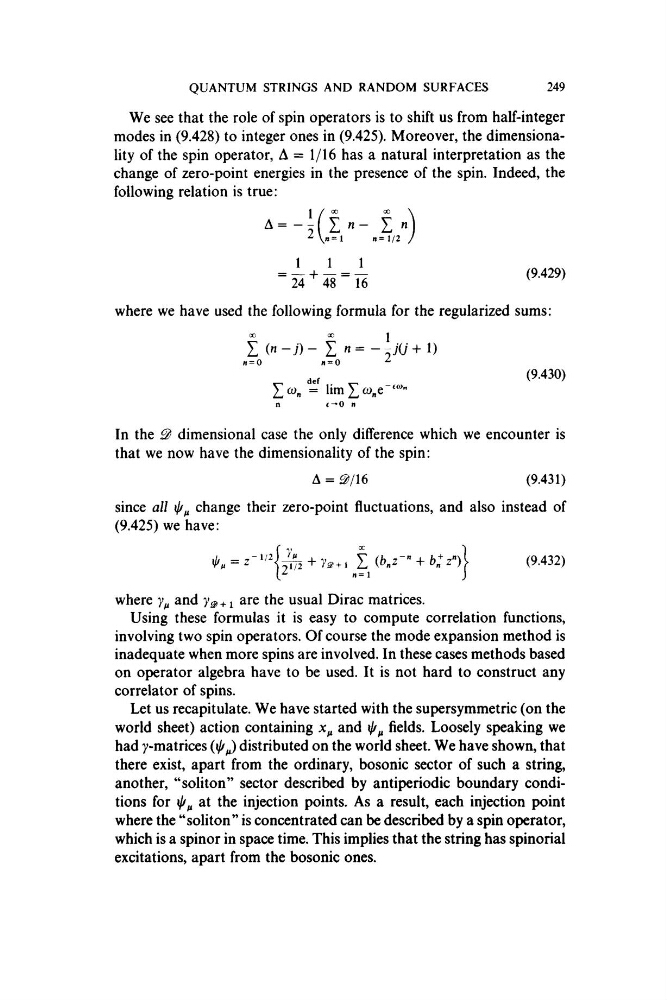
modes in (9.428) to integer ones in (9.425). Moreover, the dimensionality of the spin operator, A = 1/16 has a natural interpretation as the
change of zero-point energies in the presence of the spin. Indeed, the
following relation is true:
A=-x(Z/i- 1«
= 1
n= 1 /2
1
1
1
24
48
16
(9.429)
where we have used the following formula for the regularized sums:
1
Z (n -j)- Z n = -^j(j+ 1)
n
f-^O fi
(9.430)
In the ^ dimensional case the only difference which we encounter is
that we now have the dimensionality of the spin:
A = ^ /16
(9.431)
since all
change their zero-point fluctuations, and also instead of
(9.425) we have:
r-l/2
> 1/2
(9.432)
where and
j are the usual Dirac matrices.
Using these formulas it is easy to compute correlation functions,
involving two spin operators. Of course the mode expansion method is
inadequate when more spins are involved. In these cases methods based
on operator algebra have to be used. It is not hard to construct any
correlator of spins.
Let us recapitulate. We have started with the supersymmetric (on the
world sheet) action containing
and
fields. Loosely speaking we
had y-matrices
distributed on the world sheet. We have shown, that
there exist, apart from the ordinary, bosonic sector of such a string,
another, “soliton” sector described by antiperiodic boundary conditions for ij/^ at the injection points. As a result, each injection point
where the “soliton” is concentrated can be described by a spin operator,
which is a spinor in space time. This implies that the string has spinorial
excitations, apart from the bosonic ones.
249
We see that the role of spin operators is to shift us from half-integer
modes in (9.428) to integer ones in (9.425). Moreover, the dimensionality of the spin operator, A = 1/16 has a natural interpretation as the
change of zero-point energies in the presence of the spin. Indeed, the
following relation is true:
A=-x(Z/i- 1«
= 1
n= 1 /2
1
1
1
24
48
16
(9.429)
where we have used the following formula for the regularized sums:
1
Z (n -j)- Z n = -^j(j+ 1)
n
f-^O fi
(9.430)
In the ^ dimensional case the only difference which we encounter is
that we now have the dimensionality of the spin:
A = ^ /16
(9.431)
since all
change their zero-point fluctuations, and also instead of
(9.425) we have:
r-l/2
> 1/2
(9.432)
where and
j are the usual Dirac matrices.
Using these formulas it is easy to compute correlation functions,
involving two spin operators. Of course the mode expansion method is
inadequate when more spins are involved. In these cases methods based
on operator algebra have to be used. It is not hard to construct any
correlator of spins.
Let us recapitulate. We have started with the supersymmetric (on the
world sheet) action containing
and
fields. Loosely speaking we
had y-matrices
distributed on the world sheet. We have shown, that
there exist, apart from the ordinary, bosonic sector of such a string,
another, “soliton” sector described by antiperiodic boundary conditions for ij/^ at the injection points. As a result, each injection point
where the “soliton” is concentrated can be described by a spin operator,
which is a spinor in space time. This implies that the string has spinorial
excitations, apart from the bosonic ones.