

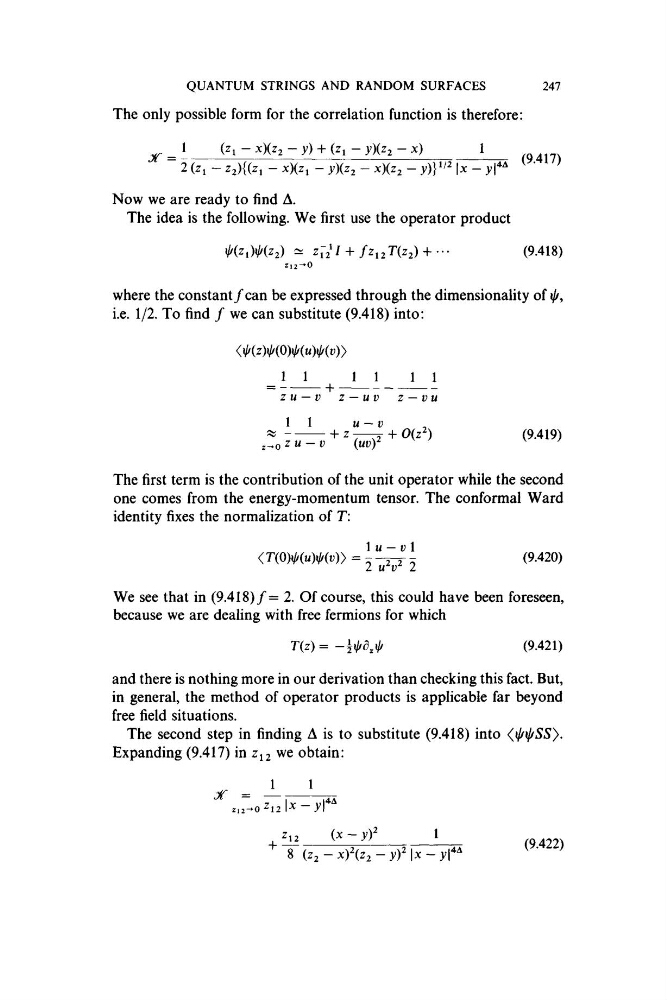
The only possible form for the correlation function is therefore:
QUANTUM STRINGS AND RANDOM SURFACES
247
j f =
1
(Zi - x)(Z2 - y) + (Zi - y)(Z2 - x)
1
2 (Zi - Z2){(zi - x)(zi - y)(z2 - X)(Z2 - y)y^^ \x -
(9.417)
Now we are ready to find A.
The idea is the following. We first use the operator product
ll/(zyil/(Z2) ^ ^l“2 f + /^12^(^2) + •••
(9.418)
where the constant/ can be expressed through the dimensionality of ij/,
i.e. 1/2. To find / we can substitute (9.418) into:
(\l/(z)ij/{0)il/{u)il/(v)}
1 1
1 1
+ -
1 1
Z U — V z — uv
z — vu
1 1
U ~ V
---------- + z - ^ + 0(z^)
^qZ U — V
(uvY
(9.419)
The first term is the contribution of the unit operator while the second
one comes from the energy-momentum tensor. The conformal Ward
identity fixes the normalization of T:
lu~vl
2 uV 2
(9.420)
We see that in (9.418) / = 2. Of course, this could have been foreseen,
because we are dealing with free fermions for which
T(z) = -jil/d,il/
(9.421)
and there is nothing more in our derivation than checking this fact. But,
in general, the method of operator products is applicable far beyond
free field situations.
The second step in finding A is to substitute (9.418) into
Expanding (9.417) in 2^2 we obtain:
j f =
1
1
,,^oZi2 Ix-y]*"'
. Z12
{ x - y f
1
8 ( z 2 - x r ( z 2 - y r |x - y r
(9.422)
QUANTUM STRINGS AND RANDOM SURFACES
247
j f =
1
(Zi - x)(Z2 - y) + (Zi - y)(Z2 - x)
1
2 (Zi - Z2){(zi - x)(zi - y)(z2 - X)(Z2 - y)y^^ \x -
(9.417)
Now we are ready to find A.
The idea is the following. We first use the operator product
ll/(zyil/(Z2) ^ ^l“2 f + /^12^(^2) + •••
(9.418)
where the constant/ can be expressed through the dimensionality of ij/,
i.e. 1/2. To find / we can substitute (9.418) into:
(\l/(z)ij/{0)il/{u)il/(v)}
1 1
1 1
+ -
1 1
Z U — V z — uv
z — vu
1 1
U ~ V
---------- + z - ^ + 0(z^)
^qZ U — V
(uvY
(9.419)
The first term is the contribution of the unit operator while the second
one comes from the energy-momentum tensor. The conformal Ward
identity fixes the normalization of T:
lu~vl
2 uV 2
(9.420)
We see that in (9.418) / = 2. Of course, this could have been foreseen,
because we are dealing with free fermions for which
T(z) = -jil/d,il/
(9.421)
and there is nothing more in our derivation than checking this fact. But,
in general, the method of operator products is applicable far beyond
free field situations.
The second step in finding A is to substitute (9.418) into
Expanding (9.417) in 2^2 we obtain:
j f =
1
1
,,^oZi2 Ix-y]*"'
. Z12
{ x - y f
1
8 ( z 2 - x r ( z 2 - y r |x - y r
(9.422)