

QUANTUM STRINGS AND RANDOM SURFACES
245
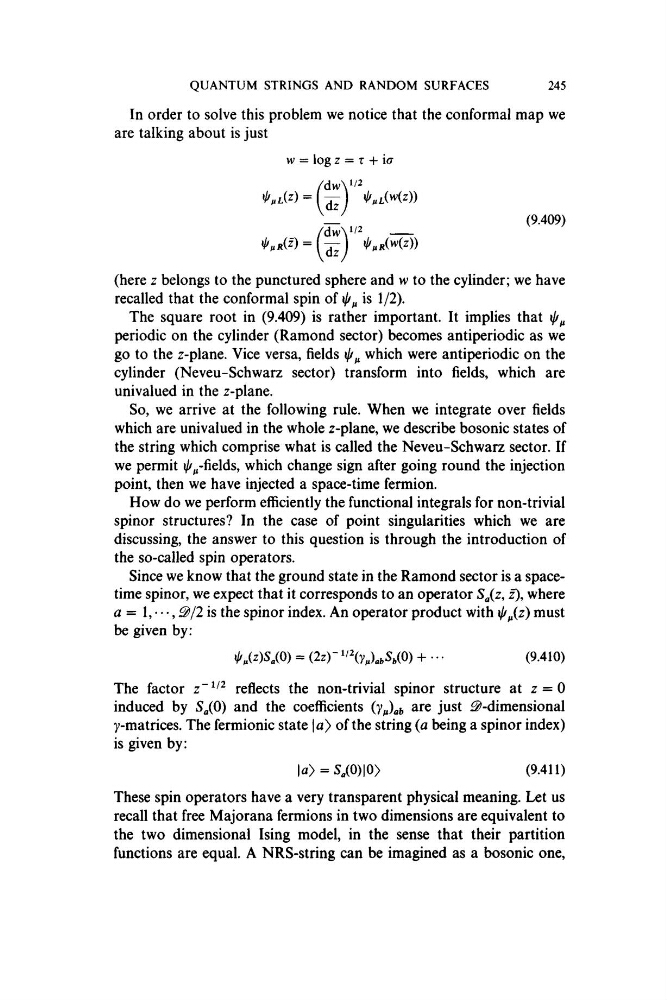
In order to solve this problem we notice that the conformal map we
are talking about is just
W = log 2 = T -I- icr
/dw\^/^
(9.409)
(here z belongs to the punctured sphere and w to the cylinder; we have
recalled that the conformal spin of
is 1/2).
The square root in (9.409) is rather important. It implies that ij/^
periodic on the cylinder (Ramond sector) becomes antiperiodic as we
go to the z-plane. Vice versa, fields {¡/^ which were antiperiodic on the
cylinder (Neveu-Schwarz sector) transform into fields, which are
univalued in the z-plane.
So, we arrive at the following rule. When we integrate over fields
which are univalued in the whole z-plane, we describe bosonic states of
the string which comprise what is called the Neveu-Schwarz sector. If
we permit lA^-fields, which change sign after going round the injection
point, then we have injected a space-time fermion.
How do we perform efficiently the functional integrals for non-trivial
spinor structures? In the case of point singularities which we are
discussing, the answer to this question is through the introduction of
the so-called spin operators.
Since we know that the ground state in the Ramond sector is a spacetime spinor, we expect that it corresponds to an operator S^(z, z), where
a = 1, • • •, ^/2 is the spinor index. An operator product with
must
be given by:
ik,(z)SM = (2z)-^>\yXtSt(0) +
(9.410)
The factor
reflects the non-trivial spinor structure at z = 0
induced by 5^(0) and the coefficients (y^)ab are just ^-dimensional
y-matrices. The fermionic state |a> of the string (a being a spinor index)
is given by:
|fl> = S,(0)|0>
(9.411)
These spin operators have a very transparent physical meaning. Let us
recall that free Majorana fermions in two dimensions are equivalent to
the two dimensional Ising model, in the sense that their partition
functions are equal. A NRS-string can be imagined as a bosonic one.
245
In order to solve this problem we notice that the conformal map we
are talking about is just
W = log 2 = T -I- icr
/dw\^/^
(9.409)
(here z belongs to the punctured sphere and w to the cylinder; we have
recalled that the conformal spin of
is 1/2).
The square root in (9.409) is rather important. It implies that ij/^
periodic on the cylinder (Ramond sector) becomes antiperiodic as we
go to the z-plane. Vice versa, fields {¡/^ which were antiperiodic on the
cylinder (Neveu-Schwarz sector) transform into fields, which are
univalued in the z-plane.
So, we arrive at the following rule. When we integrate over fields
which are univalued in the whole z-plane, we describe bosonic states of
the string which comprise what is called the Neveu-Schwarz sector. If
we permit lA^-fields, which change sign after going round the injection
point, then we have injected a space-time fermion.
How do we perform efficiently the functional integrals for non-trivial
spinor structures? In the case of point singularities which we are
discussing, the answer to this question is through the introduction of
the so-called spin operators.
Since we know that the ground state in the Ramond sector is a spacetime spinor, we expect that it corresponds to an operator S^(z, z), where
a = 1, • • •, ^/2 is the spinor index. An operator product with
must
be given by:
ik,(z)SM = (2z)-^>\yXtSt(0) +
(9.410)
The factor
reflects the non-trivial spinor structure at z = 0
induced by 5^(0) and the coefficients (y^)ab are just ^-dimensional
y-matrices. The fermionic state |a> of the string (a being a spinor index)
is given by:
|fl> = S,(0)|0>
(9.411)
These spin operators have a very transparent physical meaning. Let us
recall that free Majorana fermions in two dimensions are equivalent to
the two dimensional Ising model, in the sense that their partition
functions are equal. A NRS-string can be imagined as a bosonic one.