

QUANTUM STRINGS AND RANDOM SURFACES
235
Of course the same equation could have been derived in a long way,
starting from the standard Dirac equation with spinorial connection:
(9.370)
We have already described this way above in the case of the ghosts and
will not repeat it.
Our task now is to compute the determinants. All of them must be
local functions of p, since under naive manipulations the p dependence
drops out from all expressions. Indeed the action for the field u in
(9.366) and (9.367) which leads to the correct eigenvalue problem has
the form:
S,= p ^ d + u d
Nj ~ ^
(9.371)
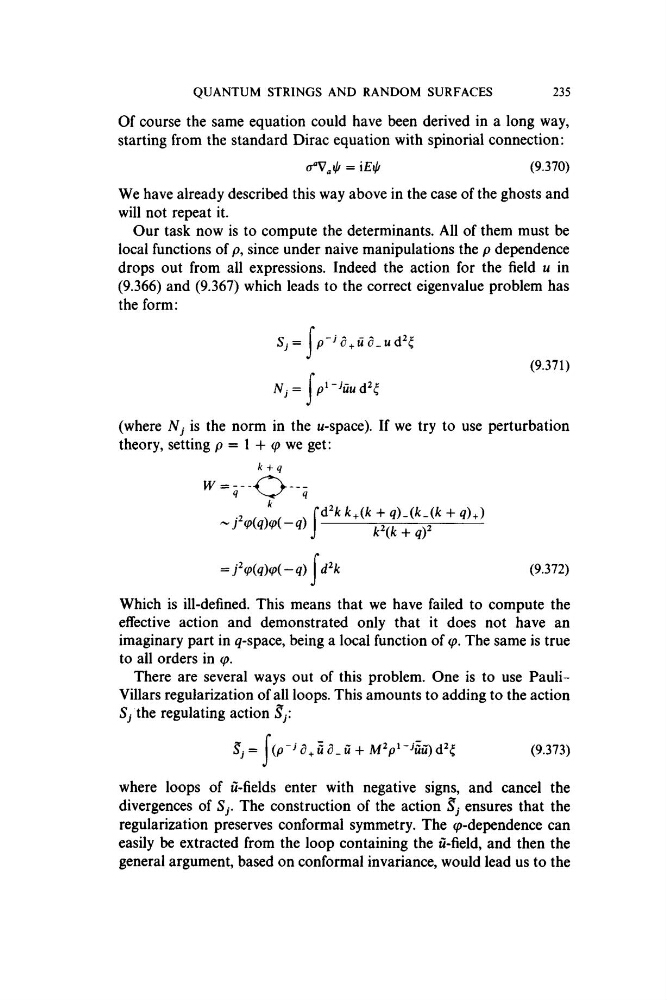
(where Nj is the norm in the u-space). If we try to use perturbation
theory, setting p = 1 + (p we get :
k + q
d^k /c+(/c -I- q ).(k_ (k -h q)+)
k^{k -h qŸ
d^k
(9.372)
Which is ill-defined. This means that we have failed to compute the
effective action and demonstrated only that it does not have an
imaginary part in ^-space, being a local function of cp. The same is true
to all orders in cp.
There are several ways out of this problem. One is to use PauliVillars regularization of all loops. This amounts to adding to the action
Sj the regulating action Sy.
s.,= (p ^d^ûd_û + M^p^ ^ÛM)d^Î
(9.373)
where loops of fi-fields enter with negative signs, and cancel the
divergences of Sj. The construction of the action §j ensures that the
regularization preserves conformal symmetry. The (p-dependence can
easily be extracted from the loop containing the u-field, and then the
general argument, based on conformal invariance, would lead us to the
235
Of course the same equation could have been derived in a long way,
starting from the standard Dirac equation with spinorial connection:
(9.370)
We have already described this way above in the case of the ghosts and
will not repeat it.
Our task now is to compute the determinants. All of them must be
local functions of p, since under naive manipulations the p dependence
drops out from all expressions. Indeed the action for the field u in
(9.366) and (9.367) which leads to the correct eigenvalue problem has
the form:
S,= p ^ d + u d
Nj ~ ^
(9.371)
(where Nj is the norm in the u-space). If we try to use perturbation
theory, setting p = 1 + (p we get :
k + q
d^k /c+(/c -I- q ).(k_ (k -h q)+)
k^{k -h qŸ
d^k
(9.372)
Which is ill-defined. This means that we have failed to compute the
effective action and demonstrated only that it does not have an
imaginary part in ^-space, being a local function of cp. The same is true
to all orders in cp.
There are several ways out of this problem. One is to use PauliVillars regularization of all loops. This amounts to adding to the action
Sj the regulating action Sy.
s.,= (p ^d^ûd_û + M^p^ ^ÛM)d^Î
(9.373)
where loops of fi-fields enter with negative signs, and cancel the
divergences of Sj. The construction of the action §j ensures that the
regularization preserves conformal symmetry. The (p-dependence can
easily be extracted from the loop containing the u-field, and then the
general argument, based on conformal invariance, would lead us to the