

QUANTUM STRINGS AND RANDOM SURFACES
213
decouple. Now we shall start the general analysis of the spectrum. The
first (and the most important) statement will be the decoupling of all
secondary operators. In other words particles correspond not to
possible operators, but to the possible conformal families.
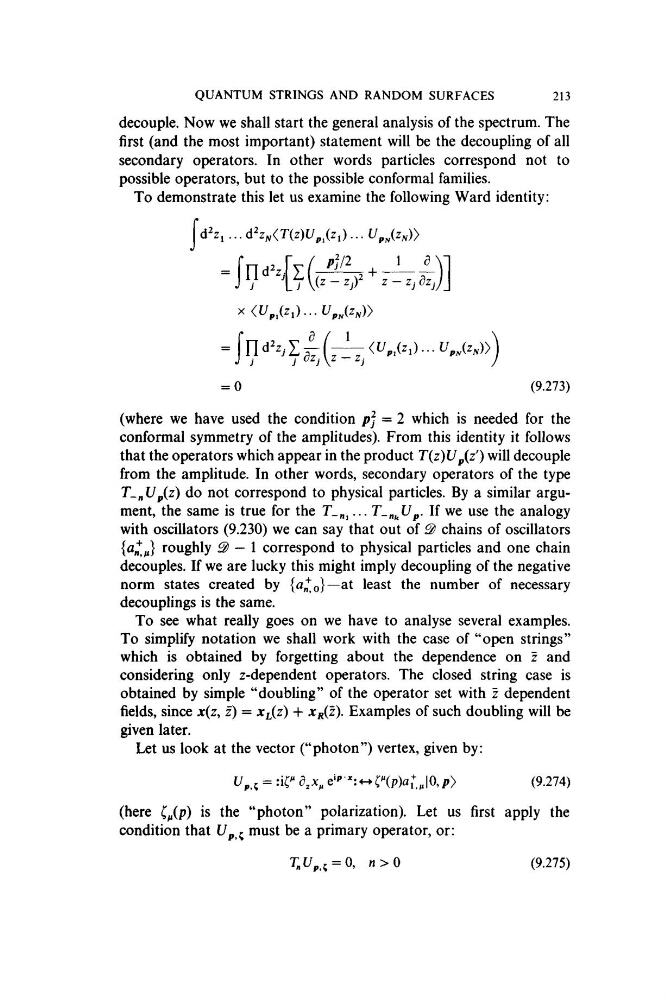
To demonstrate this let us examine the following Ward identity:
jd^z, ... d^z^
X < i / p . ( z , ) . . . l / p , ( z ^ ) >
1
J
V -
= 0
(9.273)
(where we have used the condition p] = 2 which is needed for the
conformal symmetry of the amplitudes). From this identity it follows
that the operators which appear in the product T(z)Up{z') will decouple
from the amplitude. In other words, secondary operators of the type
T^„Up(z) do not correspond to physical particles. By a similar argument, the same is true for the
... T_„^Up. If we use the analogy
with oscillators (9.230) we can say that out of ^ chains of oscillators
roughly ^ — 1 correspond to physical particles and one chain
decouples. If we are lucky this might imply decoupling of the negative
norm states created by
least the number of necessary
decouplings is the same.
To see what really goes on we have to analyse several examples.
To simplify notation we shall work with the case of “open strings”
which is obtained by forgetting about the dependence on z and
considering only z-dependent operators. The closed string case is
obtained by simple “doubling” of the operator set with z dependent
fields, since jc(z, z) = X j(^z) -h jc|^(z). Examples of such doubling will be
given later.
Let us look at the vector (“photon”) vertex, given by:
Lp,; = :iC^
(9.274)
(here C/x(p) is the “photon” polarization). Let us first apply the
condition that Up must be a primary operator, or:
T„Upj^ = 0, n > 0
(9.275)
213
decouple. Now we shall start the general analysis of the spectrum. The
first (and the most important) statement will be the decoupling of all
secondary operators. In other words particles correspond not to
possible operators, but to the possible conformal families.
To demonstrate this let us examine the following Ward identity:
jd^z, ... d^z^
X < i / p . ( z , ) . . . l / p , ( z ^ ) >
1
J
V -
= 0
(9.273)
(where we have used the condition p] = 2 which is needed for the
conformal symmetry of the amplitudes). From this identity it follows
that the operators which appear in the product T(z)Up{z') will decouple
from the amplitude. In other words, secondary operators of the type
T^„Up(z) do not correspond to physical particles. By a similar argument, the same is true for the
... T_„^Up. If we use the analogy
with oscillators (9.230) we can say that out of ^ chains of oscillators
roughly ^ — 1 correspond to physical particles and one chain
decouples. If we are lucky this might imply decoupling of the negative
norm states created by
least the number of necessary
decouplings is the same.
To see what really goes on we have to analyse several examples.
To simplify notation we shall work with the case of “open strings”
which is obtained by forgetting about the dependence on z and
considering only z-dependent operators. The closed string case is
obtained by simple “doubling” of the operator set with z dependent
fields, since jc(z, z) = X j(^z) -h jc|^(z). Examples of such doubling will be
given later.
Let us look at the vector (“photon”) vertex, given by:
Lp,; = :iC^
(9.274)
(here C/x(p) is the “photon” polarization). Let us first apply the
condition that Up must be a primary operator, or:
T„Upj^ = 0, n > 0
(9.275)