

19«
GAUGE FIELDS AND STRINGS
different but in fact coincident amplitudes si. The matter is quite trivial,
like fixing center of mass coordinates.
We shall now show an extremely important thing. Namely, the
amplitude si as function of .....-h • +
has an infinite
number of poles with factorized residues, by which we mean the
following relation, satisfied by the set of amplitudes si^{p^,..., p^\
{Pi,
(9.217)
Here, we have denoted by
the mass of a resonance, among which the
ground state with y t iq — 2(A — 1) must be present. The si^^^ are amplitudes involving k-ground state particles and one resonance. So we were
slightly imprecise when talking about the set of
In fact the
factorization requirement must be imposed on the larger set of amplitudes, involving arbitrary number of excited particles. We have not
given a formula like (9.208) for them yet, but this will be done in the
course of the proof.
The factorization condition (9.217) is clearly necessary and obvious
from the physical point of view. It reflects the fact that due to the short
range of forces, separated interactions are independent. It is equally
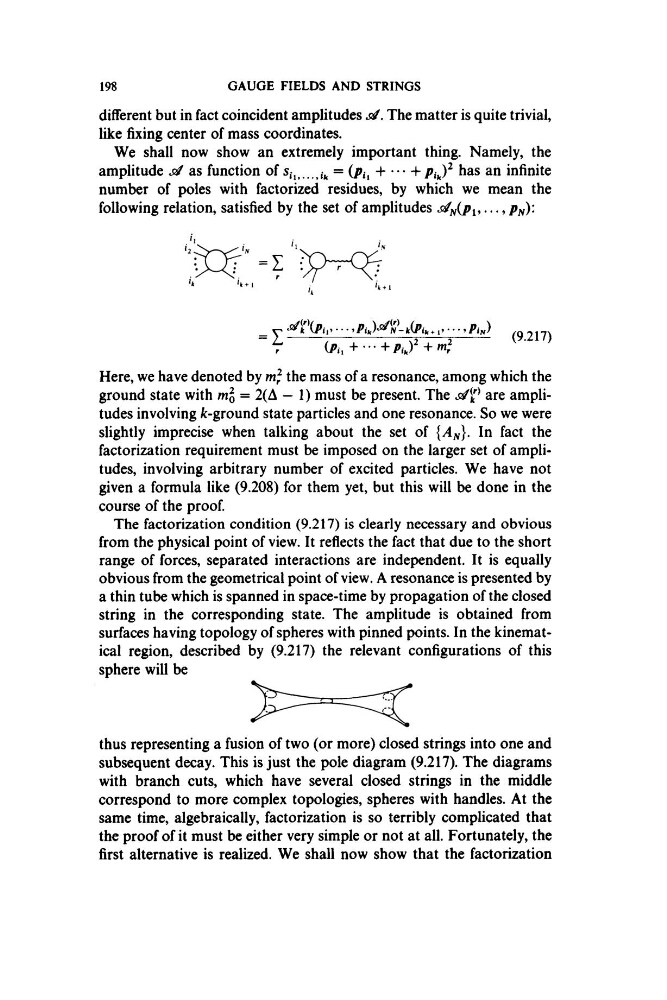
obvious from the geometrical point of view. A resonance is presented by
a thin tube which is spanned in space-time by propagation of the closed
string in the corresponding state. The amplitude is obtained from
surfaces having topology of spheres with pinned points. In the kinematical region, described by (9.217) the relevant configurations of this
sphere will be
thus representing a fusion of two (or more) closed strings into one and
subsequent decay. This is just the pole diagram (9.217). The diagrams
with branch cuts, which have several closed strings in the middle
correspond to more complex topologies, spheres with handles. At the
same time, algebraically, factorization is so terribly complicated that
the proof of it must be either very simple or not at all. Fortunately, the
first alternative is realized. We shall now show that the factorization
GAUGE FIELDS AND STRINGS
different but in fact coincident amplitudes si. The matter is quite trivial,
like fixing center of mass coordinates.
We shall now show an extremely important thing. Namely, the
amplitude si as function of .....-h • +
has an infinite
number of poles with factorized residues, by which we mean the
following relation, satisfied by the set of amplitudes si^{p^,..., p^\
{Pi,
(9.217)
Here, we have denoted by
the mass of a resonance, among which the
ground state with y t iq — 2(A — 1) must be present. The si^^^ are amplitudes involving k-ground state particles and one resonance. So we were
slightly imprecise when talking about the set of
In fact the
factorization requirement must be imposed on the larger set of amplitudes, involving arbitrary number of excited particles. We have not
given a formula like (9.208) for them yet, but this will be done in the
course of the proof.
The factorization condition (9.217) is clearly necessary and obvious
from the physical point of view. It reflects the fact that due to the short
range of forces, separated interactions are independent. It is equally
obvious from the geometrical point of view. A resonance is presented by
a thin tube which is spanned in space-time by propagation of the closed
string in the corresponding state. The amplitude is obtained from
surfaces having topology of spheres with pinned points. In the kinematical region, described by (9.217) the relevant configurations of this
sphere will be
thus representing a fusion of two (or more) closed strings into one and
subsequent decay. This is just the pole diagram (9.217). The diagrams
with branch cuts, which have several closed strings in the middle
correspond to more complex topologies, spheres with handles. At the
same time, algebraically, factorization is so terribly complicated that
the proof of it must be either very simple or not at all. Fortunately, the
first alternative is realized. We shall now show that the factorization