

9.7 Scattering Amplitudes
192
GAUGE FIELDS AND STRINGS
In the case of paths we have demonstrated how to compute Green
functions and amplitudes i.e. the amplitudes for a path to pass through
a set of given points. The answer was given by Feynman diagrams as it
should be. What shall we obtain in the case of surface, now that we have
learned how to compute the functional integral?
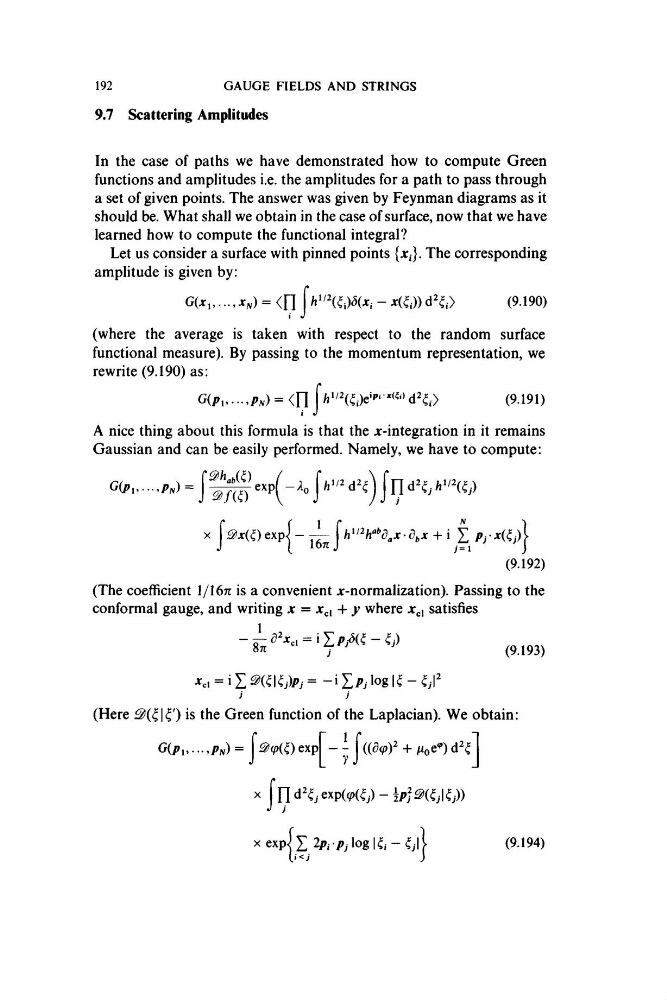
Let us consider a surface with pinned points {jcJ. The corresponding
amplitude is given by:
=
(where the average is taken with respect to the random surface
functional measure). By passing to the momentum representation, we
rewrite (9.190) as:
G(/»„-,/>^) =
(9.191)
A nice thing about this formula is that the x-integration in it remains
Gaussian and can be easily performed. Namely, we have to compute:
® /(0
exp^-Ao I I n
X ®x(Oexpi- I6n
duX +
(9.192)
(The coefficient 1/1 67t is a convenient jc-normalization). Passing to the
conformal gauge, and writing x =
y where x^ satisfies
87t
•«cl = i L
= - i L /'j log li - i /
j
j
(Here
is the Green function of the Laplacian). We obtain:
G(Pi,...,Pn) = 9q>(0 exp
e x p j x
(9.194)
192
GAUGE FIELDS AND STRINGS
In the case of paths we have demonstrated how to compute Green
functions and amplitudes i.e. the amplitudes for a path to pass through
a set of given points. The answer was given by Feynman diagrams as it
should be. What shall we obtain in the case of surface, now that we have
learned how to compute the functional integral?
Let us consider a surface with pinned points {jcJ. The corresponding
amplitude is given by:
=
(where the average is taken with respect to the random surface
functional measure). By passing to the momentum representation, we
rewrite (9.190) as:
G(/»„-,/>^) =
(9.191)
A nice thing about this formula is that the x-integration in it remains
Gaussian and can be easily performed. Namely, we have to compute:
® /(0
exp^-Ao I I n
X ®x(Oexpi- I6n
duX +
(9.192)
(The coefficient 1/1 67t is a convenient jc-normalization). Passing to the
conformal gauge, and writing x =
y where x^ satisfies
87t
•«cl = i L
= - i L /'j log li - i /
j
j
(Here
is the Green function of the Laplacian). We obtain:
G(Pi,...,Pn) = 9q>(0 exp
e x p j x
(9.194)