

QUANTUM STRINGS AND RANDOM SURFACES
9.6 Computation of Functional Integrals
185
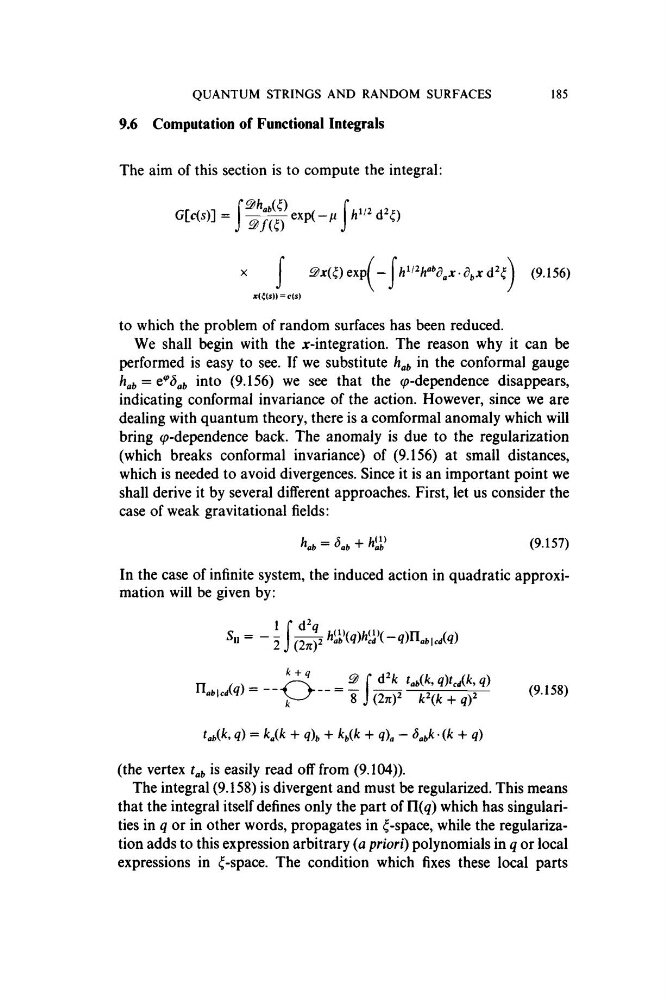
The aim of this section is to compute the integral:
G[c(s)] =
exp(-/x ^1/2 ^2^^
I
expl - h^i^h“ \x-d^xd^n (9.156)
x(^(s)) = c(s)
to which the problem of random surfaces has been reduced.
We shall begin with the jc-integration. The reason why it can be
performed is easy to see. If we substitute h^b in the conformal gauge
= Q ^^dab into (9.156) we see that the (^-dependence disappears,
indicating conformal invariance of the action. However, since we are
dealing with quantum theory, there is a comformal anomaly which will
bring (^-dependence back. The anomaly is due to the regularization
(which breaks conformal invariance) of (9.156) at small distances,
which is needed to avoid divergences. Since it is an important point we
shall derive it by several different approaches. First, let us consider the
case of weak gravitational fields:
(9.157)
In the case of infinite system, the induced action in quadratic approximation will be given by:
S„= -
flflft|cd(^)
k
q
- o - =
^ f d^/c t a b { K q ) t ,J J i,q )
8 J {InY k\k -1- q)^
(9.158)
tab(K q) = k„{k -h q)b + kt,{k + q \ - d^^k -(k + q)
(the vertex t^b is easily read off from (9.104)).
The integral (9.158) is divergent and must be regularized. This means
that the integral itself defines only the part of Il(^) which has singularities in q or in other words, propagates in (^-space, while the regularization adds to this expression arbitrary (a priori) polynomials in q or local
expressions in (^-space. The condition which fixes these local parts
9.6 Computation of Functional Integrals
185
The aim of this section is to compute the integral:
G[c(s)] =
exp(-/x ^1/2 ^2^^
I
expl - h^i^h“ \x-d^xd^n (9.156)
x(^(s)) = c(s)
to which the problem of random surfaces has been reduced.
We shall begin with the jc-integration. The reason why it can be
performed is easy to see. If we substitute h^b in the conformal gauge
= Q ^^dab into (9.156) we see that the (^-dependence disappears,
indicating conformal invariance of the action. However, since we are
dealing with quantum theory, there is a comformal anomaly which will
bring (^-dependence back. The anomaly is due to the regularization
(which breaks conformal invariance) of (9.156) at small distances,
which is needed to avoid divergences. Since it is an important point we
shall derive it by several different approaches. First, let us consider the
case of weak gravitational fields:
(9.157)
In the case of infinite system, the induced action in quadratic approximation will be given by:
S„= -
flflft|cd(^)
k
q
- o - =
^ f d^/c t a b { K q ) t ,J J i,q )
8 J {InY k\k -1- q)^
(9.158)
tab(K q) = k„{k -h q)b + kt,{k + q \ - d^^k -(k + q)
(the vertex t^b is easily read off from (9.104)).
The integral (9.158) is divergent and must be regularized. This means
that the integral itself defines only the part of Il(^) which has singularities in q or in other words, propagates in (^-space, while the regularization adds to this expression arbitrary (a priori) polynomials in q or local
expressions in (^-space. The condition which fixes these local parts