

QUANTUM STRINGS AND RANDOM SURFACES
183
of its sides and the angle between them. They are just the extra
parameters, described above. One of them can be interpreted as a
“length” of the torus, while the other is the angle which determines
some canonical directions on it.
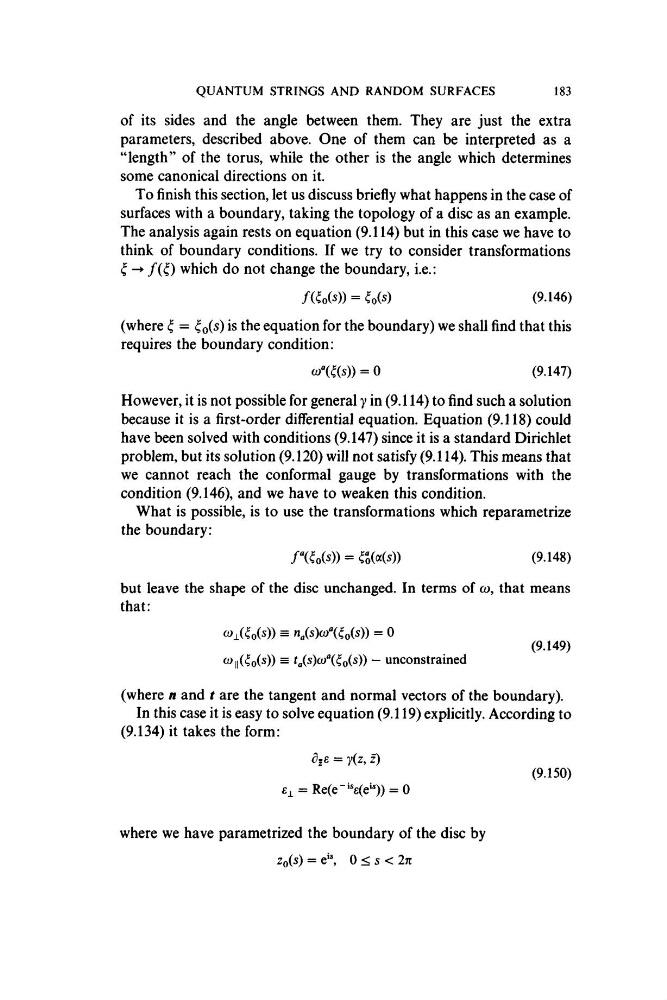
To finish this section, let us discuss briefly what happens in the case of
surfaces with a boundary, taking the topology of a disc as an example.
The analysis again rests on equation (9.114) but in this case we have to
think of boundary conditions. If we try to consider transformations
^ f(0 which do not change the boundary, i.e.:
f(Us)) = Us)
(9.146)
(where ^
is the equation for the boundary) we shall find that this
requires the boundary condition:
com ) = 0
(9.147)
However, it is not possible for general y in (9.114) to find such a solution
because it is a first-order differential equation. Equation (9.118) could
have been solved with conditions (9.147) since it is a standard Dirichlet
problem, but its solution (9.120) will not satisfy (9.114). This means that
we cannot reach the conformal gauge by transformations with the
condition (9.146), and we have to weaken this condition.
What is possible, is to use the transformations which reparametrize
the boundary:
nU s)) = Uoc(s))
(9.148)
but leave the shape of the disc unchanged. In terms of co, that means
that:
coAUs)) ^ n / s ) c o m ) ) = 0
coa(io(s)) = ta(s)co% ^Q (s)) — unconstrained
(9.149)
(where n and t are the tangent and normal vectors of the boundary).
In this case it is easy to solve equation (9.119) explicitly. According to
(9.134) it takes the form:
= 7(z, z)
= Re(e~**£(e‘0) = 0
(9.150)
where we have parametrized the boundary of the disc by
Zq(s) = e‘*, 0 < s < 271
183
of its sides and the angle between them. They are just the extra
parameters, described above. One of them can be interpreted as a
“length” of the torus, while the other is the angle which determines
some canonical directions on it.
To finish this section, let us discuss briefly what happens in the case of
surfaces with a boundary, taking the topology of a disc as an example.
The analysis again rests on equation (9.114) but in this case we have to
think of boundary conditions. If we try to consider transformations
^ f(0 which do not change the boundary, i.e.:
f(Us)) = Us)
(9.146)
(where ^
is the equation for the boundary) we shall find that this
requires the boundary condition:
com ) = 0
(9.147)
However, it is not possible for general y in (9.114) to find such a solution
because it is a first-order differential equation. Equation (9.118) could
have been solved with conditions (9.147) since it is a standard Dirichlet
problem, but its solution (9.120) will not satisfy (9.114). This means that
we cannot reach the conformal gauge by transformations with the
condition (9.146), and we have to weaken this condition.
What is possible, is to use the transformations which reparametrize
the boundary:
nU s)) = Uoc(s))
(9.148)
but leave the shape of the disc unchanged. In terms of co, that means
that:
coAUs)) ^ n / s ) c o m ) ) = 0
coa(io(s)) = ta(s)co% ^Q (s)) — unconstrained
(9.149)
(where n and t are the tangent and normal vectors of the boundary).
In this case it is easy to solve equation (9.119) explicitly. According to
(9.134) it takes the form:
= 7(z, z)
= Re(e~**£(e‘0) = 0
(9.150)
where we have parametrized the boundary of the disc by
Zq(s) = e‘*, 0 < s < 271