

QUANTUM STRINGS AND RANDOM SURFACES
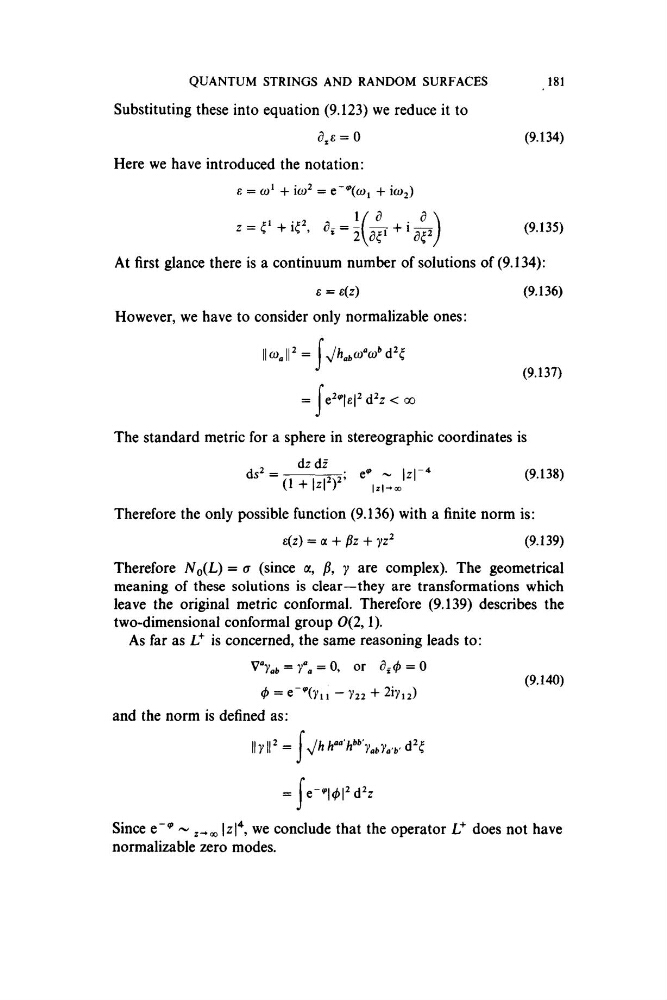
Substituting these into equation (9.123) we reduce it to
d,e = 0
Here we have introduced the notation:
£ =
+ ia> ^ =
-h ia> 2)
181
(9.134)
(9.135)
At first glance there is a continuum number of solutions of (9.134):
£ = £(z)
(9.136)
However, we have to consider only normalizable ones:
■co' ’
(9.137)
e^^|£p d^z < 00
The standard metric for a sphere in stereographic coordinates is
dz dz
ds^ =
k r
(9.138)
(l + |z|2)^’
Therefore the only possible function (9.136) with a finite norm is:
£(z) = cc pz + yz^
(9.139)
Therefore Nq(L) = a (since a, p, y are complex). The geometrical
meaning of these solutions is clear—they are transformations which
leave the original metric conformal. Therefore (9.139) describes the
two-dimensional conformal group 0(2,1).
As far as
is concerned, the same reasoning leads to:
V>ab = 7"a = 0, or a,(/) = 0
0 = e"‘ ^(7n -y22 + 2iyi2)
and the norm is defined as:
llyP=
(9.140)
= |e ^\(l>\^d^z
Since e
|zl^ we conclude that the operator
does not have
normalizable zero modes.
Substituting these into equation (9.123) we reduce it to
d,e = 0
Here we have introduced the notation:
£ =
+ ia> ^ =
-h ia> 2)
181
(9.134)
(9.135)
At first glance there is a continuum number of solutions of (9.134):
£ = £(z)
(9.136)
However, we have to consider only normalizable ones:
■co' ’
(9.137)
e^^|£p d^z < 00
The standard metric for a sphere in stereographic coordinates is
dz dz
ds^ =
k r
(9.138)
(l + |z|2)^’
Therefore the only possible function (9.136) with a finite norm is:
£(z) = cc pz + yz^
(9.139)
Therefore Nq(L) = a (since a, p, y are complex). The geometrical
meaning of these solutions is clear—they are transformations which
leave the original metric conformal. Therefore (9.139) describes the
two-dimensional conformal group 0(2,1).
As far as
is concerned, the same reasoning leads to:
V>ab = 7"a = 0, or a,(/) = 0
0 = e"‘ ^(7n -y22 + 2iyi2)
and the norm is defined as:
llyP=
(9.140)
= |e ^\(l>\^d^z
Since e
|zl^ we conclude that the operator
does not have
normalizable zero modes.