

QUANTUM STRINGS AND RANDOM SURFACES
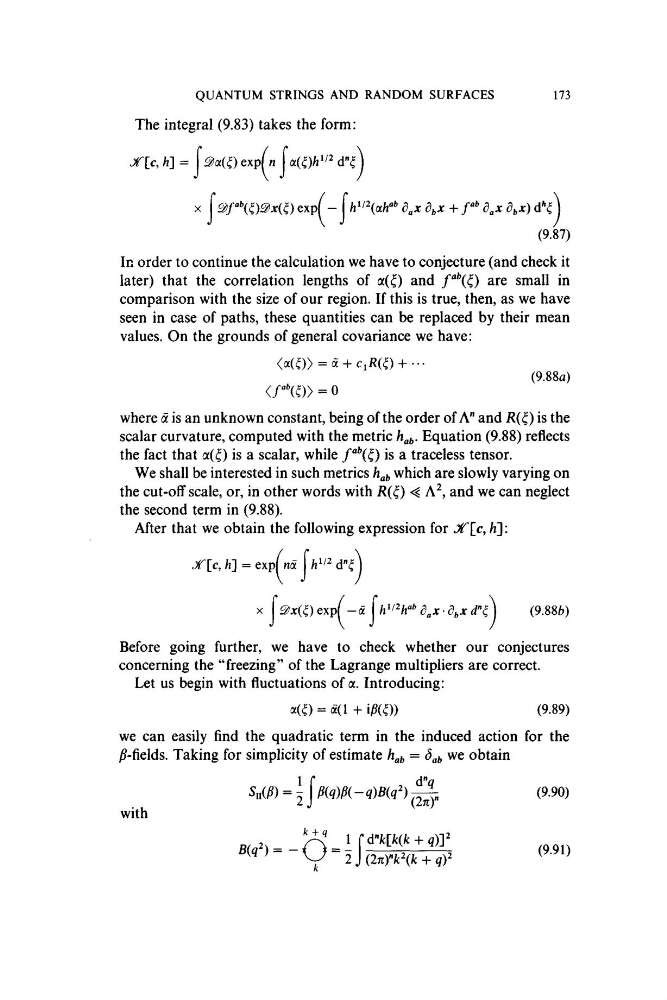
T h e in tegral (9 .8 3 ) ta k es th e form :
173
expl n
dgX df,x +
d^x ^¿jc)
Jf[c, /z] =
(9.87)
In order to continue the calculation we have to conjecture (and check it
later) that the correlation lengths of
and
are small in
comparison with the size of our region. If this is true, then, as we have
seen in case of paths, these quantities can be replaced by their mean
values. On the grounds of general covariance we have:
= a + CiR(0 + --< r \o > = 0
(9.88iz)
where à is an unknown constant, being of the order of A" and R{^ is the
scalar curvature, computed with the metric
Equation (9.88) reflects
the fact that o l {^) is a scalar, while
is a traceless tensor.
We shall be interested in such metrics h^b which are slowly varying on
the cut-ofT scale, or, in other words with R{^) A^, and we can neglect
the second term in (9.88).
After that we obtain the following expression for jr[c , K]:
jT[c, h] = exp^na
d”(^
X J ^ x ( i ) e x p ^ \ d ^ x • d j , x
(9M b)
Before going further, we have to check whether our conjectures
concerning the “freezing” of the Lagrange multipliers are correct.
Let us begin with fluctuations of a. Introducing:
a ( 0 = a-(l + m ) )
(9.89)
we can easily find the quadratic term in the induced action for the
j?-fields. Taking for simplicity of estimate h^b = Sab we obtain
Sn(P) = :
1
with
P(qW(-q)B(q^)
d"^
k + q
B( (271)"
d"fe[fe(fe + q ) y
(,2n)"kHk + q)^
(9.90)
(9.91)
T h e in tegral (9 .8 3 ) ta k es th e form :
173
expl n
dgX df,x +
d^x ^¿jc)
Jf[c, /z] =
(9.87)
In order to continue the calculation we have to conjecture (and check it
later) that the correlation lengths of
and
are small in
comparison with the size of our region. If this is true, then, as we have
seen in case of paths, these quantities can be replaced by their mean
values. On the grounds of general covariance we have:
(9.88iz)
where à is an unknown constant, being of the order of A" and R{^ is the
scalar curvature, computed with the metric
Equation (9.88) reflects
the fact that o l {^) is a scalar, while
is a traceless tensor.
We shall be interested in such metrics h^b which are slowly varying on
the cut-ofT scale, or, in other words with R{^) A^, and we can neglect
the second term in (9.88).
After that we obtain the following expression for jr[c , K]:
jT[c, h] = exp^na
d”(^
X J ^ x ( i ) e x p ^ \ d ^ x • d j , x
(9M b)
Before going further, we have to check whether our conjectures
concerning the “freezing” of the Lagrange multipliers are correct.
Let us begin with fluctuations of a. Introducing:
a ( 0 = a-(l + m ) )
(9.89)
we can easily find the quadratic term in the induced action for the
j?-fields. Taking for simplicity of estimate h^b = Sab we obtain
Sn(P) = :
1
with
P(qW(-q)B(q^)
d"^
k + q
B( (271)"
d"fe[fe(fe + q ) y
(,2n)"kHk + q)^
(9.90)
(9.91)