

QUANTUM STRINGS AND RANDOM SURFACES
171
analysis is needed in order to determine the relevance of those terms. It
is reasonable, however, to begin with the simplest action (9.74) and to
postpone the question whether renormalization produces higher derivative terms.
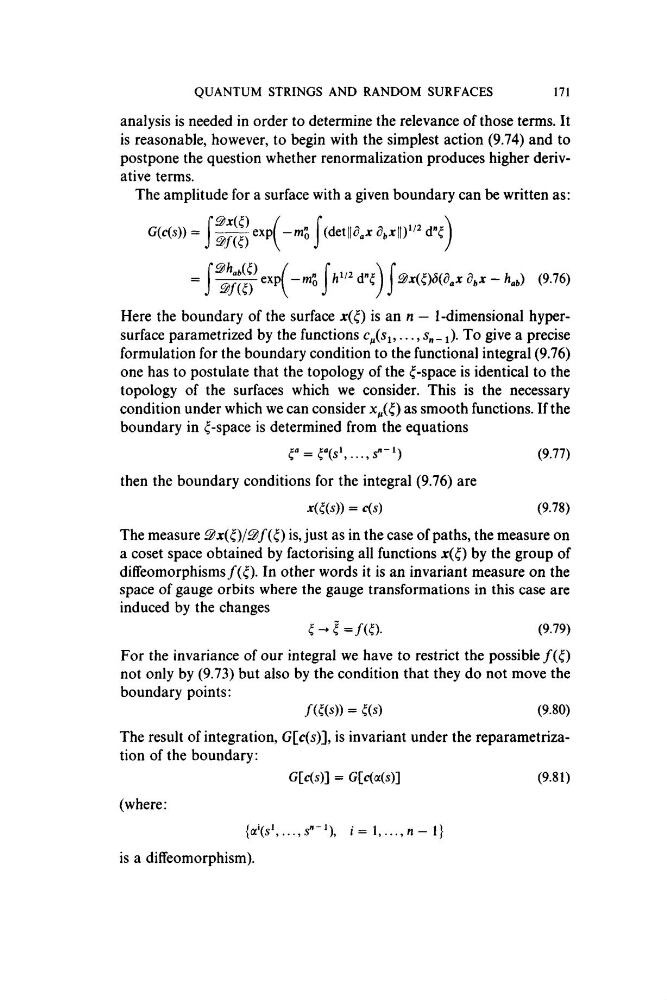
The amplitude for a surface with a given boundary can be written as:
G(c{s)) =
m o '
exp - m j
m o
expl -mñ
9x{^)6{d,x d,x - h j (9.76)
Here the boundary of the surface x{0 is an n — 1-dimensional hypersurface parametrized by the functions
...,
i). To give a precise
formulation for the boundary condition to the functional integral (9.76)
one has to postulate that the topology of the (^-space is identical to the
topology of the surfaces which we consider. This is the necessary
condition under which we can consider
as smooth functions. If the
boundary in c^-space is determined from the equations
=
(9.77)
then the boundary conditions for the integral (9.76) are
x(«5)) = c(s)
(9.78)
The measure
is, just as in the case of paths, the measure on
a coset space obtained by factorising all functions jc((J) by the group of
diffeomorphisms / (c^). In other words it is an invariant measure on the
space of gauge orbits where the gauge transformations in this case are
induced by the changes
í - > l = / ( ¿ ) .
(9.79)
For the invariance of our integral we have to restrict the possible f{<0
not only by (9.73) but also by the condition that they do not move the
boundary points:
/( i( s ) ) = ¿(S)
(9.80)
The result of integration, G[c(s)], is invariant under the reparametrization of the boundary:
G[c(5)] = G[c(a(s)]
(9.81)
(where:
{a'(s^ ..., 5"'^), I
1}
is a diffeomorphism).
171
analysis is needed in order to determine the relevance of those terms. It
is reasonable, however, to begin with the simplest action (9.74) and to
postpone the question whether renormalization produces higher derivative terms.
The amplitude for a surface with a given boundary can be written as:
G(c{s)) =
m o '
exp - m j
m o
expl -mñ
9x{^)6{d,x d,x - h j (9.76)
Here the boundary of the surface x{0 is an n — 1-dimensional hypersurface parametrized by the functions
...,
i). To give a precise
formulation for the boundary condition to the functional integral (9.76)
one has to postulate that the topology of the (^-space is identical to the
topology of the surfaces which we consider. This is the necessary
condition under which we can consider
as smooth functions. If the
boundary in c^-space is determined from the equations
=
(9.77)
then the boundary conditions for the integral (9.76) are
x(«5)) = c(s)
(9.78)
The measure
is, just as in the case of paths, the measure on
a coset space obtained by factorising all functions jc((J) by the group of
diffeomorphisms / (c^). In other words it is an invariant measure on the
space of gauge orbits where the gauge transformations in this case are
induced by the changes
í - > l = / ( ¿ ) .
(9.79)
For the invariance of our integral we have to restrict the possible f{<0
not only by (9.73) but also by the condition that they do not move the
boundary points:
/( i( s ) ) = ¿(S)
(9.80)
The result of integration, G[c(s)], is invariant under the reparametrization of the boundary:
G[c(5)] = G[c(a(s)]
(9.81)
(where:
{a'(s^ ..., 5"'^), I
1}
is a diffeomorphism).