

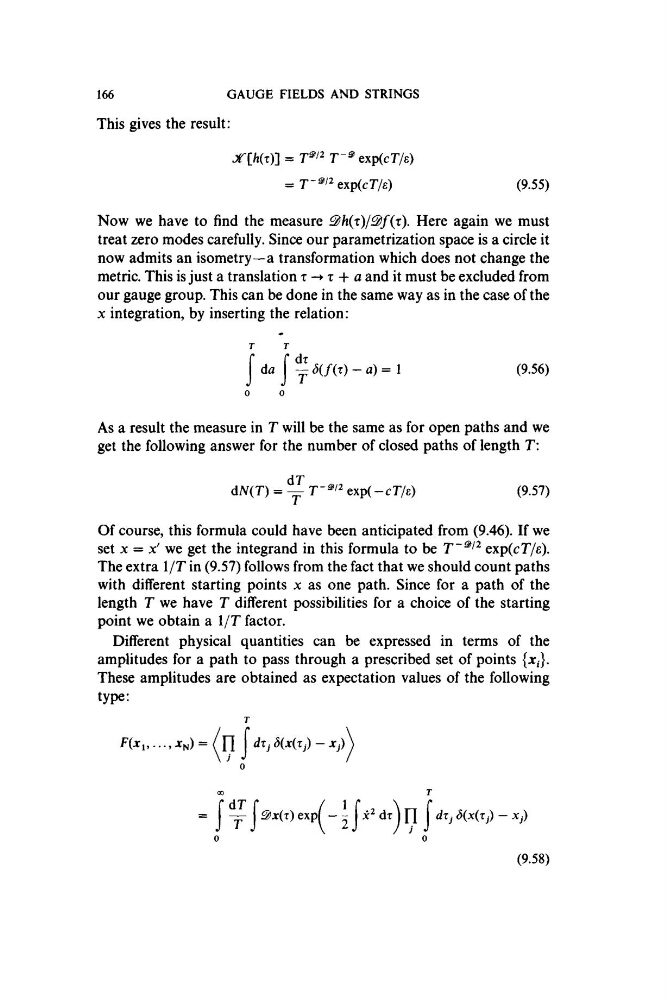
This gives the result:
jT[^(t)] = 7^/2
QxpicTls)
=
exp(cT/e)
166
GAUGE FIELDS AND STRINGS
(9.55)
Now we have to find the measure
Here again we must
treat zero modes carefully. Since our parametrization space is a circle it
now admits an isometry—a transformation which does not change the
metric. This is just a translation t -> t -h a and it must be excluded from
our gauge group. This can be done in the same way as in the case of the
X integration, by inserting the relation:
da
dr
S(f(x)-a)=l
(9.56)
As a result the measure in T will be the same as for open paths and we
get the following answer for the number of closed paths of length T:
d T
dN(T) = —
exp (-cT /£)
(9.57)
Of course, this formula could have been anticipated from (9.46). If we
set X = x' we get the integrand in this formula to be
exp(cT/e).
The extra 1/T in (9.57) follows from the fact that we should count paths
with different starting points x as one path. Since for a path of the
length T we have T different possibilities for a choice of the starting
point we obtain a 1/T factor.
Different physical quantities can be expressed in terms of the
amplitudes for a path to pass through a prescribed set of points {xj.
These amplitudes are obtained as expectation values of the following
type:
= ( n
dtj dix(Xj) - X j)
O D
dT
^ jc(t) expl
dxj d(x(xj) - Xj)
(9.58)
jT[^(t)] = 7^/2
QxpicTls)
=
exp(cT/e)
166
GAUGE FIELDS AND STRINGS
(9.55)
Now we have to find the measure
Here again we must
treat zero modes carefully. Since our parametrization space is a circle it
now admits an isometry—a transformation which does not change the
metric. This is just a translation t -> t -h a and it must be excluded from
our gauge group. This can be done in the same way as in the case of the
X integration, by inserting the relation:
da
dr
S(f(x)-a)=l
(9.56)
As a result the measure in T will be the same as for open paths and we
get the following answer for the number of closed paths of length T:
d T
dN(T) = —
exp (-cT /£)
(9.57)
Of course, this formula could have been anticipated from (9.46). If we
set X = x' we get the integrand in this formula to be
exp(cT/e).
The extra 1/T in (9.57) follows from the fact that we should count paths
with different starting points x as one path. Since for a path of the
length T we have T different possibilities for a choice of the starting
point we obtain a 1/T factor.
Different physical quantities can be expressed in terms of the
amplitudes for a path to pass through a prescribed set of points {xj.
These amplitudes are obtained as expectation values of the following
type:
= ( n
dtj dix(Xj) - X j)
O D
dT
^ jc(t) expl
dxj d(x(xj) - Xj)
(9.58)