

QUANTUM STRINGS AND RANDOM SURFACES
163
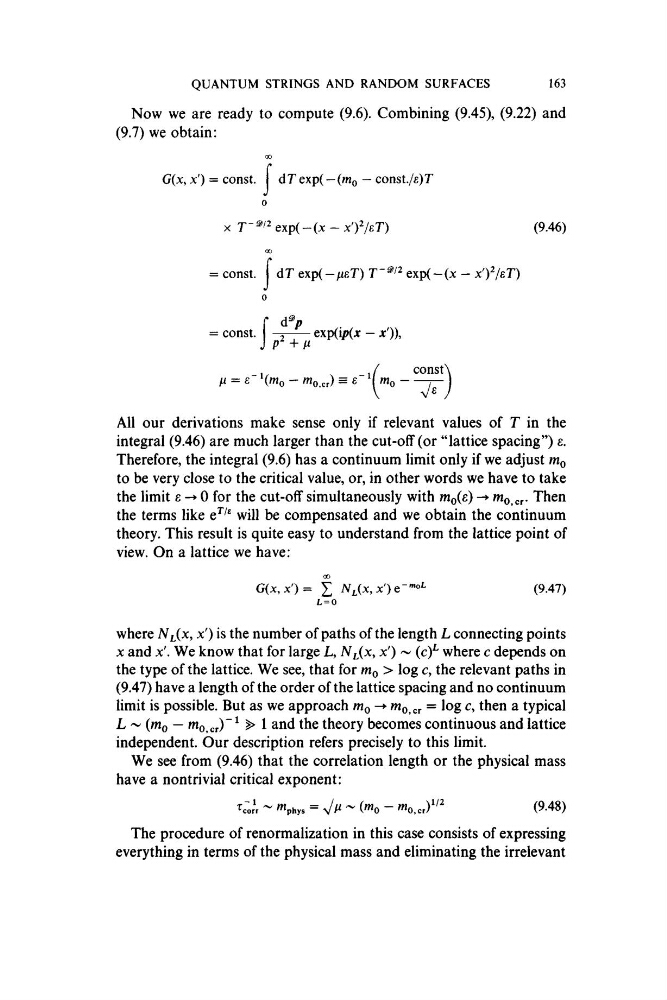
Now we are ready to compute (9.6). Combining (9.45), (9.22) and
(9.7) we obtain:
ou
1
G(x, x') = const. d r exp( —(mo — const./£)T
X T
exp( —(x — x 'Y / e T )
(9.46)
00
= const. J dT exp( —|I£T)
exp( —(x — x 'Y ls T )
= const.
i
d >
+ H
exp(i/>(jc - Ac')),
ii = £ ‘(mo - mo.cr) = s ‘ mo -
const
All our derivations make sense only if relevant values of T in the
integral (9.46) are much larger than the cut-off (or “lattice spacing”) £.
Therefore, the integral (9.6) has a continuum limit only if we adjust Mq
to be very close to the critical value, or, in other words we have to take
the limit £ -► 0 for the cut-off simultaneously with mo(£) ^ Wo,cr- Then
the terms like e^^® will be compensated and we obtain the continuum
theory. This result is quite easy to understand from the lattice point of
view. On a lattice we have:
G (x,x')= X N ^(x,x')e“"’«^
(9.47)
where A^(x, x') is the number of paths of the length L connecting points
X and x'. We know that for large L, N^(x, x') ^ (c)^ where c depends on
the type of the lattice. We see, that for Mq > log c, the relevant paths in
(9.47) have a length of the order of the lattice spacing and no continuum
limit is possible. But as we approach ytiq -► Wo,cr = 1^8 G then a typical
L ~ (mo — ^W o,cr) ” ^ ^ 1 and the theory becomes continuous and lattice
independent. Our description refers precisely to this limit.
We see from (9.46) that the correlation length or the physical mass
have a nontrivial critical exponent:
“ phys = yl P lin to- W o , „ ) ‘
(9.48)
The procedure of renormalization in this case consists of expressing
everything in terms of the physical mass and eliminating the irrelevant
163
Now we are ready to compute (9.6). Combining (9.45), (9.22) and
(9.7) we obtain:
ou
1
G(x, x') = const. d r exp( —(mo — const./£)T
X T
exp( —(x — x 'Y / e T )
(9.46)
00
= const. J dT exp( —|I£T)
exp( —(x — x 'Y ls T )
= const.
i
d >
+ H
exp(i/>(jc - Ac')),
ii = £ ‘(mo - mo.cr) = s ‘ mo -
const
All our derivations make sense only if relevant values of T in the
integral (9.46) are much larger than the cut-off (or “lattice spacing”) £.
Therefore, the integral (9.6) has a continuum limit only if we adjust Mq
to be very close to the critical value, or, in other words we have to take
the limit £ -► 0 for the cut-off simultaneously with mo(£) ^ Wo,cr- Then
the terms like e^^® will be compensated and we obtain the continuum
theory. This result is quite easy to understand from the lattice point of
view. On a lattice we have:
G (x,x')= X N ^(x,x')e“"’«^
(9.47)
where A^(x, x') is the number of paths of the length L connecting points
X and x'. We know that for large L, N^(x, x') ^ (c)^ where c depends on
the type of the lattice. We see, that for Mq > log c, the relevant paths in
(9.47) have a length of the order of the lattice spacing and no continuum
limit is possible. But as we approach ytiq -► Wo,cr = 1^8 G then a typical
L ~ (mo — ^W o,cr) ” ^ ^ 1 and the theory becomes continuous and lattice
independent. Our description refers precisely to this limit.
We see from (9.46) that the correlation length or the physical mass
have a nontrivial critical exponent:
“ phys = yl P lin to- W o , „ ) ‘
(9.48)
The procedure of renormalization in this case consists of expressing
everything in terms of the physical mass and eliminating the irrelevant