

QUANTUM STRINGS AND RANDOM SURFACES
161
and hence we have found the desired Jacobian. Now it is time to
regularize and compute the determinant in (9.39). Its infiniteness
reflects the formal nature of our manipulations with infinite dimensional measures. However, we know that the ultraviolet divergences,
according to (9.15), have to be cut off by splitting the interval into equal
small pieces, since our metric tensor on the interval [0, T] is equal to 1.
There are many equivalent and more convenient regularizations. We
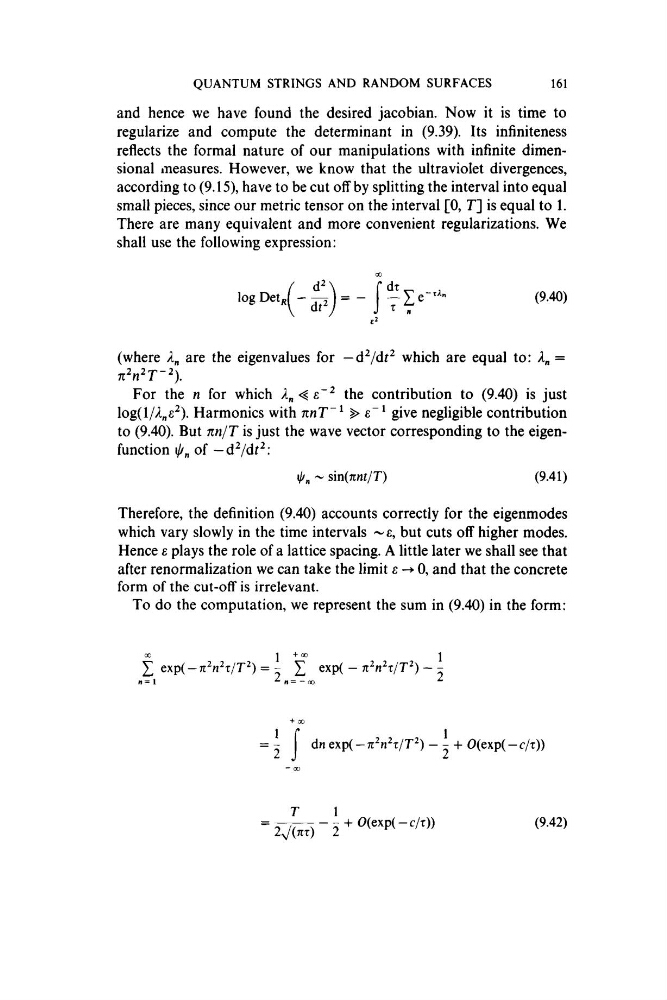
shall use the following expression:
-T72 =
dr
fd i
Z e(9.40)
(where
are the eigenvalues for —d^/dt^ which are equal to:
=
For the n for which
the contribution to (9.40) is just
log(l/2„8^). Harmonics with nnT~^ >
give negligible contribution
to (9.40). But nn/T is just the wave vector corresponding to the eigenfunction \l/„ of — d^di^:
- sininntIT)
(9.41)
Therefore, the definition (9.40) accounts correctly for the eigenmodes
which vary slowly in the time intervals ^ a, but cuts off higher modes.
Hence s plays the role of a lattice spacing. A little later we shall see that
after renormalization we can take the limit £ 0, and that the concrete
form of the cut-off is irrelevant.
To do the computation, we represent the sum in (9.40) in the form:
X exp(-7i^n^TlT^) = ^ Y.
- n^nh/T^) -
n = l
^ n = - 00
dn exp( —
— t + 0(exp( —c/t))
- ^ + 0 (e x p (-c /T ))
2yJ{nx) 2
(9.42)
161
and hence we have found the desired Jacobian. Now it is time to
regularize and compute the determinant in (9.39). Its infiniteness
reflects the formal nature of our manipulations with infinite dimensional measures. However, we know that the ultraviolet divergences,
according to (9.15), have to be cut off by splitting the interval into equal
small pieces, since our metric tensor on the interval [0, T] is equal to 1.
There are many equivalent and more convenient regularizations. We
shall use the following expression:
-T72 =
dr
fd i
Z e(9.40)
(where
are the eigenvalues for —d^/dt^ which are equal to:
=
For the n for which
the contribution to (9.40) is just
log(l/2„8^). Harmonics with nnT~^ >
give negligible contribution
to (9.40). But nn/T is just the wave vector corresponding to the eigenfunction \l/„ of — d^di^:
- sininntIT)
(9.41)
Therefore, the definition (9.40) accounts correctly for the eigenmodes
which vary slowly in the time intervals ^ a, but cuts off higher modes.
Hence s plays the role of a lattice spacing. A little later we shall see that
after renormalization we can take the limit £ 0, and that the concrete
form of the cut-off is irrelevant.
To do the computation, we represent the sum in (9.40) in the form:
X exp(-7i^n^TlT^) = ^ Y.
- n^nh/T^) -
n = l
^ n = - 00
dn exp( —
— t + 0(exp( —c/t))
- ^ + 0 (e x p (-c /T ))
2yJ{nx) 2
(9.42)